
With Nayarí Castillo (Caracas, 1977), the video image treatment has taken a singular turn in Venezuela, like photography and painting – canonic precursors of the contemporary visual experience – become an unavoidable reference. Her work returns to a contemplative stillness that seeks to regain the expanded gaze, its pauses, and voids, its revelations, and concealments, a delicate and technically impeccable execution that has been lauded with important recognitions in the Venezuelan art scene, such as the first prizes Castillo received at the 62 Salón Arturo Michelena (2004) and the VII Salón CANTV Jóvenes con FIA (2005).
Victoria Regia (Victoria Waterlily) is Castillo’s most recent solo exhibit at La Cuadra Gallery in Carácas. It gathers together videos, photographs, objects, and some texts that allude to the history of the natural sciences. These, with extreme subtlety, call attention to the relationship between knowledge and power from an autobiographical perspective, generously punctuated with the idea of travel. Thus, referential elements intertwine to form silent allegories in which animal or vegetal species and the description of natural accidents (river basins and distant places) propose a reconstructive reading of exoticism. There is tense concealment behind this strategy, which disrupts the images’ meticulous serenity and alters the rigorous taxonomy of Western rationalism.
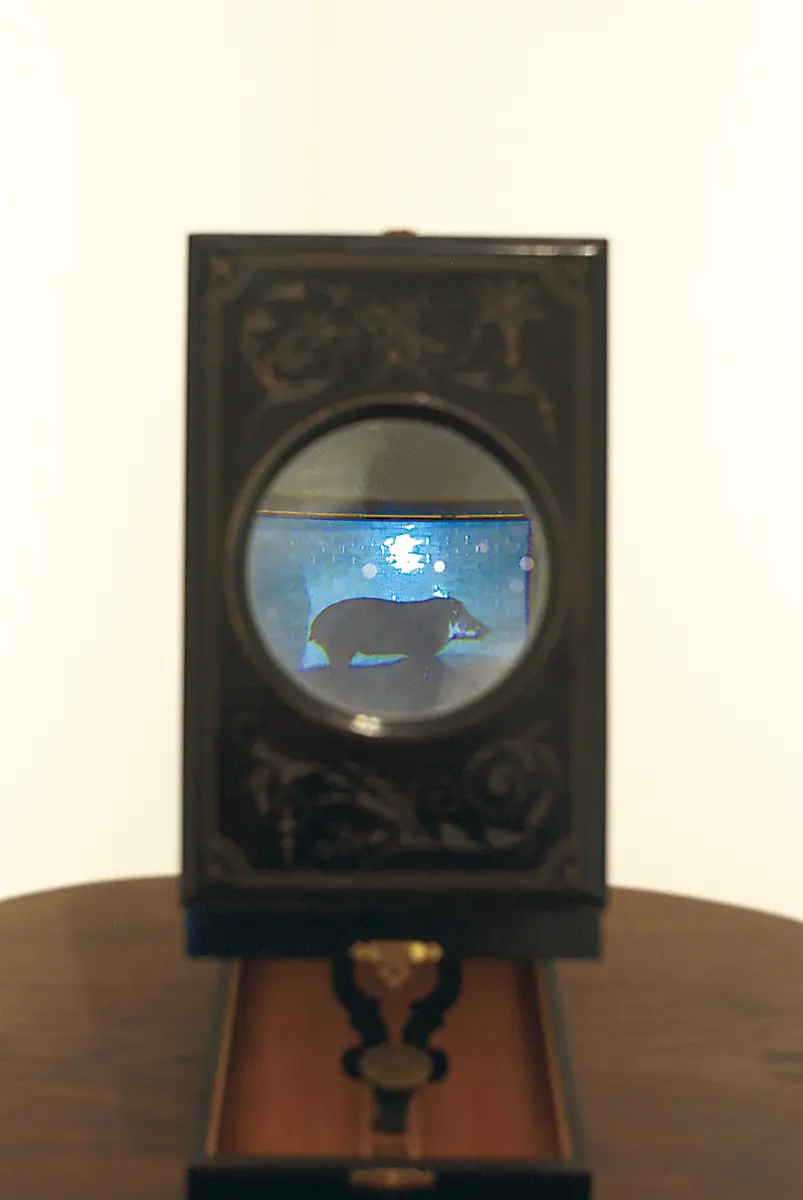
In Castillo’s proposal, the landscape resists extinction, even as the records contradicting the idealized grandiloquence of Nineteen Century paintings and engravings by European travelers suggest otherwise. Beyond the secret fables driving the artist’s artistic endeavor, a sort of perceptive trance, blends documentation with fiction in her work. María Helena Huizi notes in the catalog accompanying the exhibit that Nayari Castillo’s video landscapes “have the paradoxical quality of being expansive and intimist at once”, a notion that resonates in works such as La Nieve (The Snow, 2004––2007), Postales a Paula (Postcards to Paula, 2007), and Paisaje in Situ (In Situ Landscape, 2008). This latter work by the way draws from the landscape tradition established during the first half of the Twentieth Century by means of El Círculo de Bellas Artes y la Escuela de Carácas (The Fine Arts Association and the School of Carácas). At that time during the past century, the favored subject was the ávila, the mountain that locals in the valley of Carácas call Guaraira Repano.
In Bitácoras (Logbooks, 2008), Tapirus Terrestres (Lowland Tapirs, 2008), and the previously mentioned Paisaje in Situ, observation is made possible by means of different instruments for seeing (microscopes, binoculars, magnifying glasses) used to bring distant subjects closer and to magnify smaller ones, while the photographic and video cameras comprise the record-keeping tools. Castillo not only shows what can be seen or is in front of the viewer; she also shows these optical tools that allow precise inspection of the world. Thus, images become the extension of the devices that produce them, and consequently, carry with them the epistemological risk of science, which created these tools to dominate nature.
Confronted by the limitations of such a perspective, Victoria Regia proposes an archeology of memory that investigates the production behind these different ways of observing the world, because the artist is not only interested in documenting facts, places, and characters, but also desire to recreate places that serve as archives. Perhaps due to this, the exhibit adopts a layout similar to that of to a scientific cabinet or that of a wunderkammer (wonder chamber). Here, the heterogeneous array of apparatuses and analytic references are collected like trophies from an imaginary expedition. Nevertheless, all this is the result of an inverse trip in the search for the vernacular somewhere else, in a place different from its place of origin. The Scholossmuseum in Weimar for instance, could be that place, perhaps because there it is possible to “encounter” the four wise Germans who visited Venezuela during the Nineteenth Century, or at the small town of Worpswede, where painter Paul Moderson-Becker lived, or at the Berlin Zoo where a cold, stricken tapir lives. Such an itinerary – which also includes the Capanaparo River, the Médanos de Coro (Coro Dunes), and other places from the local geography – is full of discoveries and coincidences that at the end transform the estranged into the familiar.
FÉLIX SUAZO