
Ofelia Rodríguez’s exhibit at the Museo de Arte Moderno of Bogotá features a Colombian artist who lives abroad but has very strong ties with her native country. Curated by Ana Maria Escallon, it presents a selection of paintings, collages, and boxes that represent over thirty years of work. From the first pieces from the late sixties, clearly influenced by the Abstract Expressionism, to the most recent ones, illustrate her intense search and autobiographical appropriation of symbols, histories, myths, and traditions from Latin America.
As an art student at the Universidad de Los Andes in Bogotá, Rodríguez had very clear that her creations had to be original and not copy what was in fashion in the United States or Europe. Nor was she interested in focusing on western art history, on the contrary, she wanted to express herself with an art that was authentically Colombian. Her original intent got stronger while pursuing her Masters' degree at Yale University, where she was the first foreign female to be accepted to the program. She remembers her teachers told her then to “throw herself to the void, to start from nothing.”1
Teachers and artists who visited the students’ studios, Lucas Samaras and Claes Oldenburg among others, promoted a new aesthetic approach based on the appropriation of popular culture, known today as Pop Art. Although it was an attractive proposal, Rodríguez felt embracing it implied assimilating a foreign reality. What was popular for her was not America’s daily life, but rather the folklore, the crafts, the indigenous of her native Colombia. That is why, upon graduating and moving first to Paris and later to London where she resides, she developed a unique language full of symbols that have more in common with the Magic Realism of Latin American authors such as García Márquez or Carpentier, than with the artistic mainstream. The titles of some of her works, Magic Landscape and Blue Dream, illustrate the narrative aspect of her representations of Latin America’s visual, literary, and oral traditions.
Her boxes, collages, and paintings are characterized by bright colors and a complex way of putting together different elements. The colors are inspired by the folklore and the crafts of Colombia’s Caribbean coast, as well as by popular expressions of other Latin American cultures, particularly Mexico. She finds in them an unlimited source of found objects she carefully selects and re-contextualizes according to her own imagination. Some of these objects are particularly attractive. Reptiles (iguanas, lizards, and alligators), daily life objects (cleaning brushes, feeding nipples, and beer lids), and religious symbols, particularly skulls and bleeding hearts, are recurrent elements of her visual language.
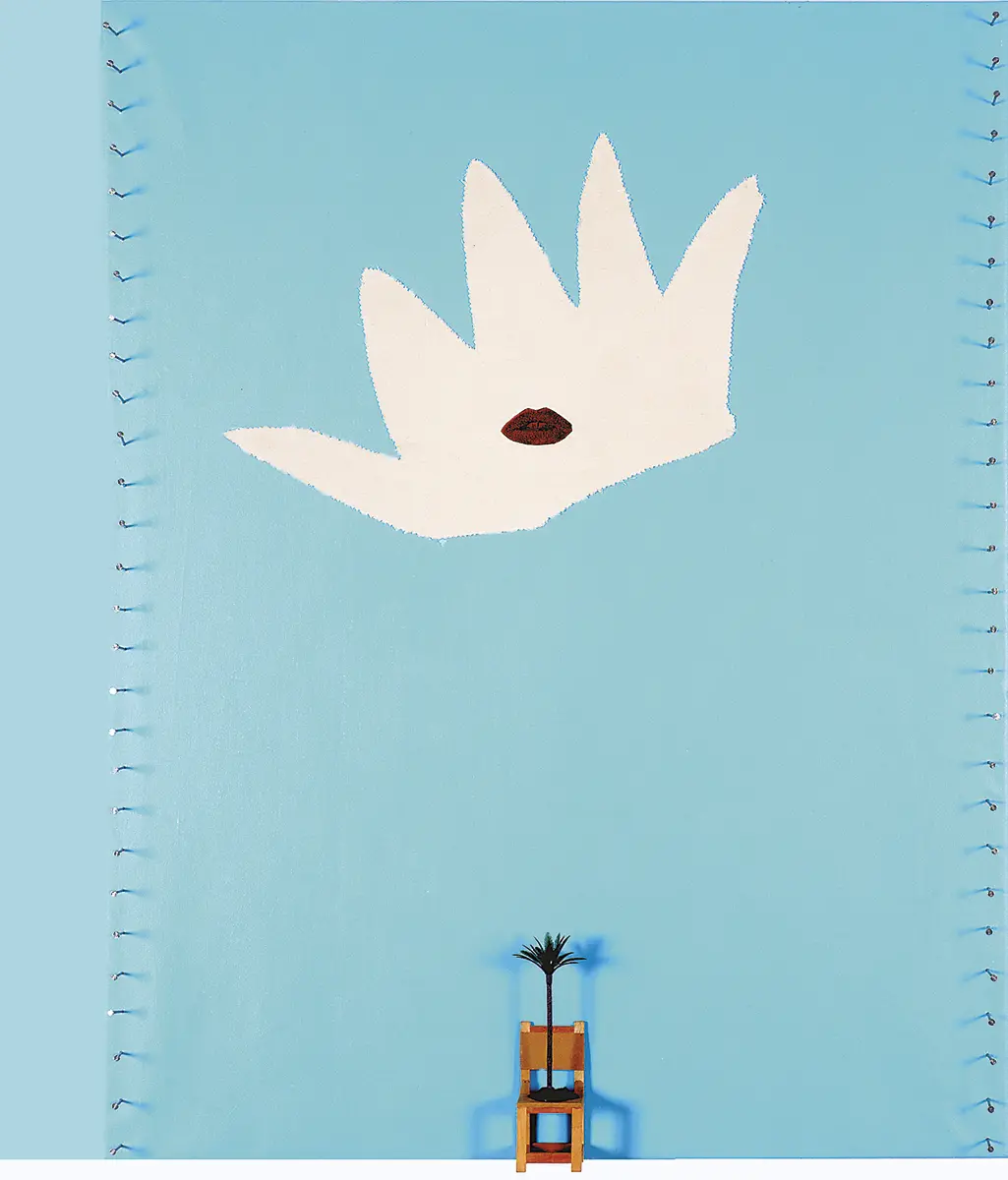
What attracts us the most from a symbolic perspective, is perhaps the presence of eyes, ears, tongues, hands, and fingers, painted, glued, or sewn on paper or canvas. These represent the senses which are fundamental to the artist’s experience. Not only she absorbs intensely what surrounds her, but most importantly, she pretends to stimulate a sensual experience among the viewers. Her intention is not to transport them to a Caribbean beach to enjoy the sun and the heat under a palm tree or to make them feel happy and in love. The palm trees and the hearts in Rodríguez’s works transmit messages, sometimes humorous, sometimes anecdotic, that denounce the calamities experienced by minorities in Latin America, particularly by blacks and indigenous groups.
Her work is clearly autobiographical. The hands that embrace the canvas are her own hands, the iguanas represented remind her of her childhood, the bleeding heart represents her own heart that suffers from social inequalities and injustices she denounces by means of a poetic yet strong symbolic language.
The use of boxes to narrate stories is common in several Latin American countries, particularly in Peru. Rodríguez’s boxes are not only inspired by these pictures on board, but also by the works of Lucas Samaras, Joseph Cornell, and even de Bernardo Salcedo, with their objects, toys, and painted limbs. Hers are unique though, thanks to the use of bright colors and the choice of objects used in their composition: alligators, horns, brushes, hands, nipples, and figurines. They are also unique in the way she uses the exterior of the boxes as part of the work by painting them, adding objects or painted bases, showing her freedom of expression.
The exhibition also includes a collection of collages in which simple forms and superimposed symbols create a different dynamic. They feature flatforms and symmetric compositions, but retain a biological aspect thanks to the use of hands, ears, mouths, and tongues, photocopied and enlarged, giving the senses a primary role.
The majority of the works in the exhibit are paintings that represent, with no particular order, over thirty years of artistic production. Although the artist is not necessarily aware of it, it is possible to differentiate several periods. In the eighties, the compositions were filled with elements that covered the whole canvas. Tormented Landscape, for example, shows a black cloud, a textured background, and a beach where the iguana lays her eggs. The combination of elements, the way these are organized, and the narrative aspect of the title, give it an illustrative character. In the nineties, the canvases became larger and the colored spaces took more space in the composition, a clear reference to Color Field artists such as Rothko or Gottlieb. Reaching out to lost hanging dreams of my past, for example, is a large yellow canvas with an iguana on top and five photocopied hands at the bottom, displayed in a symmetric way. The most recent pieces are basically monochrome and stronger in content, due to the symbols used, in particular, bleeding tongues and hears, and to their narrative titles, fundamental to the understanding of the works.
Ofelia Rodríguez is like the “island in turbulence” of one of her paintings. She is an original artist who transforms her memory and her surroundings into conceptual instruments. As Dawn Ades suggests in the exhibition catalog, “She has not restricted her interest to the multifarious living instances of popular visual expression in Latin America but has garnered inspiration from all kinds of mass-produced and readymade materials wherever she finds herself and transforms them according to a personal vision. She casts an analytical eye on them in the context of the displacements of globalized tourism and ubiquitous mass consumption, isolating, questioning and reconsidering these overlooked trifles and stereotyped mementos.”2
NOTES
1. Interview with the artist, October 2008
2. Dawn Ades, “Ofelia Rodríguez”, Ofelia Rodríguez Exposición Antológica/Anthology Exposition, Museo de Arte Moderno de Bogotá, October-November 2008. 46
FRANCINE BIRBRAGHER