
From September 13 to October 20, the Thomas Cohn Gallery presented a solo show by Paulo Queiroz (born 1971, Fortaleza, Brazil) that included never-before-exhibited oil paintings and large-format works created during 2008. In this series, Queiroz, an artist from northeastern Brazil, proposes a form of painterly tangibility that relies on a lack of focus to infuse his works with a more abstract effect. It is evident that during the past four years (since the painter’s first solo show at this gallery), Queiroz has been progressively abandoning pure iconographic references in favor of an effect of incompletion that implies the presence of time. His work is a mixture of rigor and sensuality and of superimposed, simulated identities. Tenderly erased and smudged surfaces and floating irregular forms point to absences that “breathe” under the intoxicating surface of works such as O Quintal de Na, Para Meu Amigo, Sem Começo, Achar Falta, Uma Longa Ausencia, and O de Todo Dia.
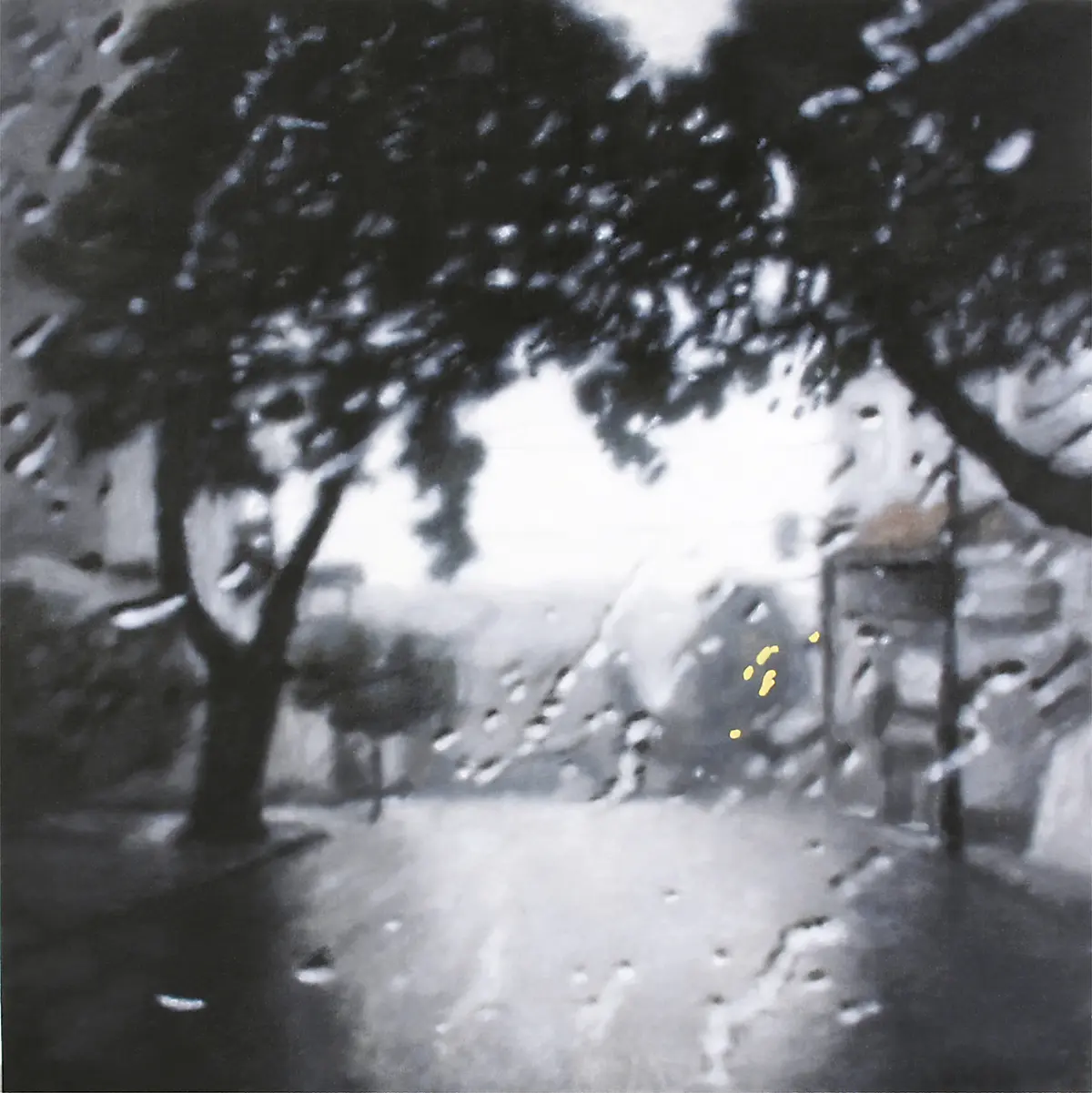
Queiroz’s images stand at the uncertain threshold of dissemination, of wateriness, of fluidity that places his paintings outside the limits of orthodox conventions. Like thin layers or silk veils ready to dissolve in front of our eyes, such works impose themselves upon the spectator. Guided by a “what if” melancholy and an intentionally dislocated approach, these works reference romantic German landscapes as they evolve into nearly abstract canvases. With this hypermodern appropriation, Queiroz achieves what Gerhard Richter’s gray paintings from the sixties (Der Graue Bilder) also accomplished: both artists manage to blur our vision. A slight convulsion shifts the components of the paintings, blurring the elements of the objective reality to which these intelligent artists resort. Queiroz’s relentless use of parodic elements delegitimizes and reorganizes reality under a contemporary perspective: the discourse of painting as the sole possible hope.
It is true that Quieroz has a different take on what the painter’s profession comprises. This can be especially observed in two of the works in the show, Sem Começo and Uma Longa Ausencia. There, the artist subtly aims to disrupt the simplicity of retinal pleasure. Time after time, one must adjust one’s eyes to untangle the works of this Brazilian painter. Queiroz strives to proceed beyond the stratum of the merely visual, the physicality of paint, the traps set in place by style, the emotional commitment, and the climax. The refined tonal scales of grays are nothing more than a new modality of pictorial nihilism. His pieces symbolize fragments of a timeless presence in images that are intentionally dull. With this group of works, Queiroz questions the universality of the pictorial code, which in these paintings is brought to the point of near collapse. Queiroz’s paintings are not merely contemplative art—they are neutralized and broken apart. I surmise that the artist agrees with Duchamp, who said, “Aesthetic delectation is the danger to be avoided,” or even with Richter, who stated that “Gray is more qualified than any other color to represent absolutely nothing.”
If the great theme in Paulo Queiroz’s earlier work was the restless dynamism and the vertigo of life in a megalopolis such as São Paulo, where the artist has resided for many years, his newer works add to the urban intensity that still persists—a landscape that has been reordered. A certain dosage of rationality also filters into the images and agreeably interacts with a disposition (the Stimmung) to recreate visions of shock. In this group of works, there is an attempt to recover a sense of dynamism while also attaining a pictorial evanescence through memories and evocation.
As Susan Sontag noted, it is a matter of stressing the point. The emphasis in these works emerges as an unstoppable desire, a gleam, or, even better, an obsession. But these paintings of urban fragments are associated not only with selected themes and motifs or with the transformations Queiroz introduces in the distorted images but also the fact of living in São Paulo. While optical veils are evident in this group of oil paintings, Queiroz introduces these from the essential quality of the present. Despite the persistent use of a monochromatic technique (grisaille), Queiroz’s paintings elicit emphatic projections and identifications from the spectator. Contemplation through perception can be a distant, neutral, and indifferent exercise. Nevertheless, these works have also been infused with a surfeit of expressions and experiences (Erleibnis). These macro-and micro-scale urban visions, as well as some of the landscapes recently exhibited by Queiroz, are authentic apocalyptic images—an equilibration between a game of seduction and an ominous, grotesque nightmare. The deep blacks are prints or signs of great significance in such works. In these, São Paulo becomes a supernatural monster that also comprises a vestige of its original self, for it has been deformed, disproportioned, shocked, and agitated by a concatenation of simulations in which the errant and nervous rhythm creates wonderment through the transforming paintbrush.
CLAUDIA LAUDANNO