
At first glance, the work of Pedro Pablo Oliva could seem to resemble the tender and simple image the artist himself projects as a human being; but if we go deep into his inner world, our opinion is likely to change as we find in his discourse a sense of expressive grotesqueness capable of provoking poignant sensations. I first had contact with his work in the 1980s, when he still worked in the house where he was born and under the care of his mother, who became also an inspiration and motivation for many of his works. I was impressed then by several paintings where the representation of the human figure, referred to through the bodies of dolls, had suffered the passage of time and the devastating action of man against man. These figures appeared hand-tied, headless, missing an arm or a leg, and incorporated their orphan-like condition into the surface of the canvas. Observing them, one could not avoid feeling unsettled. Never before had I seen the world of childhood evoked in such a heart-rending way.
There are three things that, in my opinion, no artist should lack: a sense of humor, a youthful spirit, and a great deal of imagination. They all converge in Oliva, a kind of cultural “guru” in his native province of Pinar del Río. To him are owed, in large part, many of the most significant artistic actions seen in recent years in Vueltabajo, the town of his birth, where he evolved and developed and which he has never abandoned. The National Visual Arts Award he won in 2006 resulted in a large number of interviews, commentaries, and more than one article devoted to assessing his career as an artist and teacher. Oliva’s principled attachment to his hometown has functioned as a catalyst for his productivity. His pointed assumption of artistic creation as an ethical endeavor, added to the degree of anticipation and interest around his work, despite living in the provinces, make him into a unique case.
One of Oliva’s first adolescent passions was the comics; hence his vocation as a draftsman. Between 1961 and 1964, he studied at Pinar del Río’s Escuela Provincial de Arte, and at the age of sixteen at the Escuela Nacional de Arte (ENA), in Havana, from which he graduated in 1970. Among his teachers during those student years was Servando Cabrera Moreno, who was to contribute to the development of Oliva’s excellence in the handling of lines with precision and expressiveness. His closeness to Abela gave him ideas about working with textures; Acosta León, in turn, unveiled for him a fantastic universe more closely related to the sensorial. The power of the grotesque that he found in Erliz helped him mature his interest in speaking about human anguish, and the figurativism that was to mark his approach to these topics was imbibed from Ensor, Munch, Chagall, and the fascinating work of Gustav Klimt.
A willingness to renew himself is one of this artist’s virtues. In the 1970s, when the dominant trend was towards a cultural policy devoted to highlighting national values, patriotism, and the typifiable elements of identity, Oliva was able to capture social events without reverting to clichés. There were many artists at that time who commented on the immediate context by including things like a palm tree, a mulatto woman, or a bohío in their compositions, to mention just a few of the most common patterns; Oliva, however, was incapable of adulterating his need for fantasy and for exploring the world of dreams. He wove a half-surreal, half-magical universe that nevertheless didn’t overlook everyday facts and events with their material deprivation, aspirations to build a more just society, the independence achieved by women, among other relevant topics.
Seduced by the universe of childhood and entranced by his nostalgia for a humble home, where he lost his father at the age of six, he used the language of the neo-avantgarde to create works of art with a strong impressionist accent. Such is the case of 513, where, as an emblem of the country’s pressing housing needs, a female character longs for a home, and La hacedora de cigarros, which illustrates the peculiar sagacity of the Cuban people striving in the face of great material difficulties. In turn, Y qué mala Magadalena… returns to Martí’s themes to refer to the world of childhood, and Recuerdos de navidad is a kind of song for the past. The works of this period are resolved through mixed techniques and on chrome paper. Individual characters or groups might appear in compositions that combine several planes of perspective in order to allude to different situations in a single segment of time. These works were conceived while Oliva worked as a professor at the Matanzas Art School.
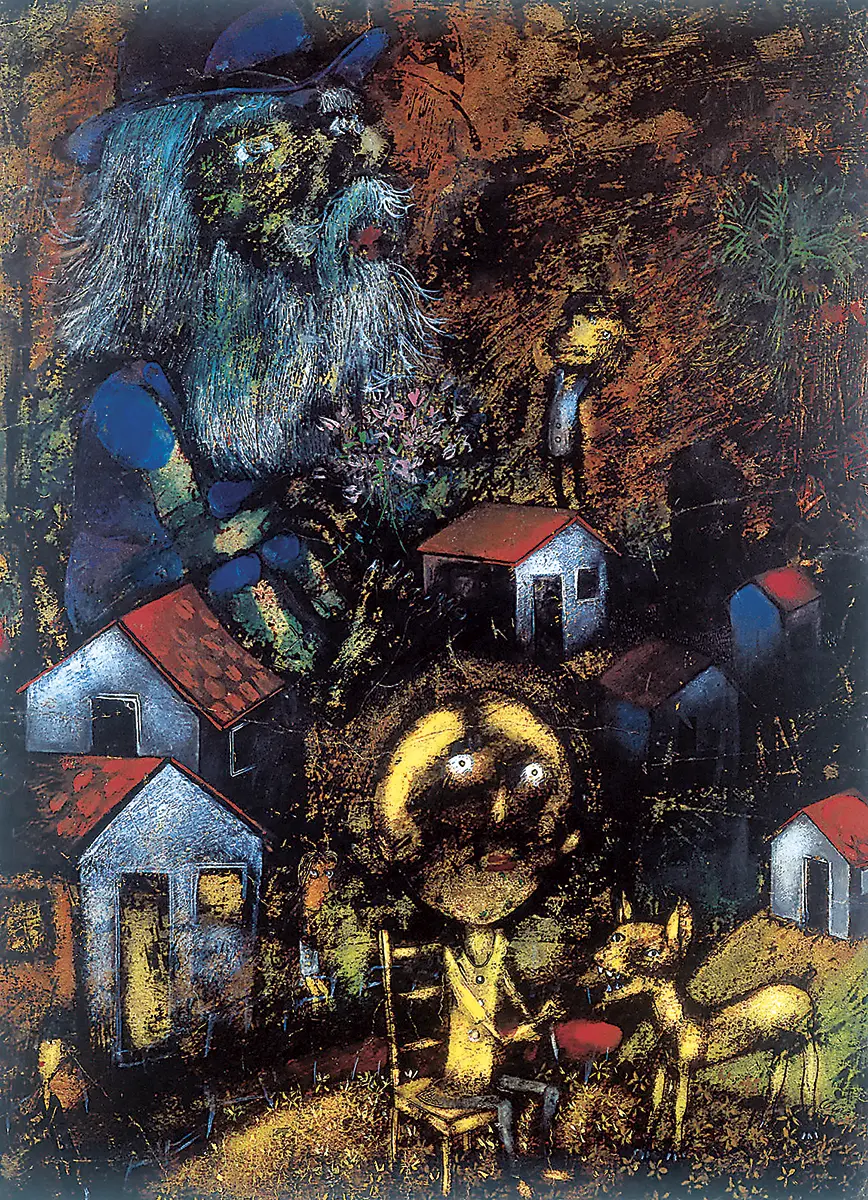
After returning to Pinar del Río in 1974, Oliva left behind the expressionist emphasis on the grotesque and his palette became colder. In canvases like El sueño, perhaps the closest Oliva came to what his colleagues were doing in those same years, we see bucolic atmospheres. This period’s small-format works on construction paper are characterized by the use of crayons in a range of ochre and sienna hues. The return home and the renewed closeness of his friends determined a shift in the strategy, noticeable in the lyric nature of these scenes, where Oliva confronts a variety of topics and which he accompanies with floral or animal motifs. In order to achieve this, he leans on the softness of drawing, among other expressive resources. The structure of these small pieces of construction paper clears away the former profusion of characters and begins to focus on small stories. Later he used the canvas with playful intent while making clear his attachment to textures. In Don Quijote de la infancia, a 1977 oil painting, he gives us an infant absorbed in his own dreams as he rides a velocipede. Here once again are the recurring childhood themes, but now in a more tender tone.
Noticeable in the artist’s production is a representation of romantic love alongside any other topic he is commenting on. Sensuality, seen through the female figure or in its coupling with the opposite sex, is another element that also comes to the fore since his earliest works. In summary, Oliva vehemently incorporates sexuality in all of its registers: romanticism, voluptuousness, and even arousing attitudes.
The late 1970s and early 1980s were years of great effervescence in the visual arts field in Cuba. With the establishment of the Ministry of Culture and the Instituto Superior de Arte (ISA) in 1976, new shifts were introduced to the country’s cultural policy. The dogmatic mechanisms that up to that point had constrained the promotion of creativity began to be subverted. Another significant development was the exhibition Volumen I in Havana (1981), which helped create a favorable climate for artistic practices that questioned art as an institution and charged provocatively against certain social structures that impeded intellectual advance. During this period, Oliva taught at the Escuela de Artes Plásticas in Pinar del Río, and had as his students artists like Eduardo Ponjuán, Ibrahim Miranda, Segundo Planes, Carlos Luna, William Carmona, among others, who later became protagonists in the renewal process that international critics have come to know as the “Cuban Renaissance.”
Caricature and humorous drawing are genres exploited by Oliva in its attempt to rectify certain bad attitudes or behaviors present in his context —double moral standards, bureaucratism, opportunism, infidelity, adulation—, assiduously exploring the issues without falling into moralizing positions. Starting in 1979, a series of works that use circus curtains as a common thread in Oliva’s commentary on human simulation and pettiness introduces us to the element of irony in his oeuvre.
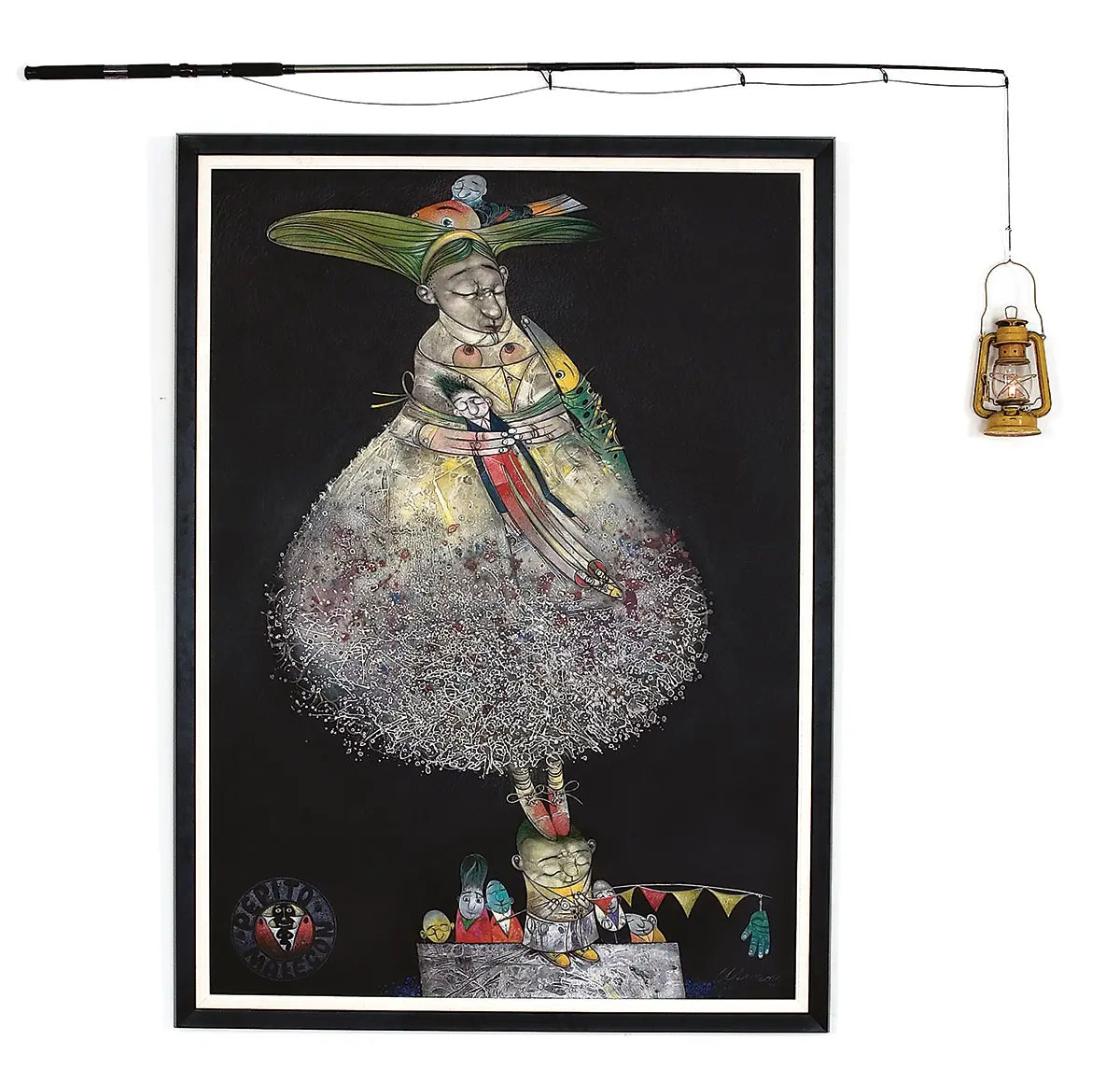
These works were followed by others where Oliva took popular sayings as the starting point for his reflections. Cuban idiosyncrasy, given to taking almost everything lightly, is questioned by the artist. Estudio para el mejor amigo and Estudio para un juguete belong to this period, during which he also created a group of independent works, resolved as mixed technique on construction paper, that are dominated by his characteristic sense of humor and the philosophical tone that pervades all of his production. Captivated by the idea of planning and projecting installations, Oliva became one of the first Cuban artists to explore that trend. La última cena and La vajilla del amor emerged then, in 1983 and 1984, respectively.
A separate mention must be made of the series Disparates, if only because it includes the sculptures Oliva named Trofeos de guerra, a kind of summary of the pain caused in Cuba by the loss of human life in the Angolan war. The polyptich Homenaje a un soldado de mi pueblo also belongs to this series. Here Oliva used dolls, cars, military boots, pillows, kitchen utensils, birdcages, and decayed clothes to create an allegory of nostalgia-tinged with sarcasm. It is important to note that the 1980s were the most fruitful period in Oliva’s career. In the catalog for the show Quiero pintar en paz…, which gathers, alongside those mentioned above, works created between 1971 and 2000, Oliva reveals that at that time he was not affected by economic, moral, or social pressures of any kind. In those years he also explored the use of textures in a more intensive way.
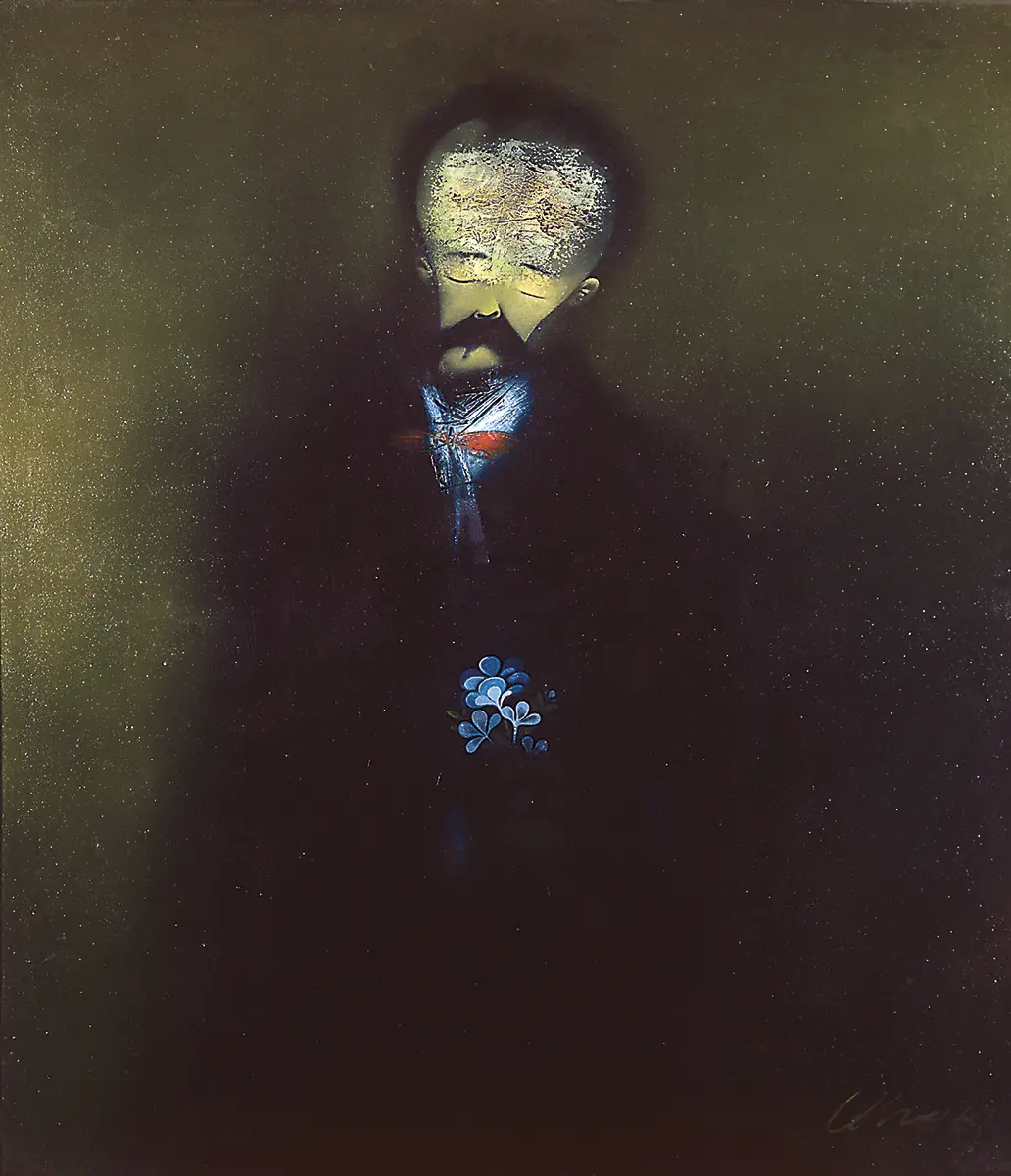
Oliva has reinvented time and again the figure of José Martí, with whom he shares a reformer’s sensibility. Martí’s ideas about human betterment are significant for this artist. This is expressed in several works dedicated to the hero, and above all in his daily work in favor of artistic creation. Retrato de niñez, 1989, is an example of the tenderness and love aroused by Martí’s image in the eyes of an artist who tenaciously builds an exemplary body of work.
Contextual events impact Oliva’s position in favor of a critical kind of art. The subsequent series Condecoraciones, Navegantes and Consejos de mamá display an ironic tone pushed into sarcasm. In the first one, Oliva charges with his usual irony against conformity and mediocrity, using Cuban folk forms of mockery and jest. He creates simulacra of official documents or medals to be given to citizens or institutions that act without diligence. For this series, he developed a “seal” to be stamped in the works’ lower margin, playing with the official character of the opinions expressed.
The mass exodus of Cubans out of their island, in any kind of vessel they can find, motivated the artist to reflect on a drama that has cost the lives of thousands of human beings. With a similar emphasis, not devoid of humor, Oliva brought into focus his mother’s eloquent judgments, which helped modulate, in a way, his own philosophical temperament. In these works from the Consejos… series, he included sentences uttered by her that retain tremendous validity and work as a textual complement for the discourse.
Oliva is one of Cuba’s most prolific artists1. His ingenuity, imagination, and hard-working character have made him sharpened his spirit and keep him well informed about all the individual and collective stories that, small or otherwise, take place around him. The sufferings and joys of his fellow human beings are never alien to him. This is why there are so many series in his oeuvre. To those already mentioned we must add others like El artista y su modelo, Jinetes y Jineteras, Extraña declaración de amor, and Boda de peninsulares y criollas.
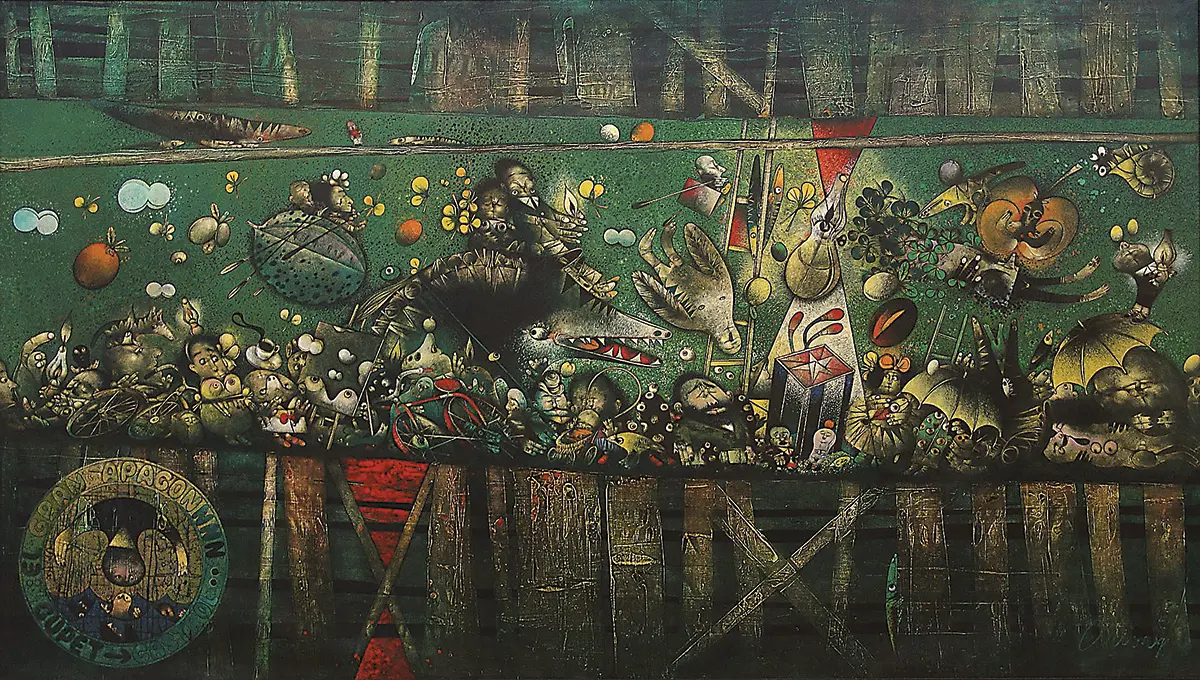
The series Refugios, which was began in 1991 and includes Oliva’s best-known work, El gran apagón, is the first of this artist’s representations of the figure of Fidel Castro. In this celebrated large-format work, a kind of mural on canvas, he presents his interpretation of the leader, placing him alongside José Martí. This canvas has become greatly popular for having been conceived during a time of great economic difficulty in the island, and because by means of humor it encompasses a polemical spectrum of suggestions —although in truth the center of its reflection points toward a dearth of initiatives and renewal in the midst of a period of crisis. Oliva’s treatment of the figures of Fidel and Martí has a common purpose: to snatch them away from their mythical images and to offer them as visions of everyday men. There also appear a large number of motifs and symbols that are present throughout his oeuvre: alligators, umbrellas, cars, bicycles, fruits, sailors, couples, podiums, all circumscribed within this double demarcation where dissimilar events occur simultaneously. Oliva once again uses his “seal” of exclusivity to refer, ironically, to the signing of agreements between Cuba’s Cupet and Mexico’s Castrol companies in an attempt to ease the country’s energy crisis. Opinion within and without the country was mobilized as the so-called “special period” began, especially for the occurrence of long blackouts (apagones) and Oliva is interested in showing all aspects of the phenomenon.
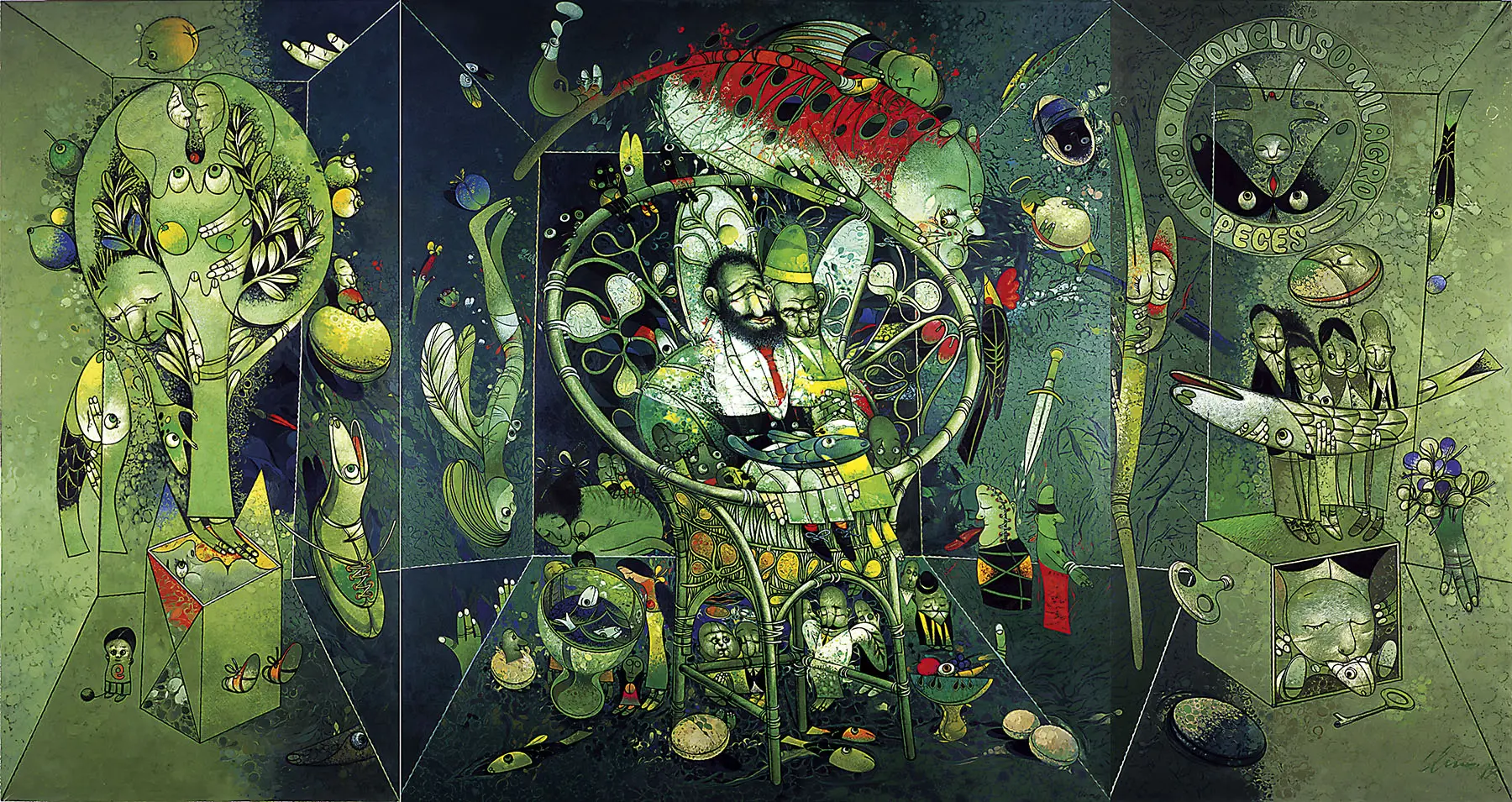
Pope John Paul II’s visit to Cuba in 2000 became a source of inspiration for the triptych El inconcluso milagro del pan y los peces. The encounter between the Pope and Fidel is represented in a fraternal environment. In the central canvas, we see both leaders sitting on rattan chairs. With his eyes closed, Castro holds in his hands a fish, and a variety of characters and symbols pullulate around the two central figures. The other two segments complete a dialog that includes the presence of romantic love, the Cuban people’s food needs, and other topics referred to the specific context. For this work, Oliva chose a cold range of greens, as a symbol of the hopefulness that surrounded the meeting.
The idea of reinterpreting the image of Fidel Castro for its historical transcendence as an emblem of resistance appeals strongly to Oliva, who thus decided to devote a series to Castro as an independent theme. Under the title of El gran abuelo, the artist produced several works in which the leader of the revolution appears in commonplace situations. The questioning psychological veneer in Oliva’s oeuvre comes through in these unusual visions of a leader who only seldom has had demystifying artistic representations.
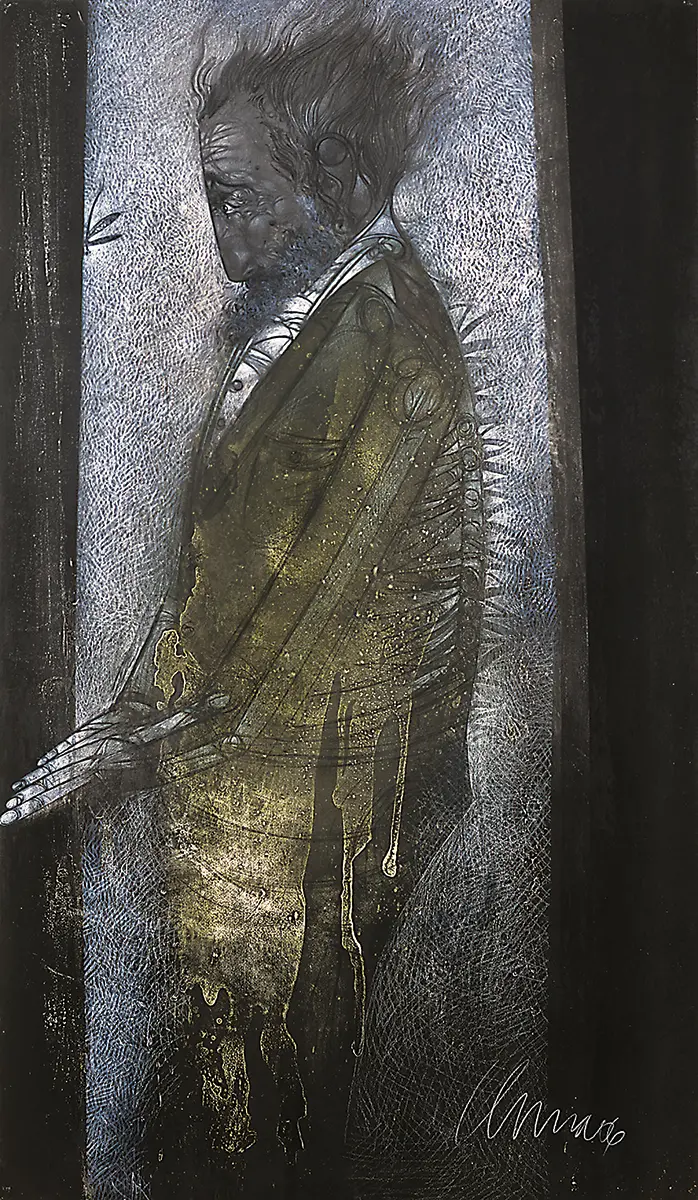
One of the most salient characteristics of Oliva’s art is his mastery of color; the artist turns the intensity of his tones on and off depending on the circumstances he is dealing with. In these versions done in tribute to Fidel Castro, he uses cool colors to convey the idea of the passage of time. The textural work in his 2007 drawing Abuelo contemplando una libélula is very distinctive. The act of watching an insect becomes a pleasurable activity for the interpreted character and also for the artist, who finds enjoyment in the small stuff of life.
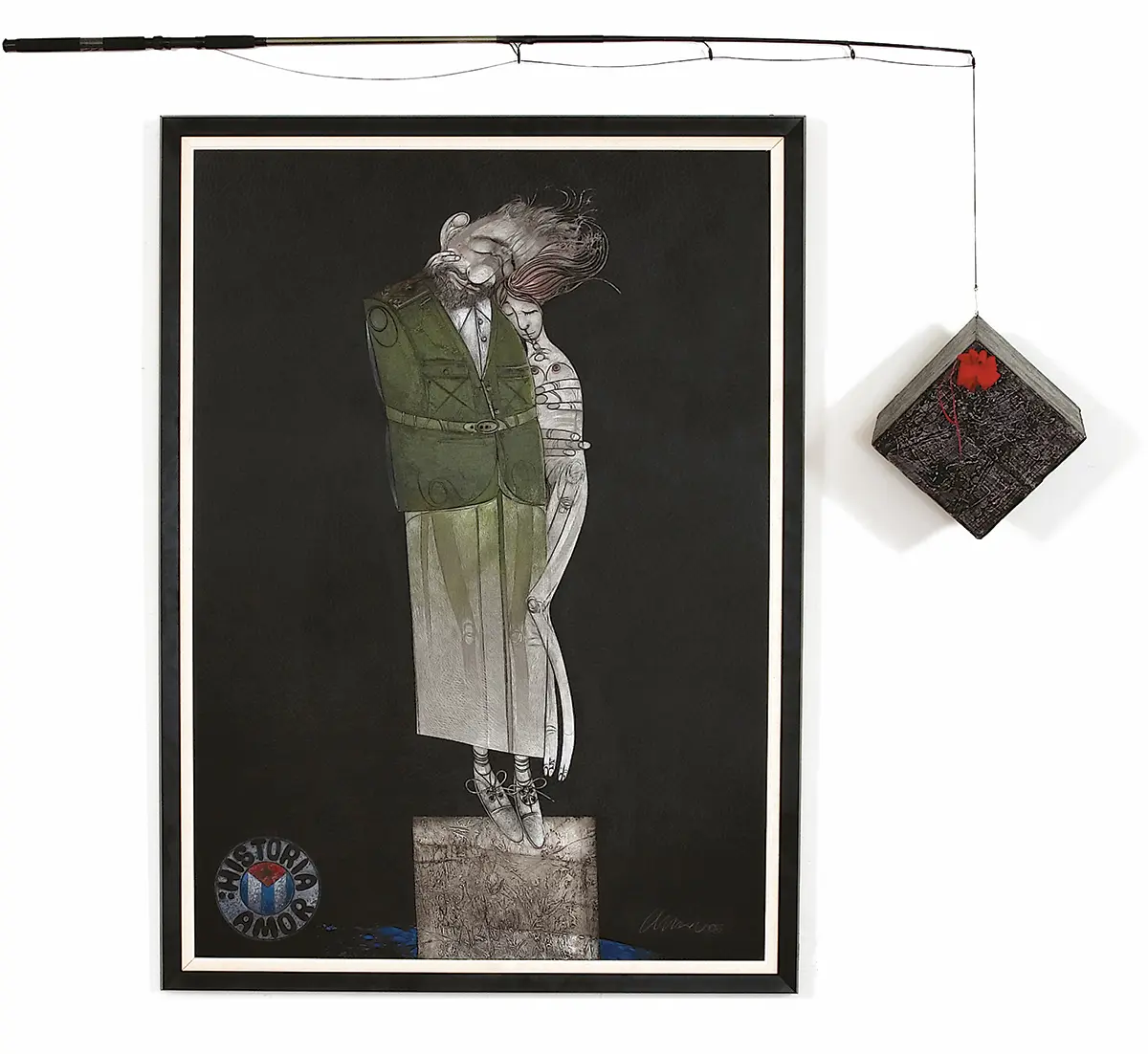
In the work that gives his most recent show, connected to the National Visual Arts Award 2006, its title, Historia de amor 2, Oliva returns to the representation of the Cuban leader. Fidel’s romantic relationship with a woman is expressed with simplicity, positing it in the location that so many Cuban couples use for their encounters: the Malecón. The work, part of a triptych in the series Alegrías y tristezas del Malecón, is characterized by its economy of strokes, it's constrained colors, and its cautious use of textures.
Throughout his career, Oliva has proven a versatile artist, excelling in drawing, comics, painting, installation, sculpture, and ceramics. he has shown particular virtuosity in the last of the genres mentioned, taking into account the fact that in Cuba very few ceramists go beyond the cliché. The presence of volume in his work is an accomplishment; this does not mean that his painting is minor, but that such projections demonstrate Oliva’s skills in three dimensions, undoubtedly more demanding as a craft. He started in the genre in 2004, and a year later he won a Special Prize in the 8th Ceramics Biennial Amelia Peláez with El iluminado. Despite his short time working in this field, with just some twenty works completed, Oliva is able to move skillfully within any mode of expression. His passage through the Varadero Ceramics Workshop has helped him achieve mastery of the form, producing works like Morboso juguete chino, Nueva historia para Mamá Inés 3, and Boda de peninsulares y criollas, to name the most relevant.
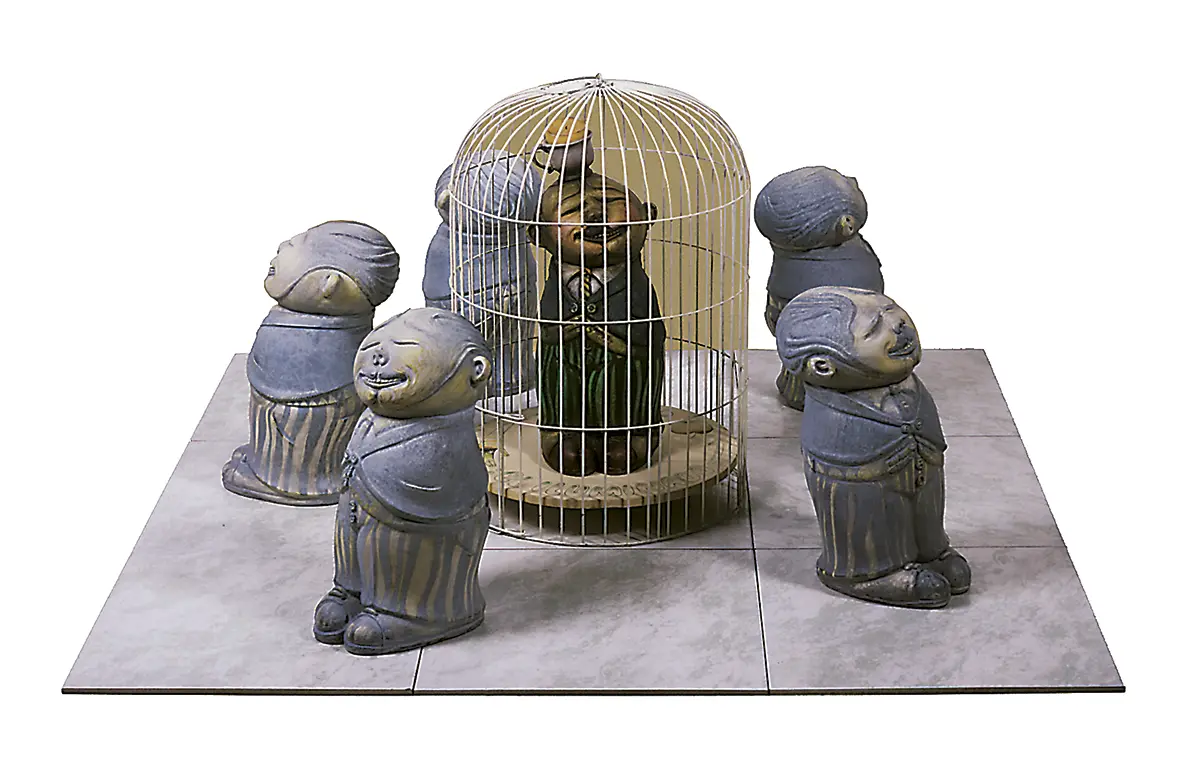
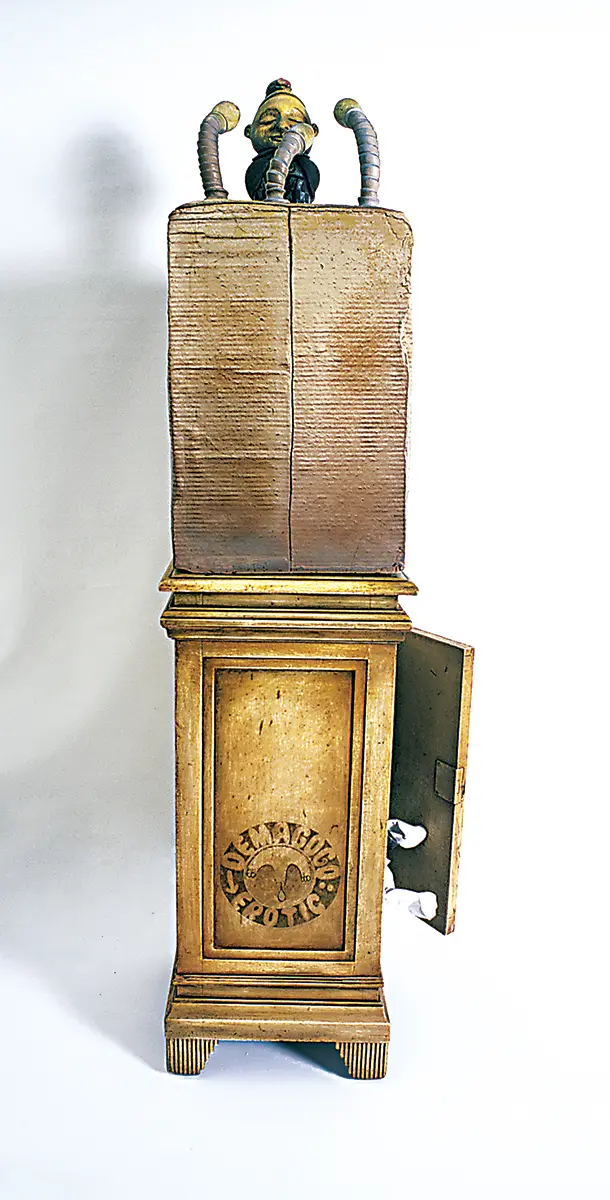
In Morboso juguete chino, 2005, Oliva calls attention to the kind of bureaucratic, rhetorical character that hides a pernicious attitude under the veil of power. It consists of a wind-up doll that speaks through phallic-looking microphones while hiding under his podium a number of Barbie dolls. Oliva insists on highlighting the simulacrum of everyday life, marked by human miseries concealed behind a dignified appearance.
Without a doubt, the name of Pedro Pablo Oliva is at the forefront in any balance of the history of the visual arts in Cuba, thanks to the ethical sense of a proposal distinguished, in formal terms, by his mastery of draftsmanship, color, and texture. Added to this is his work as a cultural promoter in his home workshop, where specialists and members of the general public can find up-to-date literature on topics of art and culture. At the same site people can hear conferences, workshops, and classes on the visual arts and other artistic expressions by renowned critics and professors. Oliva’s efforts on behalf of the creation of the Pinar del Rio Museum of Art, as well as the anticipation generated around the yearly Cubaneo award to outstanding regional-based works or projects in the art field, also contribute to making him a central figure.
The Museo Nacional de Bellas Artes holds a sizable number of Oliva’s works, between donations by the artist and institutional acquisitions. These will serve future generations to learn about a controversial social process, one that left deep marks on a man who was centrally preoccupied with commenting on the fate of mankind.
NOTES
1. The artist's extensive oeuvre can’t be completely covered in this article. He has created other series, which I won’t mention because they are less significant. His work includes also watercolors, drawings, and mixed techniques.
2. With this work, Oliva won his second distinction in the genre: Special Award at La vasija, an event held in the White Hall at the St. Francis of Assisi convent in Havana, in June 2007.
3. Historia de Amor, held at the Museo Nacional de Bellas Artes September 7 through October 31, 2007, is Oliva’s most recent exhibition after winning the National Visual Arts Award in 2006.
AMALINA BOMNIN
Critic and Cuban Art Historian.