
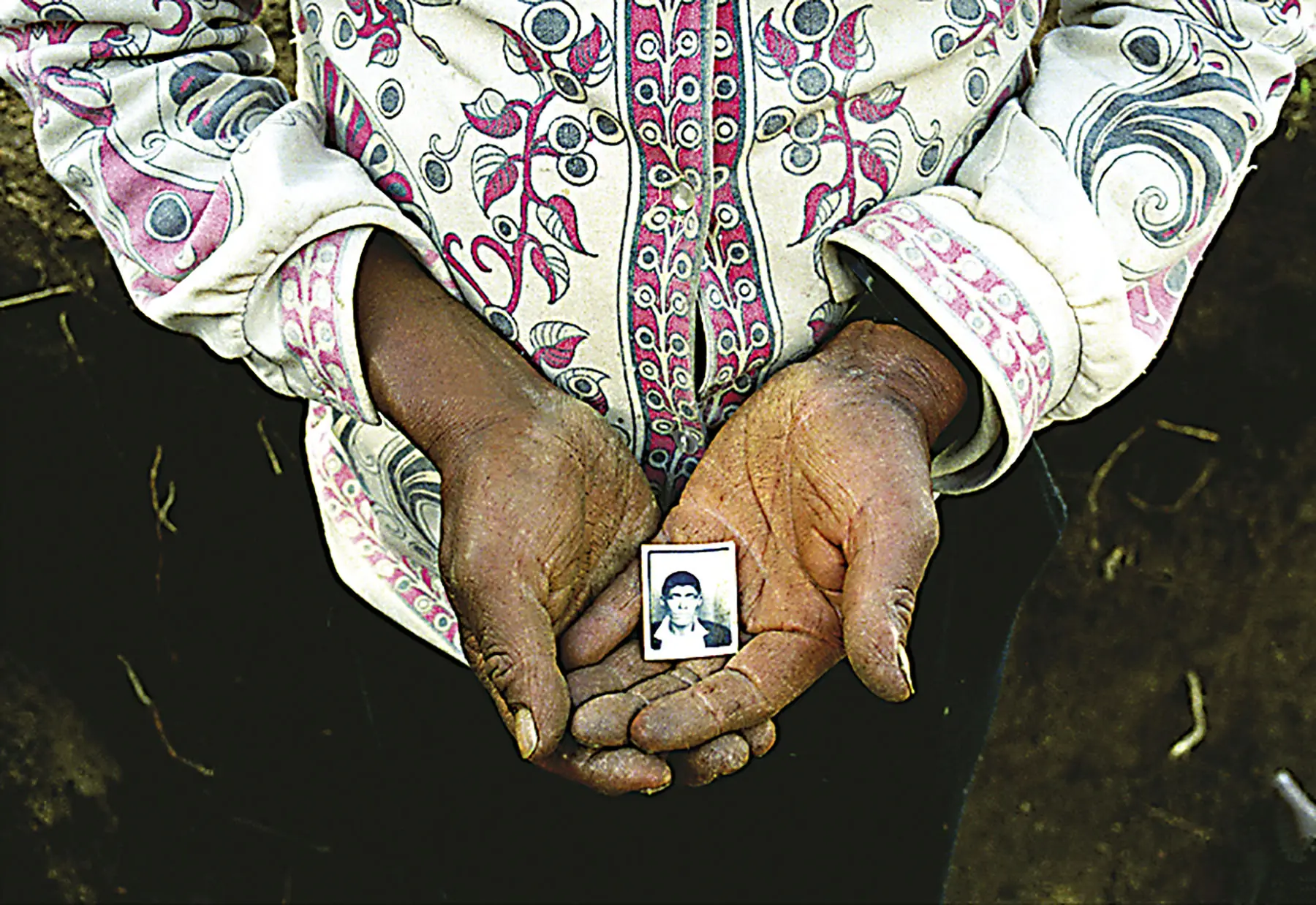
Destierro y reparación, currently on view at the Museo de Antioquia, is more than an art show. It is a cultural project combining different components that imply the public staging not only of artistic images but also of a variety of discourses and cultural practices of a different kind. For that reason, the Museum exhibit has been complemented with an investigation of emblematic cases of the Colombian exodus and accompanied by an extended cycle of lectures and discussions attempting to explore such a vast and complex topic.
At the same time, the presentation of works of art is insufficient to cover the complexity of the issue under analysis, which meant that the curators incorporated other traces of contemporary visual culture, traces that are deeply rooted in the traumatic experiences of the human groups involved in Colombia’s armed conflict and its forms of resistance. Thus, the show presents “the Bojayá curtain,” a large blanket developed as a memorial where the survivors of a massacre at the village of Bojayá church have lovingly embroidered the names of those murdered on that fateful day, in order to return them to their singularity and dignity as subjects. Situated across from this blanket in the exhibition is a work by Juan Manuel Echavarría that denotes a similar attitude in a different context. Echavarría’s work comprises inscriptions made on the cement that covers graves without headstones, the identity of their occupants configured in a variety of ways by their relatives. Through the use of a lenticular printing system, we are able to see the images of a “before” and an “after” process.
The project took shape around a series of emblematic cases, such as the Bojayá events and their connection to the displacement of Afro-Colombian populations, or Granada and the forced displacement of peasant populations, the displacement of indigenous peoples in the Guajira, intra-urban displacements in Medellín, and forced migrations in the Colombia-Ecuador border.
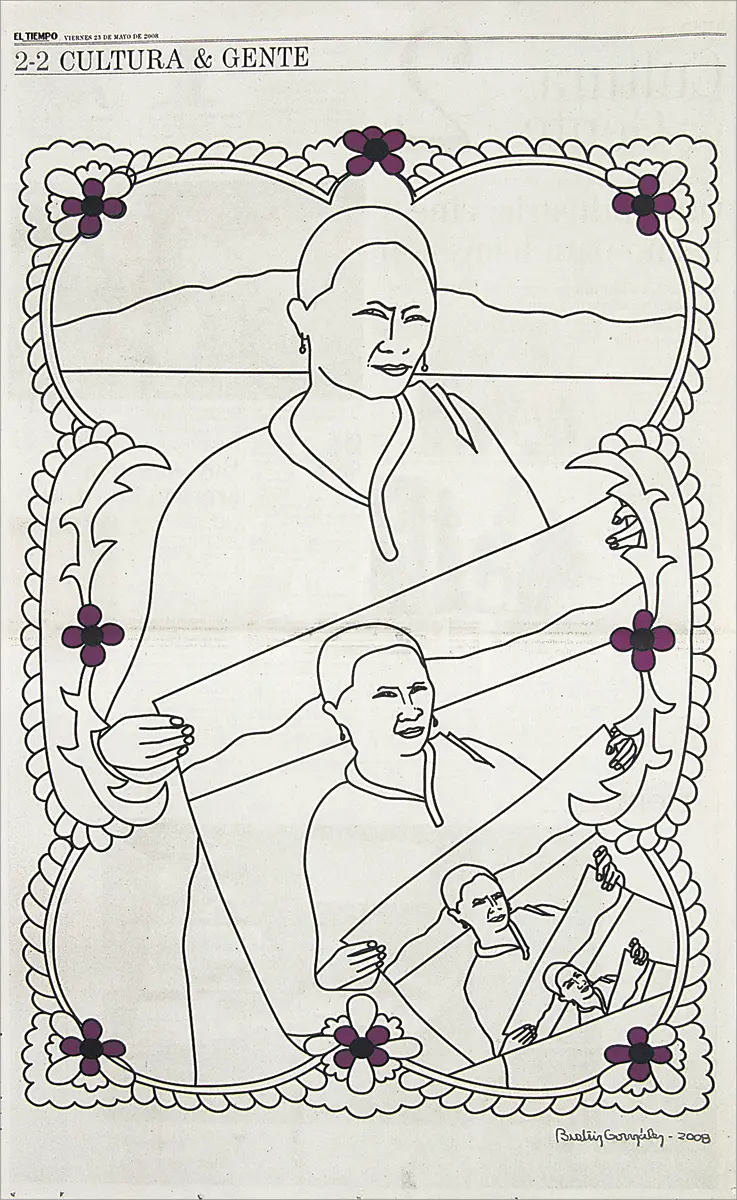
Within the exhibition component, these cases are approached on the basis of images that involve historical antecedents, cultural references, contemporary artistic practices, and a vast array of photographic practices based on a variety of interests but centered in the work of Jesús Abad Colorado, which has circulated both in the field of journalism and in the art world. Abad Colorado has been an eyewitness to the effects of forced displacement in Colombia, traveling through the most conflicted areas and becoming often the first to document the atrocities, as was the case with the Bojayá massacre. His images of this event are indelibly imprinted in our contemporary visual memory.
Each one of the exhibition galleries contains a group of photographs by Abad Colorado that highlight the testimonial character of his gaze in the context of the most painful events in the country’s recent history. Another leitmotif in the show is a series of phrases taken from texts by Alfredo Molano, who has devoted an important part of his life to gather the testimony of displaced peoples across the country. In terms of works that come from the field of art, there are some dating from the first half of the Twentieth Century that point towards the tensions around the issue of land and the movement of human groups on it. Débora Arango even recorded some evidence of this phenomenon, barely emergent at the time, in the context of Colombia’s cities.
Forced displacement is not a social phenomenon referred strictly to the present; in fact, it is mentioned in important literary works of the past. Yet, very few times in history have there been such a clean-cut equation for the relationship between exile and economic power, as we have experienced in Colombia in the second half of the Twentieth Century, and especially in the last few decades. A high number of large-scale economic projects are ultimately paid for with the land of communities that are then forced to move as the only option to preserve their life. This is why the phenomenon has had such a central role in the configuration of Colombia’s social, political, and economic map.
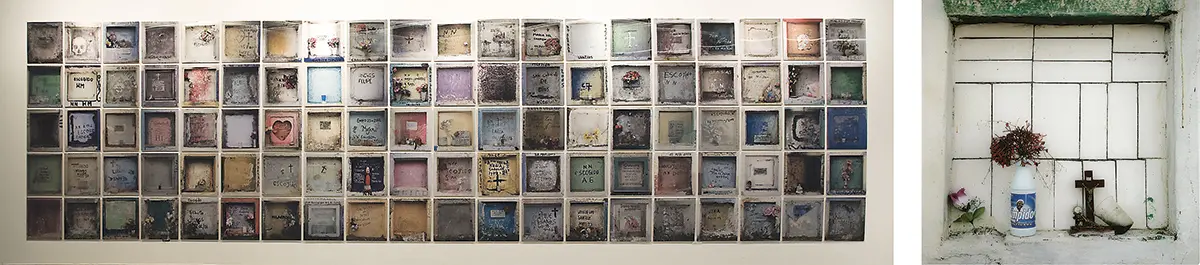
In the last decades of the Twentieth Century, we encounter artistic projects that present themselves as an antidote for such situation, and which are connected to what has been called a symbolic reparation, because while the victims of forced displacement should be materially compensated, it also seems essential to provide symbolic reparations, more closely linked to dignity and memory. Beatriz González presents an installation using an insertion she did in a Colombian newspaper, based on the photographic image of a murdered female community leader previously appeared in the same publication. In the original photograph, the woman is showing a map of the lands she is working to recover, which was among the causes of her murder. In her intervention, Beatriz González reworks the structure of the image as a drawing, and now what the woman displays is her own image, in turn displaying her own image, like a mise-en-abyme. This cycle of repetitions in which the image is its own cause and its own effect reelaborates the nefarious effect that had for this valiant woman the promotion of her cause in the mass media.
The problem of memory has been a keystone for artists since the beginning of their activity, but recently the barrenness and meaninglessness of the practice of erecting monuments has come into question. In our time, the delegation of the task of what and how to remember a cultural artifact is critiqued. Who decides, and why? Does it make sense for a cultural sign that memorializes a human event to remain immutable, while human life shifts permanently in value? The political intent of a kind of art that seeks to respond to and repair the symbolic effects of the use of power is manifest in the very terms that are used to identify its practices, among them counter-representation and counter-monument.
The term counter-monument, posited by James Young attempts to negate the illusion of the permanence of memory, nurtured by monuments. In addition, and is a direct reference to a series of works by contemporary artists, it doesn’t intend to explain the “truth” of the past, but to uncover the distance that separates it from the present it came to build. The present is expanded and made to evince its own memory. The counter-monuments are cultural witnesses of events that cannot be told, at least not in the form they occurred. They only work as mechanisms for people to act, remember, and take a position.
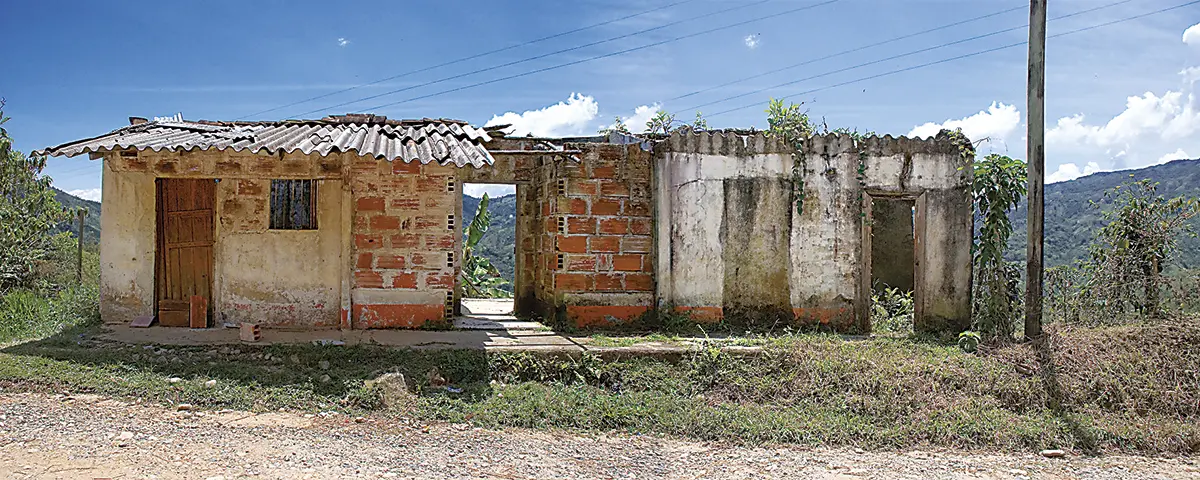
One of the best examples of a counter-monument is the 2146 stones that Jochen Gertz made in 1993 as a monument against racism, better known as the Invisible Monument. With the help of Germany’s 61 Jewish communities, a list was compiled of Jewish cemeteries in use in the country before WWII, and which were destroyed. The names of those 2,146 cemeteries were engraved in an equal number of cobblestones taken from the path that crosses the plaza in front of Saarbrücken Castle, the site of the city’s parliament. The stones were removed during the night and replaced with the engraved ones with the help of a group of Hochschule für Bildende Kunst students. All the stones were placed with the engraved side facing down so that the inscription is invisible. Initially, the work was created without any commission, secretly and illegally. During its development, the project was approved by the parliament and commissioned retroactively. The square was renamed The Square of the Invisible Monument.
The Destierro y reparación project includes a documentary exhibition at the library of Casa del Encuentro, as the contemporary wing of the Museo de Antioquia has been dubbed since Encuentro MDE07. The leitmotif here is counter-monuments and counter-representation, framed as principles of symbolic reparation. One of the projects cited in this space, by means of a series of photographs by Jesús Abad Colorado, is the Trujillo park monument.
The municipality of Trujillo, Valle, lived through seven bloody years of violence between 1987 and 1994. The Organization of American States’ Inter-American Human Rights Commission investigated the events and pronounced itself in condemnation of the Colombian state. The President of Colombia at the time publicly accepted responsibility and assumed a series of commitments for reparations, among them the park Monument to the Victims of Trujillo. Although still unfinished, it is located in the municipality’s highest ground and the population often congregates there. The state’s financial support was only sufficient to pay for the land so that the economic effort to complete the memorial has rested on the Association of Relatives of the Victims of Trujillo.
The park has two components: a space for grief and memory, and a space for reflection about the future. Walking in the site, the first thing a person encounters are traces of the tragedy. This happens in the Hall of Memories and Words of Dignity. Housed there are portraits of the victims. Crossing a tunnel called Night and Fog, we arrive at an open-air theater is reserved for productions that explore the topic of the community’s traumatic experience. Above the seats are 235 ossuaries containing the remains of several of the victims. These are aligned in seven levels, one for each year of violence. Under each of them is a plaque identifying the role played by each victim. After seeing this, we encounter a small chapel and mausoleum, called the hermitage of the Embrace, containing the remains of Father Tiberio Fernández, a community leader murdered in 1990.
This Park Monument requires the constant participation and support of all members of the community, because it wasn’t conceived for remembrance in place of people, as happens with so many historical monuments, but as a mechanism for people to contribute their effort to maintain alive the memory of those that were taken from them. There are still, many ideas haven’t been brought to fruition on the site, due to the lack of funds. The fact that it has remained for years as a work in progress is an indication of the way in which lost dignity must be recovered day after day.
JAIME CERÓN