
Visiting the central Octagon at the Pinacoteca do Estado in São Paulo during the two months of Rubens Mano’s exhibition earlier this year (July 27–October 5) was a recurring process in renegotiating one’s relationship with the museum space and with notions of perspective and context both physical and intellectual. By building an “unstable” (temporal) structure within the supposedly “stable” (atemporal) space of a museum, Mano proposed a new perspective of a familiar and accessible space, through which he challenged ideas regarding the function and purpose of a museum and of art as well as our understanding of the forms in which we inhabit our surrounding environments, such as a large metropolis.
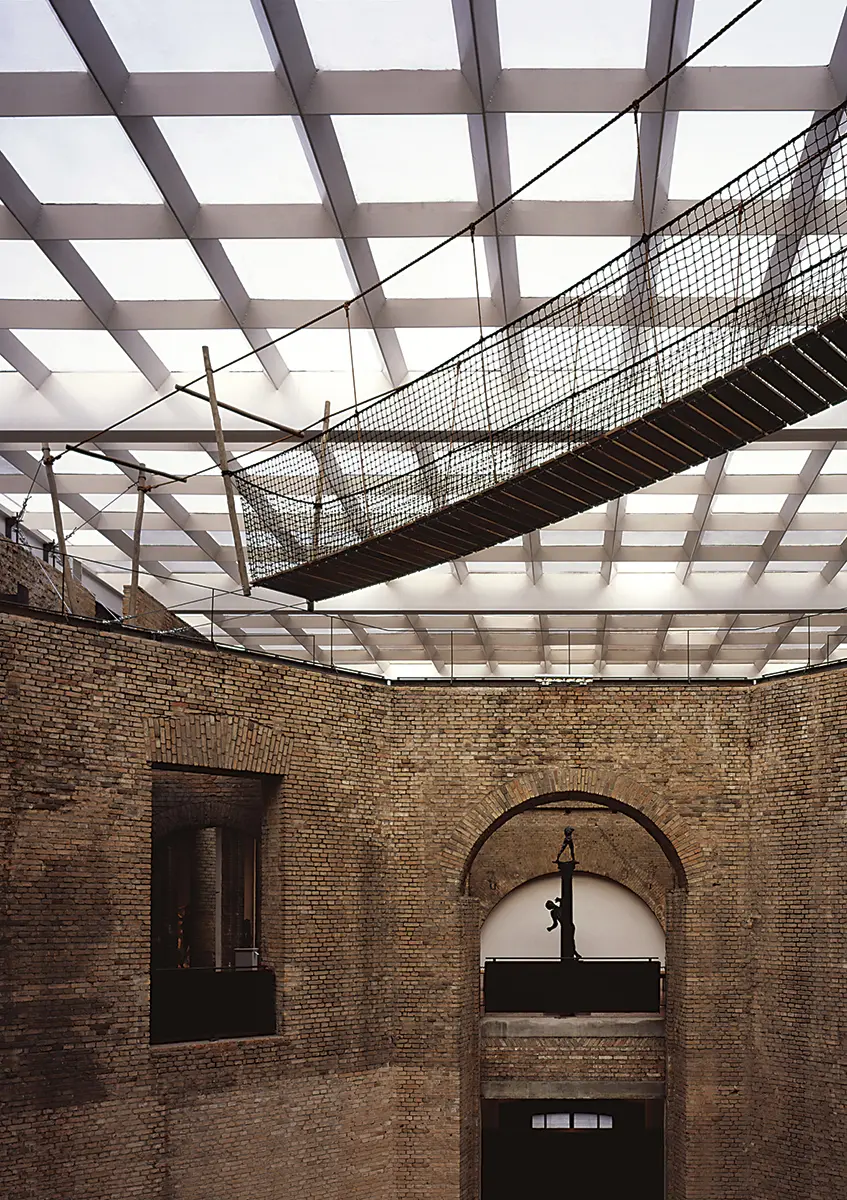
Hovering twelve meters above the central area of the Octagon, an eleven-meter-long structure of wood, rubber mesh and rope was purposefully designed and constructed to remit temporality in essence and access in function. It enabled another perspective of a permanent space (the museum’s Octagon) via a less permanent channel (the structure) and served as a catalyst to question constructed notions of space and context. Accessible to visitors, the structure was structurally stable (although metaphorically unstable and inconsistent in space) and a short walk of no more than thirty steps along it enabled one to reach its end: the abyss. What was normally the most visible exhibition point in the Octagon below was rendered empty, and the focus was on another point twelve meters directly above. The effect was a reversed vertiginous feeling toward the constructed environment at the heart of the museum. The structure’s resemblance to what was identified initially as a bridge was quickly dismissed when one realized that inherently a bridge must connect two points and this structure did not. It allowed access to an otherwise inaccessible central and “suspended” point, where one had the opportunity to approach a different perspective of an otherwise unchanged environment.
The suspended structure was one component of a two-part piece. Its complement, on the ground level of the Octagon was a single-shot video loop, filmed from a helicopter at a ninety-degree angle flying over a forty-five-kilometer stretch of São Paulo. The seamless image offered no horizons or significant points of perspective, rendering the city almost abstract: buildings and highways did not to communicate their functions and relationships as normally understood when confronted from the street but revealed them as unfamiliar, as seen from an unusual point of view. The work Suspended Contemplation questioned the forms and norms by which we usually understand and relate to spaces that are inhabited but routinely unchallenged.
For Mano, the city is an inspiring matrix due to the plurality of occasions in which we perceive things through their contexts, the conditions, and the meanings we are accustomed to applying to them or receiving from them. He views an experience of the artwork and space as an opportunity for transformation. Most of the time, we preconceive with expectations yielded from previous experience; in that light, seeing the Octagon space from twelve meters above was imaginable but not accessible before Mano’s structure. Looking up to see what was exhibited changed the habitual dynamic of the exhibition space further, functioning as a double vector of dislodged perspective and experience. This experience, paralleled with observing the uninterrupted city matrix on film, brought forth a new relationship and understanding of a familiar context.
Rubens Mano has been working with public interventions of buildings and the city matrix since the 1980s through architecture, photography, and objects. By creating situations that alter the common conditions through which we understand given spaces, Mano offers refreshing approaches to the mundane or the expected and challenges our usual experiences and notions of a given context. About Suspended Contemplation, he says: “Offering this structure is the possibility of inverting the constitutive vector of a specific space, understanding and activating it through a different relationship established between us and a given location.” As a whole, this two-fold piece achieved its goal by “appropriating something that already exists (perception) in order to unveil what exists and allowing so many other things that are veiled to surface.”
This mechanism can be translated to a social context: for example, when it is applied to concepts of what a museum space and its function are expected to be. The curator of the Octagon space, Ivo Mesquita, closed his exhibition text with:
Suspended Contemplation also checkmates the museum’s position as a privileged space for art and the experience of it. Offering conditions for a vertiginous experience, the artist’s work questions whether considering the degree of institutionalization of the contemporary museum, it would not have lost its ability to be a space in which to experience the abyss.
In closing, if one of the ways of defining art is that it is another point of view or another perspective, then Rubens Mano’s Suspended Contemplation was a physical emanation of this condition of art.
CAMILA BELCHIOR