
In her most recent exhibition at Galería 39 in Caracas, on view between May 18 and June 8, 2008, Teresa Gabaldón reiterated the important role that flowers play in her work. She presented a group of paintings with shapes characterized by a disaggregated and fractured orthogonality. In these pieces, the format created by arranging several frames together became an essential component in Gabaldón’s artistic discourse. They incorporated incoming and outgoing elements that generated horizontal as well as vertical rhythms like incomplete checkerboards, mosaics of fragments that followed the artist’s vision. The series Fragmentos de Jardín (Garden Fragments) relied on a traditional figurative component, flowers, which in these works lost part of their physical integrity and became remnants and suggestions. The theme allowed for a connection between Gabaldón’s work and the long history of floral painting. Nevertheless, her work also subtly but effectively conveyed the vast and diverse developments by painters in the fifties and sixties, led by Edward Lucie-Smith: post-pictorial abstraction, including expressionism and minimalism. Although this current stressed abstract forms, it did not neglect the organic nature of figurative forms. Teresa Gabaldón’s work appears to draw from these searches that transcend traditional painting and that have exerted an impact on the works of several generations of artists.
The effective relationship between color and form in this exhibit spoke of extensive experiences. In the artist’s earlier works, light and sketchily rendered flowers contrasted with the background tones and were isolated—left enclosed in small spaces, set apart from the groups, separated from the whole, from the blossoming gardens. These flowers were still present in her recent works, despite differences, re-readings, and transformations. They appeared as superimposed expressions that have matured in a continuum until they made themselves present. These flowers unfolded into fragments of an intimate and contained environment that shaped and gave purpose to Gabaldón’s recent work. She used these fragments to create pictorial spaces fashioned from time and memory, from sensitive experiences transfigured into symbols that acquired meaning through form and color.
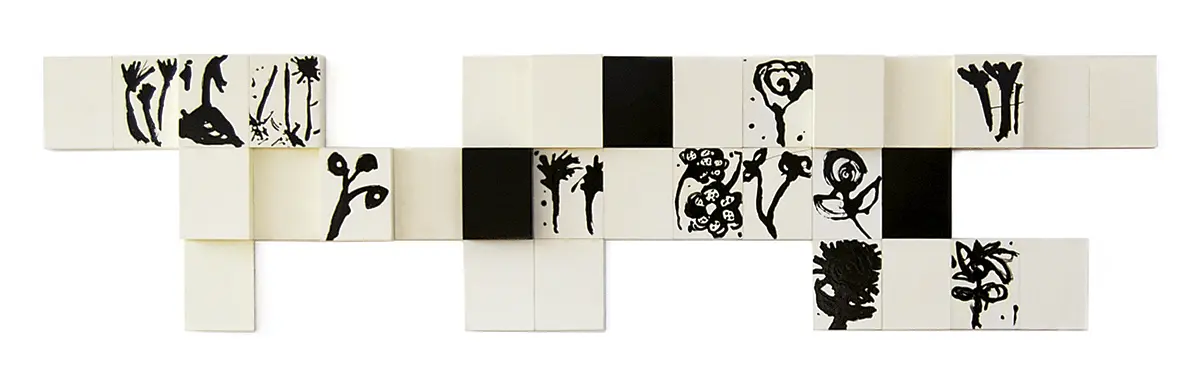
In virtually every work, the flowers were depicted with expressive black brushstrokes. In Fragmentos I (2007), they were highlighted against the dominant and passionate red of the background, while lighter tones and darker reds complimented the image. In some cases, the flowers were grouped to form small nosegays. In other instances, they stood in isolation while volumes, lines, points, and clusters of signs appeared to flank them, animating the pictorial surface. Such complementary forms balanced the internal order of the work and its spatial relationship with the picture plane. Fragmentos II (2007) attracted the viewer with the surprising luminosity of blues juxtaposed with ochre and the ever-present black rectangles; the white flowers and the empty spaces contributed to creating a balance with the dark tonalities. Chromaticism disappeared in Fragmentos VII (2008) as the work was more austere, reserved, engaged in an eternal black/white debate, a battle of opposites. Here, the flowers were more than loose petals; they were abstract forms set against a studied harmony between white and black planes that afforded the image singular sobriety and elegance. This image was the result of a vision that has become specialized and removed, which is more interested in spatiality than in chromatic values, in the concept rather than in the appearance of forms. This was perhaps a response to the search for equilibrium in view of the expansiveness of the other pieces exhibited, or it was perhaps the expression of certainty concerning the uselessness of fragments in recovering the irrecoverable.
Fragments are commonly used in contemporary art. They compose an aesthetic accepted by society and are the result of an accelerated process in time, made possible by scientific discoveries such as the atom, the law of relativity, and quantum theory. But life in modern cities has also been central to the understanding of the fragmentary. The multiplicity of stimuli in the urban landscape is presented as isolated pieces of numerous and dissimilar realities, pieces revealed simultaneously, “a repertoire of fast signs that are resolved in the spelling of the instant,” as Antón Patiño suggests. But the notion of the fragmentary also includes an inner search, a need to recover experiences and affections, to once again elaborate stories from long ago. In her work, Teresa Gabaldón sets out to reconstruct visual and affective references from fragments. This has allowed her to delve into the complexity of the pictorial discourse, into the appraisal of expressivity and conceptual intentionality, freed from concessions and detached from nostalgic sentiments.
FREDDY CARREÑO