
In his book The Three Ecologies (1989), the French theorist Félix Guattari suggested a model of living that he coined “ecosophy,” described as “an ethical-political articulation” among three ecological registers: the environment, social relations, and human subjectivity. The Argentine artist Tomás Saraceno transformed the Tanya Bonakdar Gallery into a place where theories of sustainable living were put into practice to envision what could become, at some point, the urban centers of the future. From the street and through the gallery’s window, one was able to discern a small installation of solar lamps in the shape of a tiny planet. It was just the right setting for the lamps to absorb the solar energy they required for illuminating the space at night. From that point of encounter between the sun and art, Saraceno invited the viewer to understand and to enter into his ecological utopia of life.
The main exhibit room contained Galaxies Forming Along Filaments, Like Droplets Along the Strands of a Spider’s Web, a huge installation evoking the shape of an enormous black web that appeared to trap everything that would venture into it. This piece contained the greatest amount of detailed “craftwork” in its center, as if it were forming tense globes along the length and width of the gallery. The elastic filaments formed triangles and polyhedrons, echoing the patterns of silk strands created by an industrious spider. Visitors were obliged to increase their level of physical activity, because they were compelled to circumvent the threads—as if these were poisonous—to cross to the other side of the room.
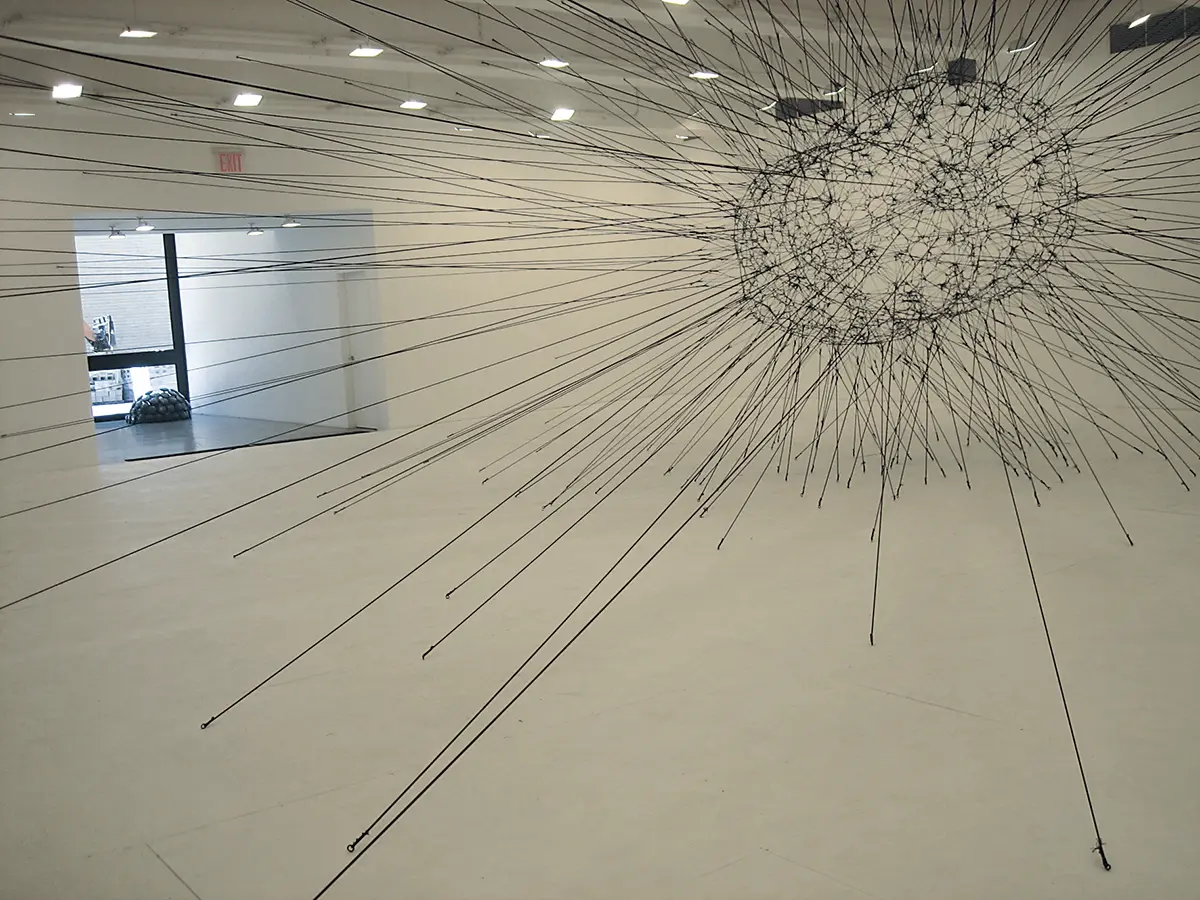
After observing this piece for a while, I reflected upon the arachnid abilities of Tomás Saraceno—who is definitely a kind of Spiderman—and the manner in which this work summoned his idea of enabling new ways of life-based on observation and the study of the laws of physics, geometry, and engineering as dictated by nature. For example, consider the fabrication of a web on the scale of the insect world and the conglomeration of galactic groups known as the cosmic web, a scenario in which the laws of gravity do not exist, and everything remains afloat and in constant action. Saraceno adopts ideas and even materials from the aerospace industry to move his theory even closer to reality. In his works, the artist applied materials such as the aero-gel used in spacecraft, because this gel is even lighter than air. Saraceno observed and imitated the sustaining of life and was able to regenerate the prehistoric silk house model created by the industrious spider.
Saraceno currently resides in Germany, but his work is deeply influenced by his training as an architect in his native Argentina as well as by the theories and inventive achievements of the U.S. engineer Buckminster Fuller (1895–1983). One example is the geodesic dome Fuller patented in the 1940s as a geometric system of energetic synergies.
Saraceno’s exhibit of recent works also included other smaller-scale installations such as the artist’s Flying Garden, his floor installation of paper that evoked the classification of clouds, and a PVC globe containing distilled water that generated droplets thanks to the physical process of evaporation.
To Saraceno, the sky has served on several occasions as a point of departure, particularly in the case of the series Airport Cities, which he has been developing for several years. The artist carefully observes the transforming processes of the clouds; he then contemplates the possibility of creating new galaxies where humans and nature can co-exist without competing. He proposes sites that leave behind unnecessary things, viable cells that are flexible and that possess ever-changing freedom of movement, just like the clouds that continually metamorphose into stratus, cumulus, or cirrus shapes.
These ideas compose part of the theories that the artist explored earlier: cities as floating airports ruled by international laws that confront and overcome social, economic, political, and cultural limitations. Guattari affirms in his text, “The true solution to the ecological crisis can only be achieved on a planetary scale, and under the condition that a true political, social, and cultural revolution materializes in order to redirect the objectives of the production of material and immaterial goods.” Historically, artists have questioned models of social life—which are presented as normal—with the purpose of rerouting these models in the search for novel opportunities. Strengthened by theoretical thinking, Tomás Saraceno bursts upon the utopian field of creative imagination and scientific, architectonic, and ecologic possibilities and presents a micro-scaled universe that is imaginable and possible.
REBECA NORIEGA