
Yolanda Gutiérrez created her most recent works in France at the park of the Chateau of Chamarande near Paris, after completing a one-month residency there. This opportunity followed Gutiérrez’s earlier works in Amiens in 2001 and in Colar in 2006, all of which were made possible by the independent art promoter Maribel Nadal. In 2001, after having belonged to a private business, the seventeenth-century, austere, and lordly Chamarande estate (with its park and adjacent facilities) became a site dedicated to culture and contemporary creative endeavor. Included in the province’s plans for artistic projects, one of the goals set by the provincial leaders is to elicit reflection on the inherent influences shared between the patrimonial spaces (park and castle) and contemporary art. Here, artists labor to create ephemeral or perennial on-site works in a dialogue with the setting. Exhibits are organized regularly in all interior and exterior spaces of the estate.
If it is true that ecological preoccupation had been at the center of Gutiérrez’s work, recently this Mexican artist radicalized this preoccupation and transformed it into a sociological and even political gesture that led her to study agronomy at a school in Yucatán, in southeastern Mexico. Accustomed to transforming spaces that are not highly organized—or “virgin” landscapes—Gutiérrez confronted in Chamarande a natural area that has been totally domesticated, one artificially organized by humans to serve the beauty of the setting and the pleasure of its visitors. Charmander was not just a new challenge for Gutiérrez; it also offered her an opportunity to concretize her newly acquired awareness and ecological ideas, to experiment with formulating an artistic and pedagogical discourse involving contemporary art as an urgent response to and in defense of the natural world under siege. The fact that her intervention was financed by public funds also increased Gutiérrez’s sense of artistic responsibility.
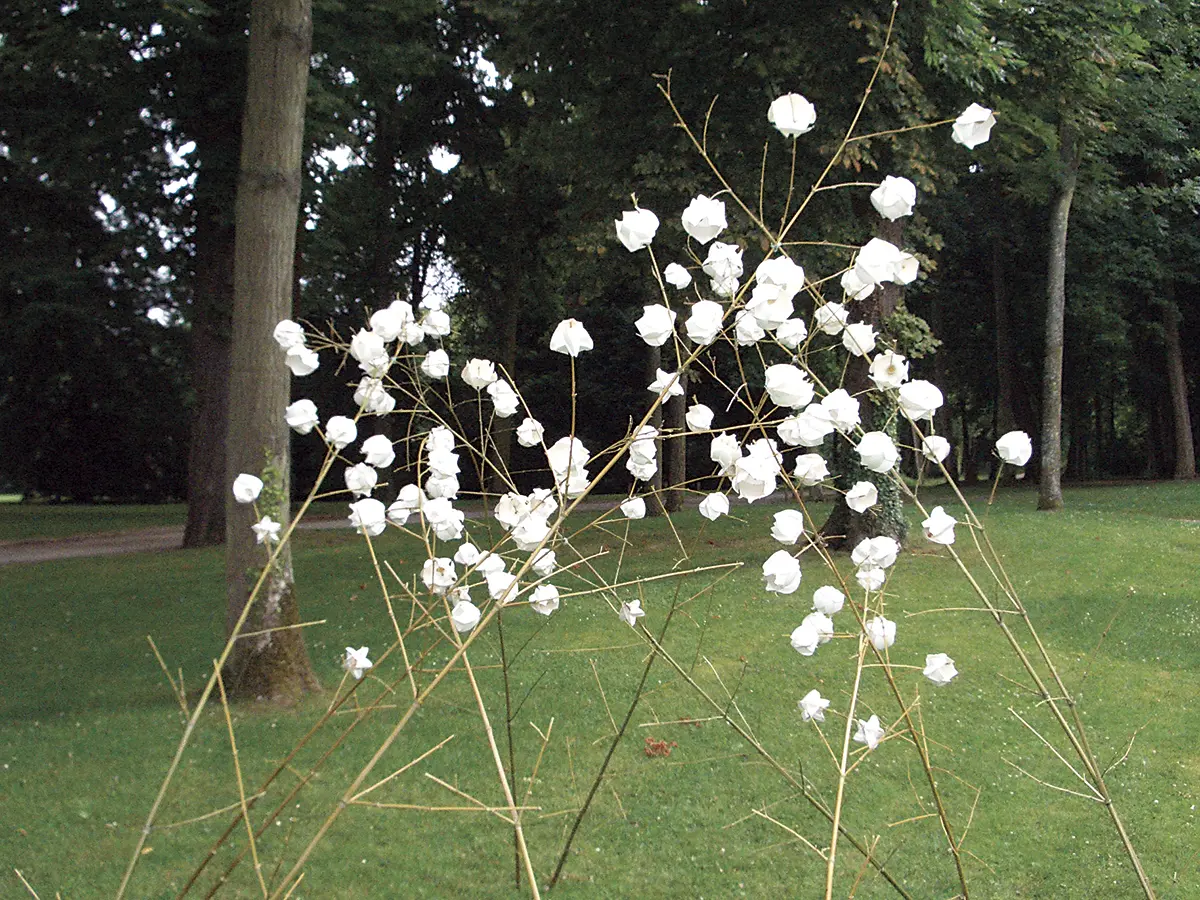
But how could she transform an already neutralized space? How could she probe into nature without running over it, assaulting it, or harming it? In the end, Gutiérrez opted to focus on areas with water (the lake and the stream) and not the huge lawn reclaimed from the forest and sprinkled with centenarian trees. The artist’s global project, conceived as a symbolic act for the preservation of natural diversity, consisted of several ephemeral installations. Semillas de Utopía (Utopian Seeds) was a series of ecological interventions in the area surrounding the lake, the island, and the channel’s shoreline. Gutiérrez installed a series of small constructions made of pots and small biodegradable baskets. All of these constructions were painted yellow and were meant to become refuges for insects and vertebrate amphibians without tails such as frogs, as well as watering holes for birds. Some of these constructions were designed to allow for the recovery of the biodiversity in these humid zones, which originally sustained diverse ecosystems but today are threatened by neglect, ignorance, and incomprehension. The other installation, titled Gracias (Thanks), was an offering to insects that may show up at nests—bees in particular. Gracias consisted of a bouquet of lilies of the valley (but made of bamboo, recycled paper, and honey candy of different sizes). This ephemeral installation was inspired by Gutiérrez’s discovery of an old French tradition: the sale of lilies of the valley every May 1. The purpose of this installation was to make visitors aware of the disappearance of bees around the world.
One of the characteristics of the artist is her willingness to adapt intellectually and aesthetically to the conditions of each site. She generously and respectfully contemplates the smallest of natural details, nature’s resources, and those it no longer possesses. Her attention is directed toward the most problematic aspects of global warmings, such as those affecting the equilibrium of biodiversity and the vital importance of water for the sustainability of fauna and flora. All these concerns distinguish what Gutiérrez calls “Ecological Art.” Her interventions in nature are intended to incite visitors not only to become aware of the problems afflicting the environment but also to bring them to the realization that they must change their habits of consumption. Thus, it is a society that Gutiérrez’s work calls into question. Her creations could not be further from works by other artists who take the landscape hostage for aesthetic and commercial ends, as Christo does. On the contrary, Gutiérrez seeks to build a relationship in which viewers of her art question nature through her work. In her own words, Gutiérrez “dream[s] of a utopian society living in harmony with nature.”
CHRISTINE FRÉROT