Adrián Villar Rojas (Rosario,
Argentina, 1980) is a kind of romantic. In nearly every instance, his works
address heartbreak (the other side of love) in his creation of intimate and
colossal universes. Far from choosing to show beautiful representations of
nature and dream-like nostalgic images, with this amazing installation entitled
Lo que el Fuego Me Trajo
(Things the Fire Gave Me), Villar-Rojas builds an overwhelmingly silent, but
also excessive, scenery replete with future memories.
The new space of the Ruth Benzacar Art Gallery is accessed by climbing down a stairway. Even before descending to the actual space, from this vantage point upon moving inside, the observer can guess that behind the rubble obstructing the entrance lies something exceptional about to be discovered. Villar-Rojas was overheard to say, in connection with this work, that “It is as if I had died two hundred years ago”. To a certain extent, this work is concerned with a search for the essential, a quest that is at once dazzling and unsettling at more than one level.
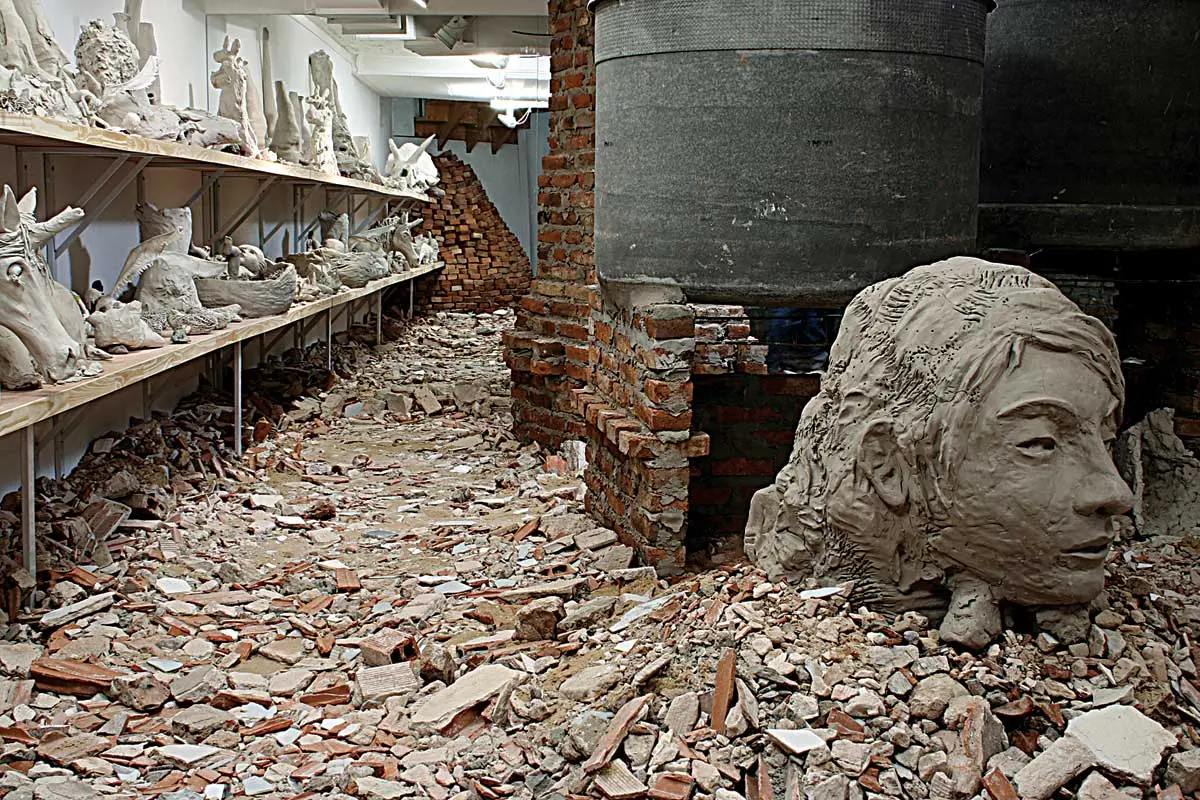
Villar-Rojas creates a territory in which construction and destruction play a mysterious match-up game. Alongside a series of architectonic elements –constructions similar to chimneys and water tanks – the site also contains piles of bricks, a winged human figure, a “David”, a giant head, and a stranded crustacean. All these elements are disseminated throughout the room in no apparent order. The human figures – modeled after some of Villar-Rojas’ love images – and the monuments are made of raw clay, thus their whitish color. “I create monuments because I am not ready to let go of anything”, affirms this young artist, who like a compulsive collector appears to want to treasure forever the multiplicity of the real and imaginary elements that may surround, or that at some point surrounded him.
The exhibit room was visually expanded with the use of a large mirror occupying an entire wall. The room also contains two natural wood shelves one on top of the other on two of the lateral walls; a board has been placed at the third wall, which is also the entrance. The shelves are filled with a great assortment of objects, also made of clay, laid out as if they unearthed archeological findings in various stages of decomposition or restoration. Giant bones, prehistoric animals, mythological figures, dolls, busts, and reclining human figures (women, babies) vie for shelf space with organic forms: everyday utensils; footwear; a car’s body part (virtually the only item here with color, aside from other objects such as a butterfly, a bird, and a piece of fruit), undecipherable objects constructed by Villar-Rojas, his girlfriend, and some of his colleagues.
Because raw clay is prone to crack, Villar-Rojas is at the gallery nearly every day to wet down the pieces. With this upkeep, the latter appears to demand a sort of permanent sacrifice. Villar-Rojas patiently “waters” this immemorial garden that could very well be part of the remains of a battle or of an unknown galaxy. A photograph from the Star Wars films of Luke Skywalker as a blond young boy, hung on the gallery’s entrance by the artist, appear not to be a mere coincidence.
With six solo exhibits to his credit – including this one, and with a long list of participation in group shows, Villar-Rojas has already moved visitors, such as in 2007 with his extraordinary installation titled Pedazos de las Personas que Amamos (Pieces of the Persons We Love), in which he presented dozens of moments and objects from life about to self-destroy.
Villar-Rojas became a recognizable artistic figure in Buenos Aires with his work Incendio (Fire), after he was awarded First Prize in the Curriculum Cero 2003 competition at the Ruth Benzacar Art Gallery. His individual exhibit consisting of 98 small-format works (between drawings and collages) and two paintings of dinosaurs, each measuring six meters demonstrated his fascination with combining different elements with coincidences and extremes.
The artist is a skillful drawer and admits that painting and sculpture are to his liking. Nevertheless, he completed his education at the National Fine Arts University in Rosario. He exhibited his first solo show in this city in 2003 at the Juan B. Castagnino Fine Arts Municipal Museum, Villar-Rojas was an assistant of Artist Jorge Macchi for a few years and regards this experience as very educational, one for which he is infinitely thankful.
An avid reader of comic books, he draws inspiration from these, as well as from figures found in other publications and on the Internet to create his own imagery in works such as Sin Ti (Without You), which aside from drawings also included photographs and videos. Villar-Rojas’s inclination for works that span several fields led him to participate in a series of interventions of tickets cards used for public transportation and in the artistic director of several music records.
Lo que el Fuego Me Trajo is complemented by a novel written by the artist’s brother, Sebastián Villar-Rojas. It is a sort of intimate handwritten diary, edited in the form of a photocopy. Here, the author’s alter ego relates to the tale of his brother, Ongry, who ventures inside a video game. This is a long narration that recounts the adventures of Ongry and his life-and-death struggle against the zombies. “I personally like the idea that the text cannot possibly be read in its entirety during a visit to the exhibit, and requires leisurely reading at a different time, after which one returns to the gallery to rethink the entire thing”, affirms Villar-Rojas. Could it be that Lo que el Fuego Me Trajo represents the theater of the eternal struggle between fiction and reality? There is no explanation for the disaster; the saga must move on.
VICTORIA VERLICHAK