
Agustina Woodgate has in her studio
all kinds of memories and objects that belong to her life and to the life of
her family. She uses them to create a body of work that relies mainly on her
individual and collective memory, opening up from the intimate to the universal
as she principally focuses on revising notions of identity. She collects toys,
dresses, small chairs, hairbrushes, wigs, buttons, and an endless assortment of
fetishistic objects that aid the artist in constructing her physical and
conceptual work. There has been, in recent years, a particular organic element
that has become the focus of her attention: human hair.
She is interested in hair and everything that it affects, its presence throughout human history as a weapon of seduction, a fetish, a symbol of power, knowledge, subjugation, love, history, etc.
For this young Argentine artist, the search is important for the relationship between the intimate memory of the body and the social, historical, and cultural implications of hair as it relates with an identity from several strata. Similarly, recycling is another evident idea emanating from her work, for Woodgate fashions her works of discarded objects from the past: hair that has been cut, hair that is no longer good. She gives new life to something that is no longer alive. The resulting objects – produced with human hair from hundreds of different heads as if they were a sort of collective continuum – represent all of us. It is in that realm that Woodgate´s work transcends the self-referential to become universal.
She has explored several aspects of memory through the fragmentation and creation of sculptures, actions, drawings, photographs, performances, and large-format installations. During recent years, in order to collect large amounts of hair, she carried out performances in which she would cut the hair of passers-by she would invite to improvised hairdressing salons, in the street itself, or inside galleries. Woodgate also collected hair from relatives and friends, as well as from beauty parlors that collaborated with her. She also has also drawn on threads sewn on paper, clothes sewn with hair, and has built a castle with bricks made of hair. The scale of the artist’s work has been growing progressively, and the natural evolution of her work resulted in her decision to create a ten-yard-long hairpiece, inspired by one that belonged to her grandmother.
It is from the conception of this sculptural piece that the installation/performance Letting Down was born, and it is precisely this great wig fashioned by Woodgate that functions as the sculptural object and entity giving substance to the narrative of the re-created story: Rapunzel.
Woodgate had already re-created in other work scenarios from fairy tales such as Sleeping Beauty and Hansel and Gretel. For this series, she readopts the narrative oral tradition found in such stories, as also draws from recollections of her grandmother telling her these stories. Woodgate goes on to reconstruct specific scenes from narrations that somehow have made a strong impression on her. Using the tale of Hansel and Gretel, she put together a performance with her brother in which they ate all kinds of candy for 25 minutes to the rhythm of improvised music.
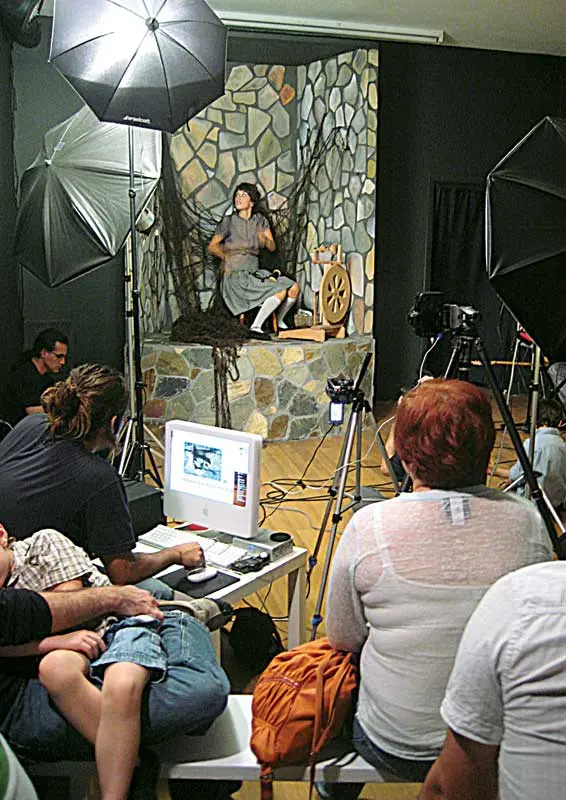
In Letting Down, the spectator became a participant in a complex working space that could also be called a stage. Playing the role of Rapunzel, Woodgate sat next to a spinning wheel, inside a small stage resembling a tower. As Rapunzel would spin the threads of her long hair – the wig inspired by that of her grandmother – her stepmother – played by the Woodgate’s mother in real life – would nail the threads to the tower’s walls, as if constructing a spiderweb to keep the heroine in captivity.
Rapunzel’s non-stop spinning of her own hair symbolized a promise of freedom, while her stepmother’s actions keep her from fulfilling this promise and from another kind of life – free and filled with love – outside of the tower. In this loosely based version of the original story, Rapunzel never achieves freedom. Through these reinterpretations, Woodgate is interested in establishing a connection between stories and legends concerned with the mortal sins and the heavenly virtues, lust the sin alluded to in this particular work.
Throughout the duration of the action set as a loop, there is also a photoshoot documenting all the action, and two musicians playing an improvised theme live. The members of the audience also become part of the performance. They appear to have entered into a photographic studio or that of the artist.
Woodgate´s body of work expresses an understanding of the world we live in through our magical or hidden relationships with objects and materials, and through the capacity that art possesses to transform reality. To Agustina Woodgate, the creative process is as important as the resulting work. It is impossible to understand her art without being cognizant of the long process she undertakes prior to the completion of a piece and the connection she weaves from one project into another. Her work contains multiple readings, all of them threaded by means of a long and intricate process. We could affirm that the work she has already completed finds its genesis in her childhood and that it will continue to evolve for a long time into the future, like life itself.
AMALIA CAPUTO