Since
its beginnings, photography has always contributed to the creation of other
retinal myths in popular culture. Che’s “auratic” visage, romantic symbol of
revolutionary ideals, has reached the Twenty-First century transformed into an
icon as popular as Andy Warhol’s Marilyn Monroe. Yet, nobody remembers,
encountering it on a T-shirt or a teacup, that his creator was Korda. (It is a high-contrast resolution of a
photograph shot by Korda on March 5, 1960, during a tribute to the victims of
the sabotage of the French ship La Coubre. The original 8 x 10 inches was
cropped to leave Che’s face at the center of the frame. The photographer gave
the negative to Giancarlo Feltrinelli, who, having journeyed to Cuba from
Bolivia, arrived at his studio thanks to Haidé Santamaría, looking for a
picture of Che. The image was reproduced in Italy as a poster for the “Che
Lives!” campaign. Interview with Cristina Figueroa).
Casa de América brought to Madrid a retrospective exhibition of works by Alberto Díaz (1928-2001) better known as Korda, from Cuba’s Fototeca Nacional and a book published by La Fábrica. (Korda Conocido Desconocido. Madrid: La Fábrica, 2008. As well as a publishing house devoted to art issues, La Fábrica produces the well-known PhotoEspaña yearly event, among others.)
Taking this book as her axis, the Cuban curator and critic Cristina Vives created the show’s narrative based on five chapters: "Korda Studio", "The leaders", "The People", "Woman", and "The Sea." Her closeness to Korda allowed her to include not only well-known iconic photographs but also unsigned and unpublished works, developed by Alberto Figueroa, Korda’s printer since 1964. (Interview with Cristina Figueroa, the organizer alongside her mother, Cristina Vives, and her father, José Alberto Figueroa, the printer. The family was very close to Korda and his daughter Diana Diaz, executor of the photographer’s state). The goal of this tribute to the creator of Che’s best-known image was to reaffirm his indisputable mastery and his place of pride in international photography, beyond the fortunate individual with a single snapshot.
Bringing forth the face of Che was not Korda’s sole achievement. He also contributed to the creation of other “historical icons.” As the official photographer and presidential witness to Fidel Castro, he created the narrative of the revolutionary leader’s personality and propaganda mosaic, supported by the “veracity” of the image captured by the camera. Who but a well-versed and passionate photographer would have been able to add to history the image of those protagonists of the revolutionary epic? Korda was an exceptional “snoop,” with an important oeuvre anchored on Latin America’s best documentary photography tradition, as well as on photo-journalism and fashion photography, all of which made it possible for him to transcend the condition of being a witness with a camera. Deeply identified with the barbudos of the revolution, Korda built the legend of Fidel in the Sierra on the basis of the everyday images of the journey. (Fidel vuelve a la sierra, Photo-essay for Revolución magazine in 1962.)
His photographs were able to create a hero. Korda’s image reveals his knowledge of the power of photography in the construction of mediated representation. He used this power with a subject who, in turn, knew he was being photographed. The cooperation is evident. From each unusual angle it seeks, the camera finds a set of eyes that are responsive, that return its gaze, even when Fidel is captured immersed in work, among people, speaking in public, or in everyday moments.
The images that circled the world and romanticized the charismatic leader are due to a vigilant photographer that shoots his instrument to record a warm, accessible, simple human being as he shared with peasants, played baseball or chess with his comrades, or napped like a legendary Adonis in a tropical mountain hut. (Fidel durante la zafra azucarera de 1967). Having mastered black and white photography and the many qualities of gray, Korda was able to chisel the harsh light of the Caribbean into high contrasts of shadows with subtle variations in his interior scenes. In the Sleeping Fidel/Adonis, the camera-as-voyeur scrutinizes the back of an object in order to frame the nude chest, oblivious to the observer, in the softest of lights. This is the opposite to that high-angle image of Fidel as the leader who rises against the horizon in all his masculinity, his power reinforced by the palm tree and the stillness of his expression. The mythical, transcendent dimension of the elevated gaze reasserts the flight of a bird. One can’t help but think of Rodchenko and the German photographic tradition so patently expressed in Leni Riefenstahl’s Olympic athletes.
And then there are the other images, the ones that puzzle out the man through his objects and fragments. Like Hans Namuth in the snapshots and films that manifested the genius of Jackson Pollock by showing us his paint-stained shoes and his ritualistic dance around the canvas, Korda captures Fidel’s meticulousness and sense of order in his perfectly shined shoes and the impeccable uniform on the sleeping cot. (Objetos personales de Fidel, Oriente, ca. 1966). For these personal but static objects, Korda sought the perfect composition and framing, enlivened however by the freshness of the fleeting.
Korda’s mastery was not only expressed in his ability to capture the magnetism of the leader. Of his most brilliant photographs, we find here the portrait of a group of barbudos titled Rebeldes cubanos (Venezuela, January 23-27, 1959.) In a parody —I don’t know whether conscious or otherwise—of the typical business group portrait, these young, military-clad, bearded men pose for the camera in improvised attitudes. Some seated on a wide couch and some standing, they offer a spectrum of memorable attitudes that go from bold self-confidence to expressions of mock seriousness. Despite the sameness of their uniforms, the image captures in a brilliant way their individual psychology and personality.
Other memorable photographs by Korda included in this exhibition are his shots of rallies in Revolution Square. Korda turned his shots into registers of each slogan shouted out; he was receiver and transmitter of the energy of these mass events. But the people are presented as a sum, the infinite repetition of an anonymous face, brushstrokes, and expressions symbolizing the collective. It appears like an anonymous idealized hero, in back-lit shots of workers, cane cutters, the mambí on a streetlamp, above the multitude, (El Quijote de la farola (Eleuterio) first July 26 celebration after the triumph of the revolution. Revolution Square, Havana, 1959.) as the expression of a moment that was unique and cannot be repeated. Undoubtedly, preciosistic creations, repetitions of the same human element reproduced like flags against the sky.
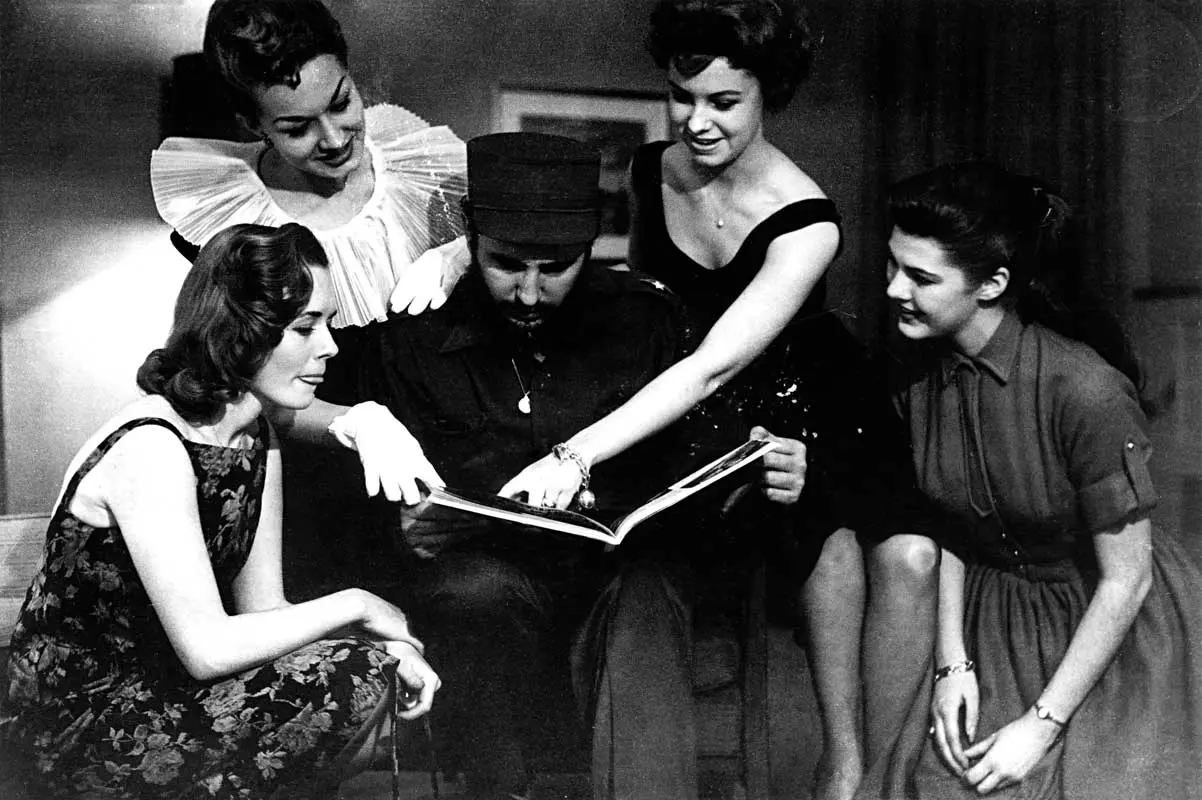
Korda’s telephoto lens found, from its privileged position, a different subject: women. But not any women: women as protagonists and participants in revolutionary change. The photographer capable of creating large-scale media images stops only to contemplate the typical Cuban ideal of mestizo revolutionary beauty. The photo of the female militia fighter, the sculptural beauty of distracted youths in the public square or the parade. Passionate about female beauty, Korda demonstrates once again his mastery of portraiture. The intimate three-quarters image of Lourdes Colete (ca 1959) highlights the depth of the subject’s gaze and her un-self-aware beauty captured in the instant of the shutter’s opening. One contrast is his studio photographs for fashion magazines. Highly aware of the aesthetic of the period, Korda emulates the masters of Harper’s Bazaar or Vogue in their aesthetic sense and careful search for the perfect light, taking advantage of the beauty and pose in his unquestionable mastery of black and white image-making.
In 1968, Cuba’s Council of the State took charge of all of Korda’s negatives, not only those of his travels with Fidel or his records of rallies and revolutionary activities, but also the originals of his fashion sessions. The frustration of losing control of many years of work drove him to focus, at the age of 50, on undersea photography. The sea appears then as a metaphor for a new period in his life. The show closes with a silent submersion in the ocean, alongside the note of his death in Paris, in the arms of one of his young lovers.
Without a doubt, this exhibition reveals an unknown Korda, an undisputed master of documentary images well beyond the romantic icon of Che. His death abroad at the dawn of the Twenty-First century is a symbolic expression of a period when the heroism and leadership of Fidel’s charismatic figure are at their lowest point. However, the mythical moment of Cuba’s revolutionary epic remains recorded forever, as does its masculine, magnetic leader in unforgettable sequences. And this is, essentially, a legacy of Korda, an undeniable master in the construction of myths through photographic images.
DERMIS PÉREZ