
“The trip from collaboration to solo work is a big challenge not only for the transition, but the idea of simply overlapping “I” on “we” took more effort than expected. Sometimes I still confuse myself and say “we.” On the other hand, my current work tends to be more provocative, more about using the design for building ideas for specific places and to dialog in relation to the particular story of a given place. There is an aspect in the projects of the dysfunctional that I didn’t develop before, [yet] my work is [also] a continuity of the previous collaborations."1
Alexandre Arrechea (Februry 2009)
One of the questions I want to pose as a critical frame for Alexandre Arrechea’s work since he left Los Carpinteros in the summer of 2003 is in what ways his newly launched individualism has co-mingled with that group’s social, critical, and collaborative aesthetics. The choice of individualism, the long-held necessity for social liberation, has been rendered problematic and even dangerous in an art-world model where creative individualism remains the heralding cry of an art system that demands yet another hero-celebrity to parade before the arena audience. Here, even the best intentions toward the social self are realized within the constructed amnesia of a capitalized hegemony in which social trauma is seen as a temporary anomaly, which heals and returns us to the natural order of things, rather than as the continuing nature of social reality.
A different individualism emerges within social collaboration and is filtered through the material convulsions that are an accepted part of everyday Cuban reality. Individualism forged here automatically demands the separation of the private self from the proclaimed social system at the same time that the system defines the self. Double consciousness then is a hard-won gift of defense—cynical and critical—to those whose social contradictions in life are obvious rather than hidden. And Fortuna smiles! Central to the global conversations that must take place are the negotiations within ourselves as private and specific yet public and social beings. The irony is that although the US most need to have it, the conversation cannot occur where the social and private selves are conceived and experienced as a static whole. At this time, the negotiations or dialogues are best held by those outside the US—those whose interrelationships between the private and public were realized through separate critical and social models. Answers and questions, which are never complete, are in the works.
Arrechea’s first large, public, and independent project was The Garden of
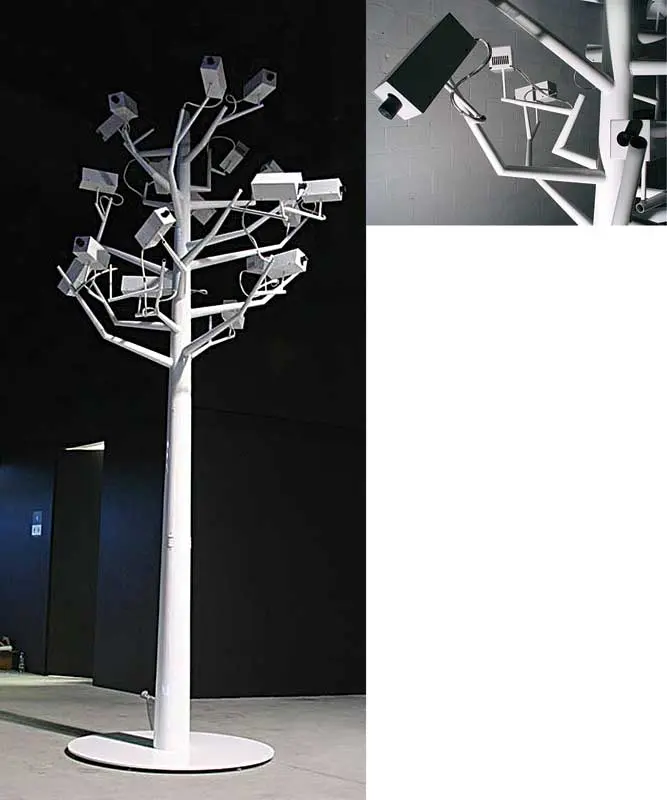
Mistrust (2003–05), a metal tree measuring over thirteen feet tall, with more than twenty surveillance cameras attached to the end of the branches. The cameras were disembodied observers of the museum visitors; those who came to watch were watched, their images and acts recorded, uploaded, and made visible on the Internet to a larger public.
Arrechea said that his decision to “focus on reflections about power, surveillance, and control issues” was “born with our [Los Carpinteros’] first studies on panoptic systems when building the jail for Transportable City (2000), now taken to a new level with the technology of today’s world."2
But Arrechea also wrote publicly of another aspect of the work. The project was conceived immediately after the death of his mother, a fact that automatically relates the intensely private with the social. The psychoanalyst Julia Kristeva argues that the inherent trauma of facing a corpse casts us outside the symbolic order of the cultural world: a once-living subject is now an object, what Kristeva calls the “site of the abject” and the place where we negotiate identity. It is in the mother/maternal—that part of our lives that is out-of-sight, hidden deep within—that we must objectify in order to define ourselves in cultural terms. Thus the mother’s death and corpse, as one and the same, turns and confronts us as a “cognitive dissonance” that cast us both out and in. We shift from the loved one who is watched to the wary watcher, from interior to exterior. How interesting that Arrechea was at the same time cast into a similar position of duality by the US government. Arrechea could not see the work except through the Internet; he could not enter the US between 2004 and 2007, due to the strengthening of travel restrictions by the Department of Homeland Security toward countries that had long been on a list of “state sponsors of terrorism,” which at the time grouped Cuba with Iran, Syria, Sudan, and North Korea.3
To Arrechea, this presented questions and dialogue:
A dialogue begins between the public and the piece that goes beyond the immediate. The dialogue arises through a means that’s used fundamentally by governments, businesses, and even private individuals as a means of control, surveillance. We try to control everything, and in the end, we don’t even know why we are doing it. To protect ourselves? From what? It’s a form of manipulation, of course, generated fundamentally by governments to instill panic in the public. It makes people think twice about what they do."4
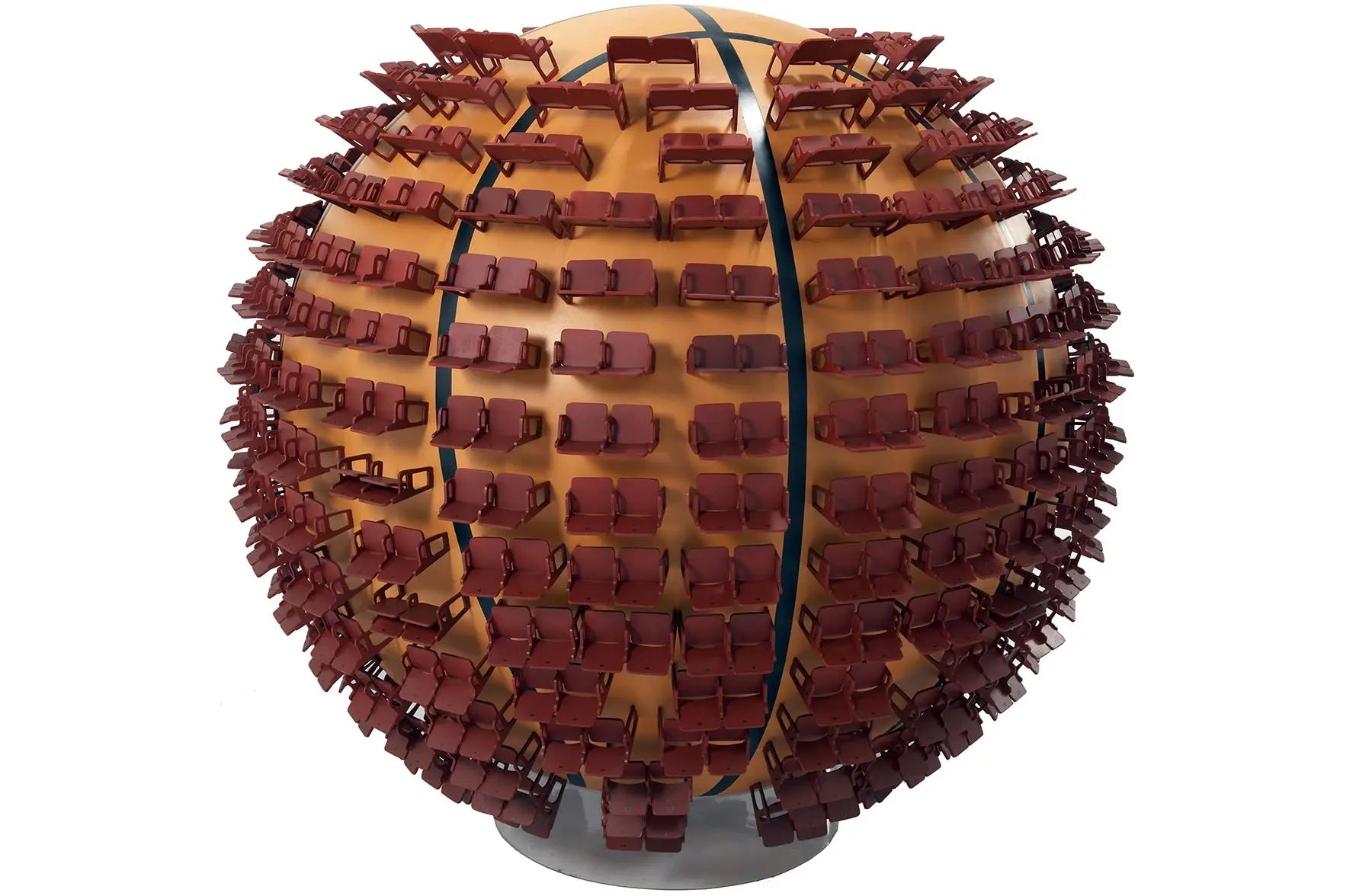
Arrechea has made it clear that he considers these issues and The Garden of Mistrust seminal in much of his thinking. His ideas of surveillance and the public arena began to coalesce around the issue of sports in 2005, with his drawings of soccer balls and basketballs covered with small buildings and arena seating. Years later, Arena 2 (2007) was one result: a fiberglass basketball, forty-three inches in diameter and covered with over one thousand miniature Yankee Stadium seats cast in resin. Sports is the obvious metaphor but through removal—a participatory game that cannot be played but is only signified by the object. But as the signifier of the imagined viewer’s private/communal moment in a stadium becomes an object in the world, life as watching/sharing becomes life watched objectively.
Arrechea posed it as a never-ending well of mirrors, depending on the scale as a conceptual fulcrum.
The French psychoanalyst Jacques Lacan argued that at an early age, we form the concept of a whole self through looking, but that image of completeness is a lie; we are an incompleteness that will never match the imaginary. Thus the “mirror stage” establishes a misrecognition that can never be fully realized but partially and symbolically enacted throughout our lives in the gaze (le regard): us looking at others and they at us.
Looking-in/looking-at is a process of negotiation between the private and the public that fascinates Arrechea not simply as a negative or “dis-regard.” Once negotiated in collaborative works, his private self recognizes the formation of the social self without cynicism. What others might see existentially (the isolation of individual seats in an arena as an ineffectual effort to join the whole), the social (and now specular) self also sees it as a negotiation, a relational rather than a merely static activity for a communal identity within the spectacle. There is no resolution, no collapse into one answer; looking in, at, and through a public field forms a complex and reciprocal process that is not reducible to a single value and is essential to identity construction.
Arrechea’s first large-scale architectural embodiment of an arena, titled Arena (2007), carried the same ideas. Typical of the artist’s constellation-like processes, its form descended from a series of watercolor drawings, which at first combined a single chair with the elements of a stadium and by 2006 morphed into an ominous wall of block stadium seating that stretched into the archaic spatial infinity of the unconscious. The various forms were grouped under the series title Journey into Loneliness, which made clear Arrechea’s thinking and the elements of his dialogue.
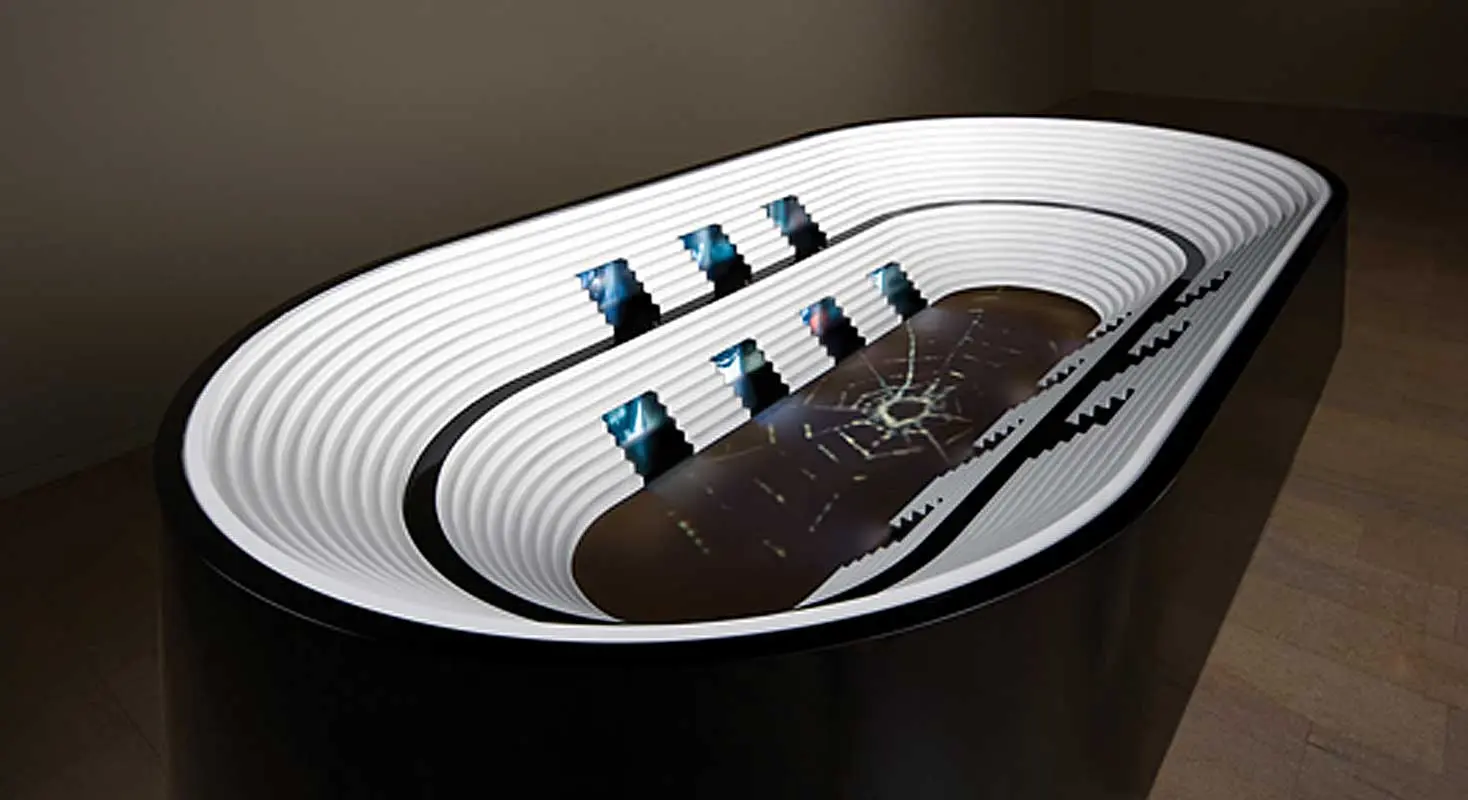
Arena was a four-by-seven-feet model of an elliptical enclosed stadium that sat, furniture-like, on conical supports that raised it to a level at which viewers could look into the bowl. The seven “entrances” to the stadium on both long sides held fourteen small monitors that showed images of the viewers as they entered the museum. It was a self-contained system with no exits; one was digitally trapped within and referenced outside by the arrival of other visitors. Here remained the legacy of Los Carpinteros’ uncanny wooden hybrids and dysfunctional constructions but, as Arrechea claims, now it referenced more directly a functional object, daily processes, and a relational context.
This does not mean that the desolation of not belonging is overcome in Arrechea’s work. There remains a kind of public mourning for its loss and its inadequate substitutes. In the work, there is a “colder consciousness,” one that participates in numbness that Susan Buck-Morss calls “anesthetics,” a characteristic that Arrechea frequently incorporates.5 The idealist social self within me is more attracted to his projects in which I can see the embodied participation of human agency. But to Arrechea, a project cannot be an either/or situation but must participate in both sides. As early as 2004, he presented a demonstration of this.
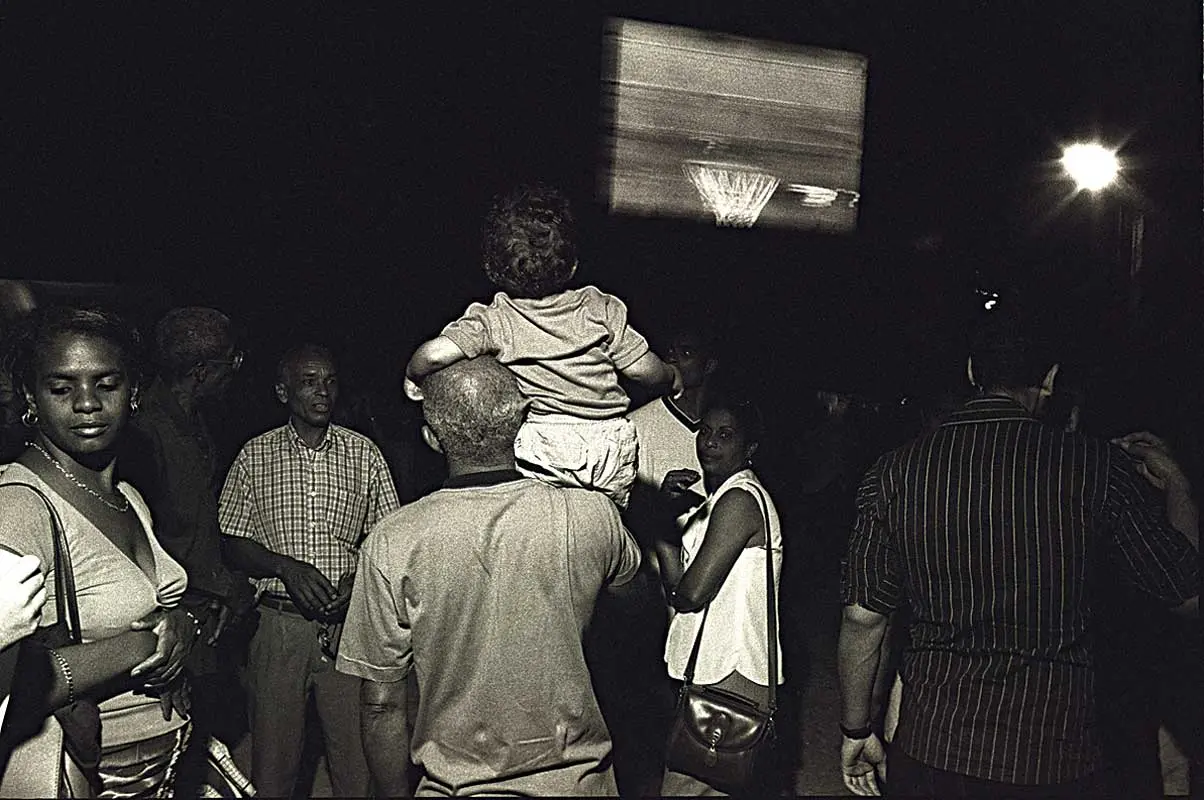
For the project Sweat (2004), Arrechea aimed his video camera at the backboard of a local basketball court: as his friends and neighbors played ball during a normal week, he recorded the audio of the activity and the video of the hoop and backboard. In February 2004, he organized a party of neighbors at the same ball court and projected the video work, which functioned, as he said, “as a floating memory of the locale.” The concept of playing was conceptually doubled with the sweat imagined—or, depending on one’s interpretation, removed—to create, as he said, “a social sculpture that is ephemeral in nature” and “to reflect on participation as an active as well as a passive experience. I use the same idea (from The Garden) in Sweat. It becomes a form of manipulation. You are in the arena of the game, but you can’t participate or change anything."6
My case seems to be made by the artist’s admission: there is no affective social change. In Sweat, individualism seems to operate negatively as a mechanism for social control and stasis. But it doesn’t, really. The pictures that document the second event show friends and neighbors gathered at their basketball court, sharing the sounds if not the sights of their weekly activity. One set of the social, the game now removed, was made into a signifier that allowed a second set, the social group, to operate.
Everyone implicitly recognized that Arrechea was, as he said, “trying to understand space in general physical terms as well as mental terms, and (as) originating in the specificity of certain determinate moments.” Contrast this to Joseph Beuys, the German artist who made the concept of “social sculpture” famous. Often Beuys’s works were not only arcane and enigmatic but also isolated. He performed his private self in public; the viewer watching from a distance was not allowed to enter Beuys’s symbolic arena. But Arrechea’s project was the self, made critical through the process of the social, even though it was unrecoverable in its totality; life, as Adorno has written, as damaged goods.
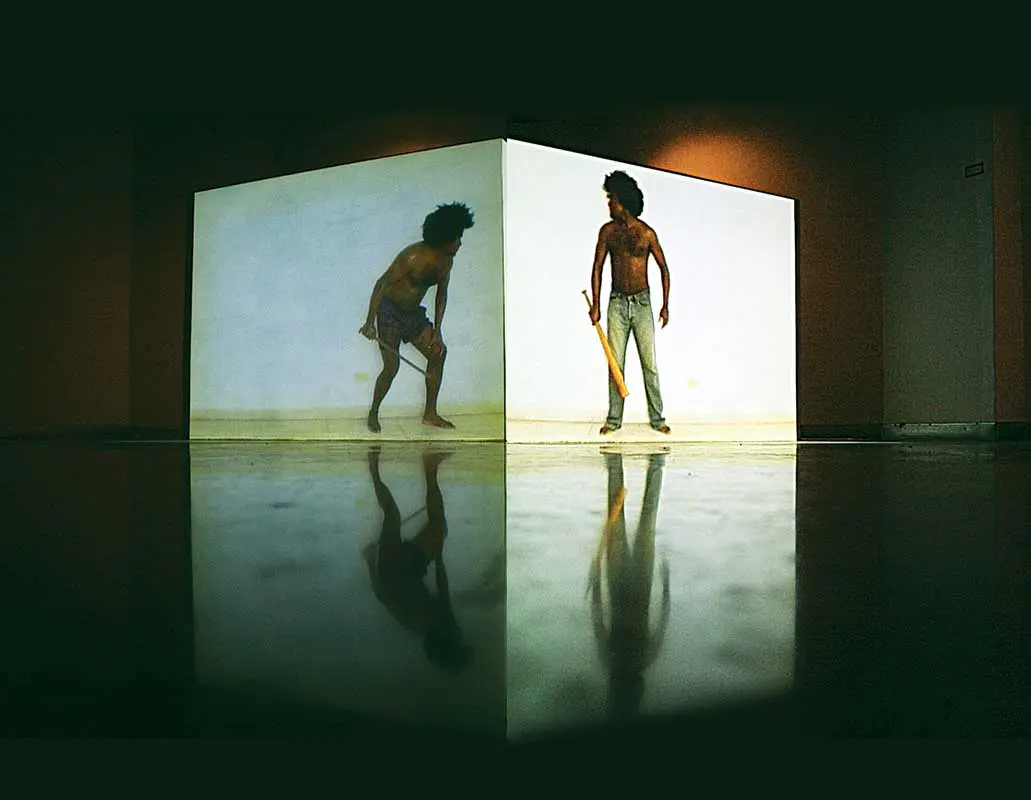
The site of that damage, if not the specific sources, can be seen in Arrechea’s 2006 White Corner. In this video projection, the dark-skinned Arrechea is the figure against a stark white background in two images; each image is projected on one of two walls that almost meet at a right angle, such that an actual person in the position of Arrechea’s figure cannot see but suspects the presence of the other. In one projection, Arrechea menacingly wields a baseball bat and, in the other, a machete. Both figures threateningly advance and retreat from the unseen and unmet other. The threat is merely expected, internalized without verification from the world, missing but made “real” by internal and general fears, paranoia, and mistrust of what isn’t seen; yet simultaneously, it is ourselves against ourselves, ourselves as the enemy “other.” Arrechea combines the specific individual, a black Cuban native whose ancestors wielded machetes in the Independence War, with a universal figure, creating a conceptual space in which to contemplate our own motivations and sources.
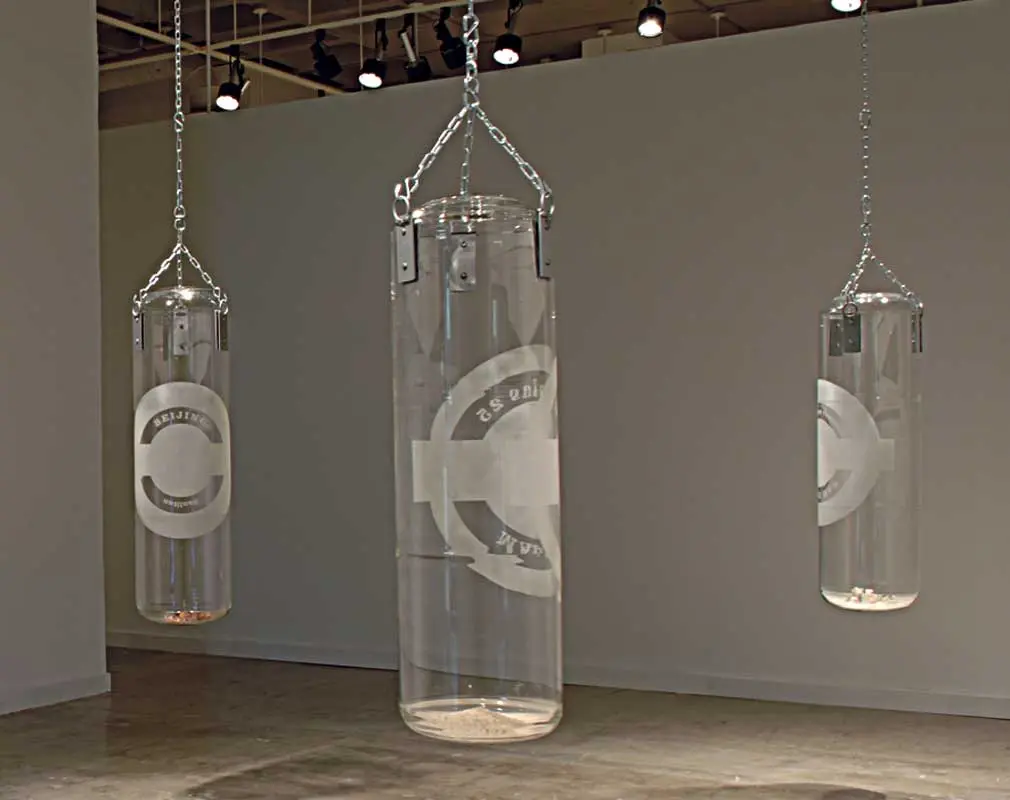
The solidity of reality is based on psychological fragilities enacted in the world. In his first solo exhibition in the US, Arrechea used this concept but applied it to many interpretations. The Dust series of 2005–2006 presented life-size, hand-blown glass punching bags, hanging from the ceiling. Each contained debris from a specific city whose name was etched on the bag. One assumed that each city held significance for the artist since memories are such faulty and fragile mechanisms. If the bags remained intact, one would never know the artist’s personal truths, and if one were to smash the glass to obtain them, the debris would scatter and join the rest of the dust of the world. What purpose would the aggression have if the consequences were the same? And what are the consequences if we live like unbroken vessels, with transparent unknowability?

The precariousness of both reality (the “as is”) and the anticipated or imagined (the “as might be”) also seems to be the central concern for the ambitious project known as Black Sun. First appearing in 2007 as a watercolor drawing, the image of a long black building with many windows and a black wrecking ball poised to strike it quickly became a C-print and then a video. And, if the infamously difficult permissions can be managed, the wrecking ball will be digitally projected onto a New York City building for one night in the summer of 2009. What consequence will it have? None, really. Unlike the project Sweat, there is no forum for the social; Buck-Morss’s “anesthetic” is no substitute for criticism.
I find this aspect of Arrechea’s work to be a problem. While my idealist self loves the concept of removing what is expected in the hope that one’s consciousness is opened to accept other possibilities, my realist self knows that the alteration of consciousness can bring reification and regression as easily as social progress. I trust more the open dialogue between the privation of the private and the chaos of the social body. I’m not saying that art should provide answers (what can?), but it should not merely offer ambivalence. It should also provide sufficient integrity of both positions: the general anesthetizing of the phantasmagoria and what Hannah Arendt offered as “specificity”—her answer (and I think Arrechea’s as well) to the helpless and hapless understanding of worldlessness as the modern (or global) condition. Specificity, which Arrechea’s work possesses in abundance, refers to the never-ending process of identity-construction, one of constant struggle and—to use Arrechea’s concept laid over Arendt’s—constant renegotiation.
Arrechea walks this line and wants to challenge it without collapsing into either the isolation of privatism or idealist notions of the social whole. I do not expect him to be fully clear nor fully defined. I do expect him to explore how such processes work and fail. To my mind, he asks the right questions and even offers the praxis of change, moving beyond the assumption that art is limited to consciousness-raising by merely asking questions. Art can (and should) embody the more visceral and psychological struggles necessary for a disjointed existence.
We can consider the problem in terms of Arrechea’s proposal for the 10th Havana Biennial, titled The Room of All, 2009, that exists as a proposal for a house shape repeated across 11 steel panel sections to be built on a ten-foot scale. According to Arrechea (personal email): “Each panel is mounted on ball bearings and they move on a threaded axis. Each day during the course of the biennial, the installation would change by manually expanding or closing its spaces to the ‘rhythm’ of the economic fluctuations of the Dow Jones Industrial shown on the Internet… The degree of freedom achieved in art is cornered when art practice is regulated under new hegemonic identities. To procure freedom implies a search for new methods of improvisation.”
Few can argue with the financial dominance of the Dow Jones, global markets, and the wreckage it has caused but ten-foot steel plates argue quite differently from the fragility of glass punching bags. From the position of a theory of social change, I ask where is the mechanism or agent for personal leverage, where is the tension in the work that embodies any possibility for individual resistance in the face of such hegemony? But at the same time, I acknowledge the new developments - rather than mere faith - in the complex relationships between self-consciousness and the social whole emerging from the last fifteen years of scientific inquiry into what has been called “the theatre of consciousness.”
NOTES
1. From the author’s e-mail correspondence with the artist, February 13 and 15, 2009.
2. See Charmaine Picard, “Cuban Artists Denied Entry to the United States,” The Art Newspaper, no. 184 (October 2007).
3. “Alexandre Arechea in Conversation with Rosa Lowinger,” in Alexandre Arechea (New York: Magnan Projects, 2007), 33.
4. See Susan Buck-Morss, “Aesthetics and Anaesthetics: Walter Benjamin’s Artwork Essay Reconsidered,” October 62 (Autumn 1992): 3–41.
5. For all of the artist’s statements on Sweat, see Alexandre Arechea (New York: Magnan Projects, 2007), 34.
6. See Adam Kirsch’s discussion of Hannah Arendt’s study of Rahel Varnhagen in “Beware of Pity: Hanna Arendt and the Power of the Impersonal,” in The New Yorker (January 12, 2009), 62–68.
*My thanks to Alexandre Arrechea for his patient and full responses to my questions and to Alberto Magnan and his staff at Magnan Projects, NYC, for their quick, concerned, and professional responses.
RICHARD LESLIE
Visiting Assistant Professor in Art History, Theory & Criticism at the State University of New York at Stony Brook and lecturer in the MFA and Visual Culture departments of the School of Visual Arts in New York City. He is a freelance critic and currently at work on his fourth book, Lawrence Alloway and the Emergence of Topical Criticism.