Ana Patricia Palacios featured her
most overtly political body of work in an exhibition titled Situations recently on view at Latin collector. This deeply moving presentation, which
included a group of fourteen gouaches and a video, dealing with the social
effects of violence in Colombia. It built on the legacy of figurative art in
Palacios’s native country and also argued for the continued relevance of
drawing as a medium through which to express critical themes of contemporary
experience.
The exhibition was sparse and minimalist, echoing Palacios’s imagery. Each drawing measured only forty-one by thirty-one centimeters and consisted for the most part of portraits of individuals set against white backgrounds. Eight of the works, from the series Minas, depicted victims of landmines: mostly girls and boys, innocent sufferers of a conflict that remains incomprehensible to most. While not directly engaging with violence, the rest of the drawings reflected themes of alienation and the absurd, familiar tropes of Palacios’s oeuvre that gained new meaning in the context of the Minas series. Whereas her previous work had frequently probed the nature of identity and the individual in a more general way, the drawings of a political nature recast these themes within a specific social context.
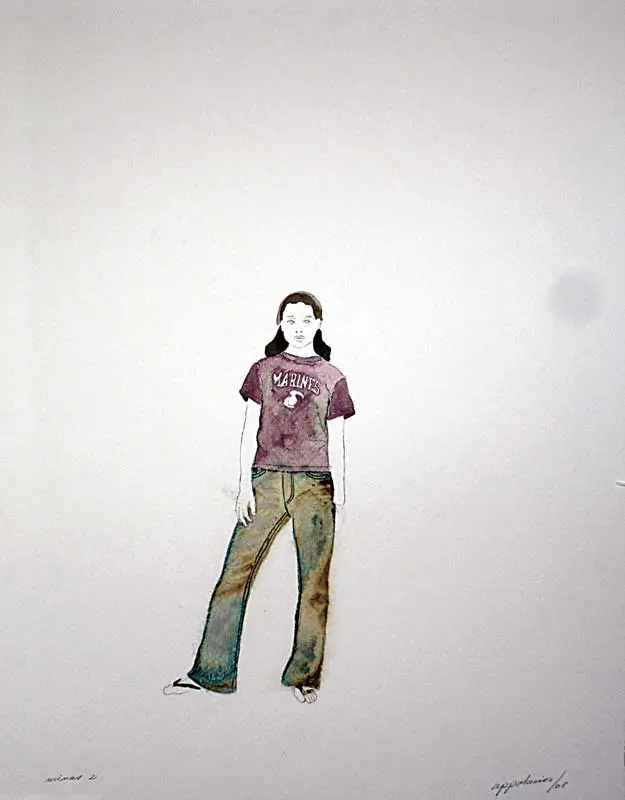
For the Minas drawings, Palacios collaborated with the organization United for Colombia. The subjects were not identified in the titles, and in some cases, their disabilities were not immediately apparent. One-piece featured a teenage boy in an informal pose, sporting jeans, flip-flops, and a V-neck shirt. With his head slightly tilted, he looked to the side and held his hand in his pocket, except that he was missing this appendage. In another drawing, a young girl stood in a relaxed contrapposto, looking directly at the viewer. She wore dirty and faded jeans—rendered by the artist’s masterful application of pigment—and a T-shirt, and her arms hung casually by her sides. Her absent hand only became obvious upon closer examination; otherwise, she was the paragon of the typical adolescent. In other images, the disability was harder to ignore, such as a picture of a boy kicking a soccer ball with a prosthetic leg. In another, a brown-haired girl leaned forward with a huge smile on her face; despite her physical limitation, the girl conveyed a sense of hope and optimism that was not typical of Palacios’s subjects. She did not invoke the viewers’ pity as much as their admiration. The drawing of the boy with the soccer ball was more expressionistic, as Palacios posed him against an amorphous white background that created an eerie atmosphere. Compounding the effect was the soccer ball: its colors bled beyond their borders. Here, the artist effectively called attention to the dichotomy between representation and reality. Such painterly passages served to remind one that this was a picture, but one remained aware that it represented a real person. Though they lacked the documentary value of photographs, Palacios’s Minas gouaches were painfully real.
Other drawings reflected absurd situations in a way that challenged the spectator to guess what was real, particularly those from the series Situations. Two of these were multi-figural compositions: in one, a group of men stood around looking at an open manhole in the street, and in the other, a group of children pushed a school bus. The viewer was left wondering whether these situations really happened, especially because they appeared to be derived from candid snapshots. In the image with the men, most of the figures looked down, absorbed by whatever might be in the hole, but one made eye contact with the spectator as if to say, “Come have a look.” The picture with the children suggested a world turned upside down, in the tradition of Pieter Brueghel’s Children’s Games. Palacios’s image may have been a metaphor for contemporary Colombia, but it was as intriguing as an Old Master painting.
It was easy to focus on the subject matter in Palacios’s gouaches because her sparse, minimalist technique tended to direct the eye toward the central image. It was worth lingering on their facture, however, because the poetry was in the details. Palacios is adept at infusing the watercolor medium with an impressive tonal range, and she creates memorable passages with a remarkable economy of means.
In addition to the gouaches, the exhibition also included a video that simultaneously depicted the lives of three aspiring female boxers in Cartagena. Filmed through a red filter, it juxtaposed the dreams of youth with the harshness of life, returning again to the artist’s exploration of the space in between representation and reality.
TATIANA FLORES