This is the first time that Espace 315,
reserved for contemporary art, presents the work of a young Latin American
artist. Damián Ortega (Mexico City, 1967) was invited by curator Christine
Macel to design an original work for this space of around two hundred square
meters. November 13th, 2008 - February 9th, 2009. Ortega belongs to that new
generation of Mexican artists who, like Gabriel Orozco or Carlos Amorales,
experiment masterfully with different languages in order to respond to the
aesthetic and sociological questions posed by a world dominated by instability
and relativity. He first grabbed the limelight with Cosmic Thing, at the 50th
Venice Biennale, in 2003, where a Volkswagen “bug”, dismantled and hanging from
the ceiling was exhibited as the ironic deconstruction of a cult object in
consumerist society.
At the entrance to the gallery, a drawing titled Tabla periódica de los elementos (2008) represents the breaking of the atom in three dimensions, announcing the installation and its intellectual and material process. At the beginning of this installation, Ortega worked on the pixels of the amplified image and drew an abstract module of the atom, moving into the construction of an object in different sizes that he had manufactured in volume in primary-color plexiglas. “I developed an interest in the global visualization of an object, all the way through its molecular structure. This project derives from the photograph of an eye, transformed and reduced to magenta, yellow, cyan, and black dots, as in a large billboard, newspaper, or magazine. I took this image from a poster I found in the streets of Buenos Aires, which I then blew up—an allegorical reference to Atonioni’s film, Blow-Up. I this way I wanted to reach the image's smallest particle, its most basic component, which is nothing but a visual snare: an optical illusion.”
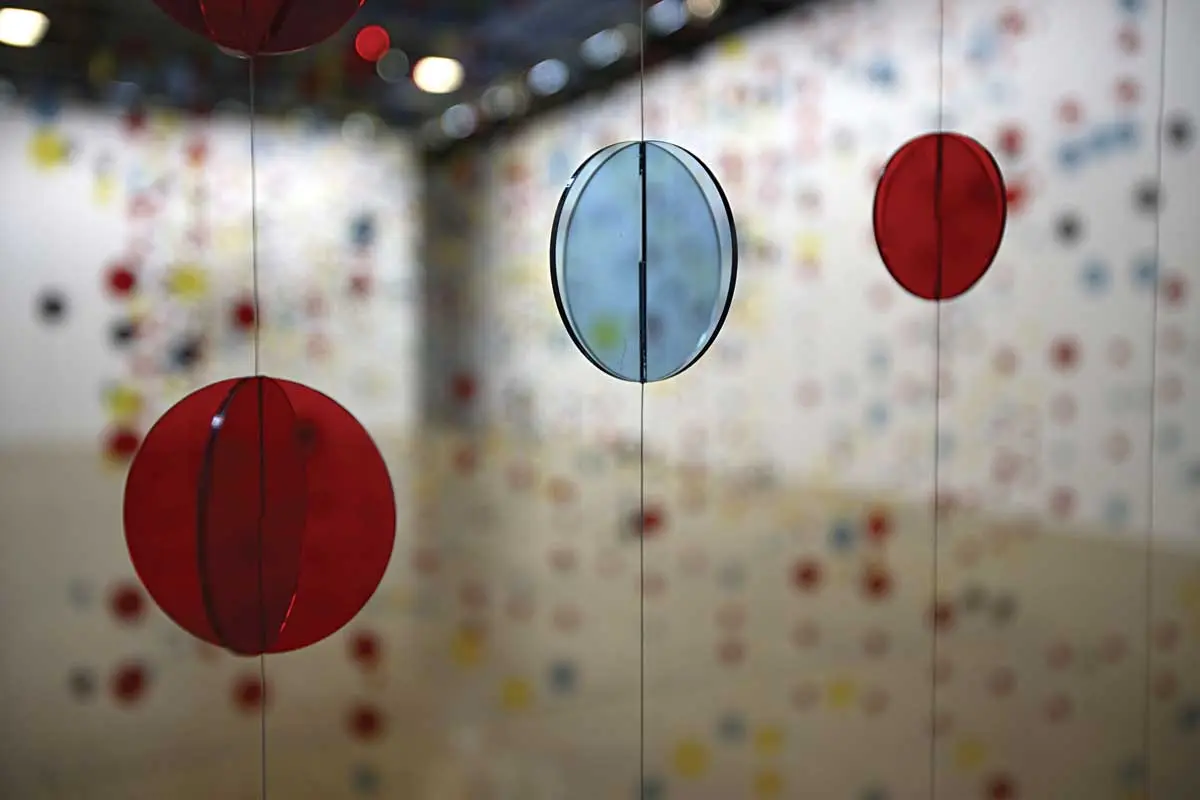
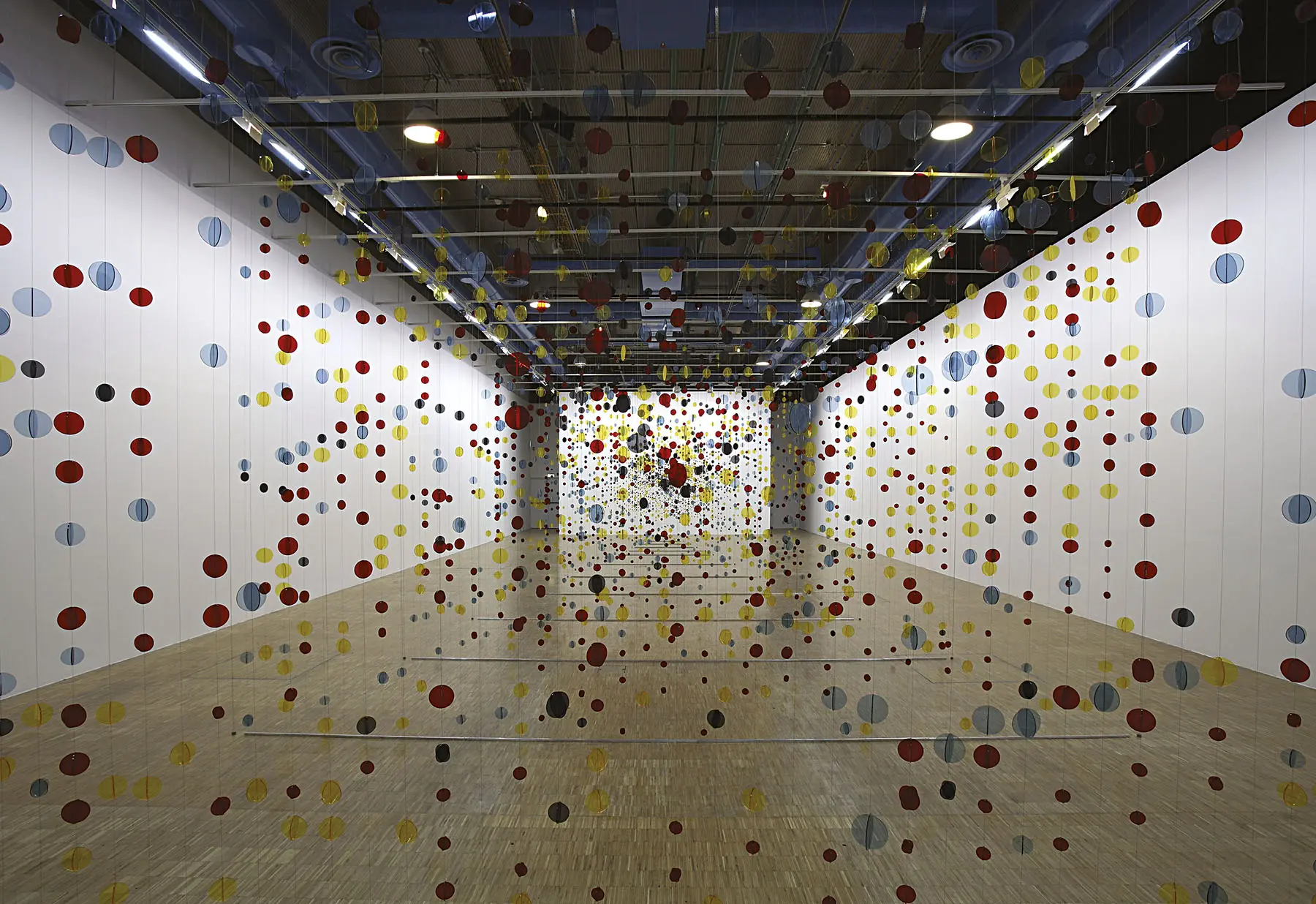
The installation Campo visual (around 25 meters long by 8 meters wide and 4.50 tall) 1 takes over the entire gallery. In this large-scale work — the meaning of which will be revealed later to the visitor — the apprehension of emptiness, caused by the transparency of the material and the lightness of the suspensions, is a spatial challenge with an emotional dimension underscored by the artist (interview with D. Ortega, video, G. Pompidou Center, 2008.) The work presents its viewers with what French critic Nicolas Bourriaud calls a “relational aesthetics.” It is, indeed, both a “penetrable” work like the ones conceived by Jesús Soto (with the primary colors that were so appreciated by kinetic art practitioners) and an interactive work similar to Julio le Parc’s sensorial environments, thanks to a mechanism specially designed for the viewer, who discovers it after having walked through the whole installation. The viewer is invited to move behind a frieze with a small perforation and a lens through which to see the installation. The viewer then discovers — as space seems to have lost its original substance — the single “image” of an eye comprised of red pixels, formed in the distance by the group of modules. “The seeing eye finds itself thus confronted with its own representation and the very process of its functioning.” With the reconstitution of an eye, illusion vs. reality, the artist brings science to bear, following recent discoveries in neuroscience that tell us that what is perceived, rather than shapes, are colors and that the line doesn’t exist. Damián Ortega took to heart the principle that colors have no reality, and challenged it with a work of art that would surely have gained the approval of Marcel Duchamp, whose observation that “it is the viewer who makes the painting” finds here its meaning fulfilled.
The flotation of works in Plexiglas, exhibited at different heights on strings that hang under the gallery, forms an almost invisible grid and forces a path among the various “strata” of suspended objects, offering multiple points of view that modify our visual and sensorial perception of the whole, as well as it's perspective. In the visitor’s movement — determined, to a degree, by the artist — the notion of the “viewer in movement” that was one of Mexican painter David Alfaro Siqueiros’ leitmotifs for his “picto-sculptures,” belongs also, perhaps, to Damián Ortega’s unconscious legacy. As one moves forward in or beside the installation, one realizes that the size of the objects/atoms shrinks, but not in a uniform manner.
The work exists and is perceived in several dimensions. Besides the playful and sensorial aspects, the prior “technical” work done by the artist, which allows for the eye to appear, confronts the physical experience (in Ortega’s words) between emptiness and fullness, between exterior and interior, between illusion and reality, between microcosm and totality. There is not only interrogation but play and references to what films or paintings created as illusions that here are equivalent to a kind of mirror effect of the mechanism’s illusory “depth”, between dissemination and rationality.
This work, then, opens up multiple ways of seeing. Inscribed on the limits of illusion, comprised of objects “filled with nothing” as Ortega says, “densified” in a “pictoriality” that connects it with a kind of technological pointillism, it exists in its materiality and its transparency, in its essence, presence, and evanescence, between appearing and disappearing. Ortega’s vision invokes the position of Man at the center of a reality whose definition is problematic and unstable. It invites visitors to experience the vulnerability of their situation in space and overcome it, inventing new modes of perception that are new strategies to test the “real”.
NOTE
1. Decrease in width of 8m to 80cm, approximately, in 12 parallel linear suspensions.
CHRISTINE FRÈROT
Art historian active as a critic, researcher and teacher.