The
virtuous mannerism characterizing Cuban artist Glexis Novoa’s drawings is in
contrast to the harsh and cold urban landscapes of his anti-totalitarian
reflections, and with the political and ideological symbolism they project. On
the other hand, the construction of the cityscapes he creates is similar to
that of the futuristic cities found in comic books and science fiction
illustrations, in the sense that Novoa’s images also represent a post-human
world. Novoa may be attempting to underscore the effect of civilization on the
landscape, on the natural world, and on life itself, as well as the dominating the stance of humanity over the environment and its architecture.
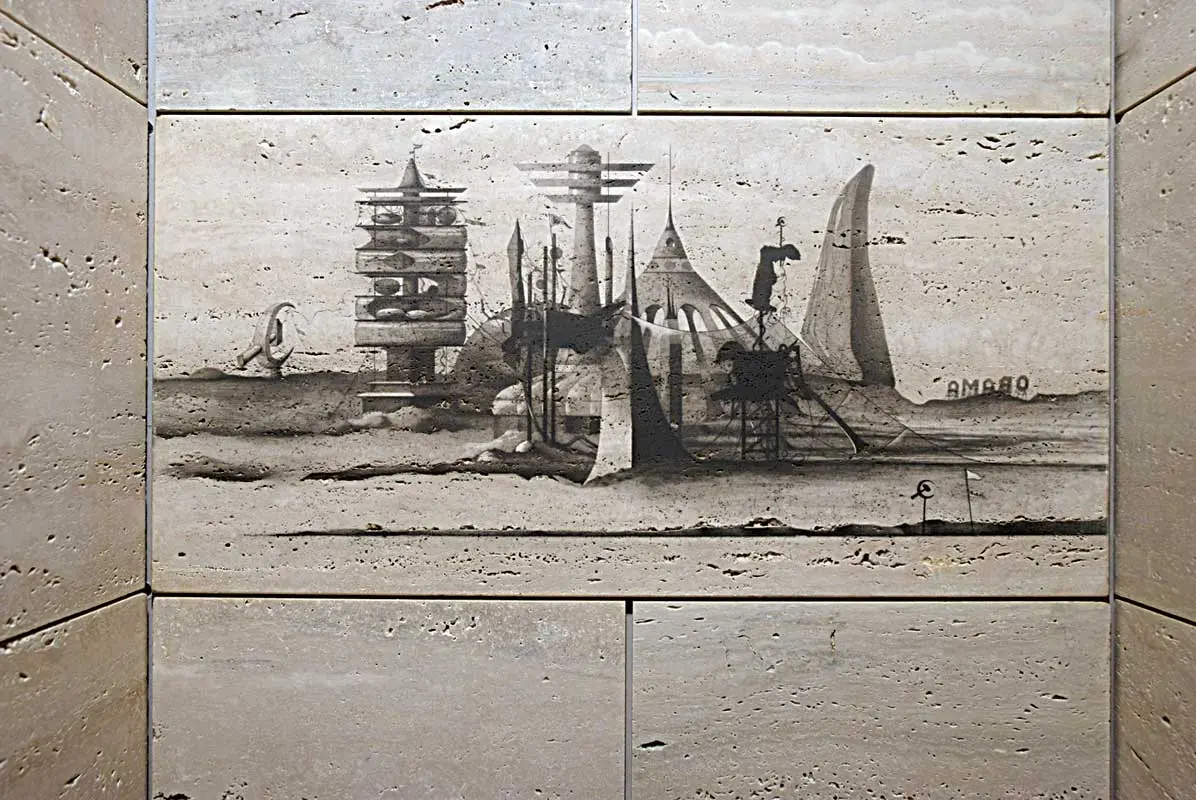
In interventions on any surface such as marble or a wall, Novoa plays at reconstituting a landscape atop that of a pre-existing one, in order to superimpose ideas, concepts, and political and historic strategies, all the while impressing the notion of supplanting the old with the new. Instead of confronting blank, virginal pieces of paper, the artist takes advantage of surfaces that already are something, as when he uses graphite on the marble: he incorporates this support, its swirls and veins, into the drawing, adding textures to the artistic design that emphasize the arid atmosphere of each piece. Novoa’s works generally speak to the idea of human displacement as a conceptual strategy, and to the power or dominion by political forces over regular citizens, through the imposition of constructions in the artistic space. The minarets and ziggurats that often appear in his cities, as well as the recognizable monuments from international architecture, have stood, throughout his artistic trajectory, for rigid representations of the political agenda in exerting power on society. These are effectively understood as provocateurs, inciters of obligatory respect, to be social, political, or religious.
The body of work by Novoa does not represent hopeful futuristic utopias; it questions, instead, an idea of the future that we all fear: that of anthropomorphous humans employing their power to self-destroy as they eschew the symbols they created to pacify their own society. Novoa’s works convey the solemnity of both futuristic and historical monuments that confront – and triumph over – the fragility of human life. Humanity’s involution and the weight of history in the artist’s work cast a shadow of doubt on the notions of evolution and progress. Architecture here stands for ideological propaganda. The city becomes an accident, or rather, the aftermath of such “accident,” as Paul Virilio suggests in The Original Accident (2007) when addressing the negative growth of both social positivism and scientific progress.
For his Old/New solo exhibit, Novoa presents new pieces in which the imagined city is no longer the central protagonist. The city becomes the background, the distant horizon in relation to the power symbols in the mid-and foreground: flags and their emblems; the Marxist-Leninist hammer and sickle; the silhouettes of politicians and their names within the context of the piece – Hugo, Obama, Fidel, etc. –, or the use of nouns such as FARC, oil towers, car insignias – the Mercedes Benz emblem or Chrysler’s eagle –; landmarks of art history, such as The Victory of Samotracia, The Venus de Milo, and the reworked image of Korda’s photograph of Ché Guevara is some examples of the many juxtaposed images that inhabit the works, along with the reiterated presence of the island of Cuba.
In these new series in which the landscape takes on a secondary role, human figures emerge in totally dark silhouettes and shadows that have no detail. Their body postures are imposing, as can be observed in the work titled Cit-hu-go (Simon Bolivar, Lenin, and Discobolous), 2008. Likewise, the use of balloons, circus flags, and tightropes and cords that are utilized by jugglers and trapeze artists are among some of the new formal elements Novoa inserts to move these figures through the air as if he were expatriating them or removing them from the history of their place. This rendition confers upon his work a certain degree of lightness. It is interesting to study the titles Novoa gives to his works. These shed light on the amalgam of critical strategies that the artist formulates, as they are critical and chaotic at the same time, for instance in the case of: Cuba, Fidel & Obama (SITE, YF-23, Kim II Sung, Samotracia, ONL & Palmera Antiimperialista), 2008 or Cit-hu-go (Simon Bolivar, Lenin and Discobolous), 2008, to name a few.
There are no accidents in Novoa’s images. His body of work has been generated through deep critical, historical, and political reflection. He is thorough in his approach not only as it pertains to the rendering of the images he creates, but also to his conceptual strategy. In burying history, Novoa leaves no doubts concerning his standing as a great analyst of our times.
AMALIA CAPUTO