I first
saw the work of Isabel de Obaldía about twelve years ago, when I was
researching contemporary Panamanian art for the exhibition Crosscurrents:
Contemporary Painting from Panama, 1968–1998 at the Americas Society in New
York in 1998. My co-curator Mónica Kupfer introduced me to many artists,
including Obaldía, whose work I had admired in exhibition catalogs. After
spending many long days in Obaldía’s studios in Panama City and in New York, I
came to understand the complexities of her aesthetic expression. For 1998
exhibition, I paid most attention to Obaldía’s paintings: large canvases whose
vigorous construction and energetic brushwork attested to her interest in
neo-expressionism but, more importantly, served as paradigms for her dedication
to the raw power of nature.
The intensity I first observed in Obaldía’s paintings was equally potent in the glass sculpture that has become her major form of expression. North American audiences have long understood glass art to be part of the canon of contemporary forms of artistic expression. Dale Chihuly is the most famous of many glasses artists from the US; his work is seen regularly in galleries and museums, such as the relatively new Museum of Glass in Tacoma, Washington. Glass artists from Latin America, however, is more of a rarity. The Mexican brothers Einar and Jamex de la Torre come to mind, but it is to Obaldía to whom we turn for the most audacious and inventive output in this medium that requires such exacting skill, physical dexterity, and visual creative power. Obaldía is a disciplined, methodical worker whose many hours of aesthetic contemplation are accompanied by hundreds more spent in the workshops of the various ateliers with which she has been identified (such as Pilchuck Glass School in Washington state and, more recently, the WheatonArts Creative Glass Center in Millville, New Jersey).
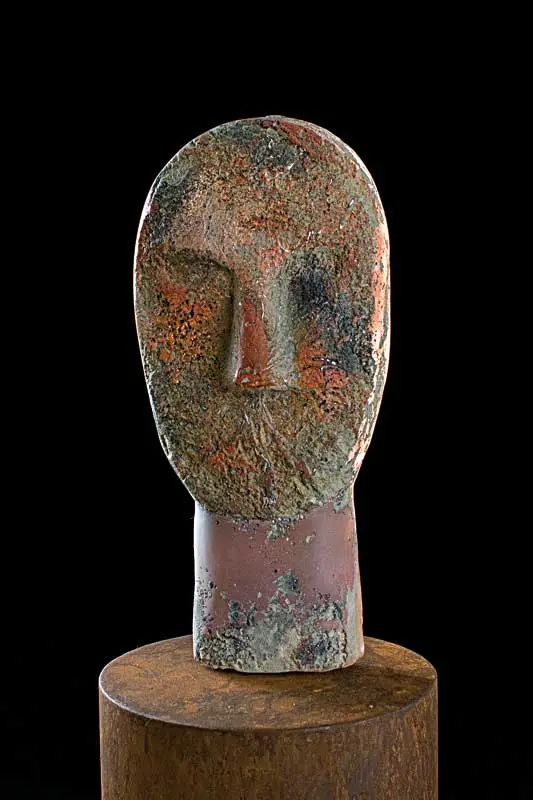
Obaldía’s recent exhibition was the fifth in a series of shows presented by Mary-Anne Martin Fine Art, New York. The show had two distinct parts, but the sensitive installation in the darkened gallery brought them together seamlessly. The first group of work was a series of heads. In each of these glass likenesses, there were reminiscences of both ancient Mediterranean sculpture and classic modernism. Epitomized by the compelling Homage to Dubuffet, these pieces spoke directly of the solemnities and enigmas of Cycladic art of about 3000 B.C.E. as of the smooth, spare surfaces and summary features of Constantin Brancusi’s heads. Yet there are always paradoxes in Obaldía’s art, and this piece was no exception. The Dubuffet functioned as a tribute to an artist much admired by the Panamanian sculptor. Dubuffet is known for the Art Brut roughness of his forms and confrontational modes of expression. In the Dubuffet and related pieces, the suavity of the general form was belied by the irregularities and even violent treatment of the surfaces. The sculptures were executed in New Jersey with Obaldía’s direct intervention and then sent to her workshop in Panama for additional elaboration. It was there that they acquired their extraordinarily emotive patinas.
The more imposing works were a series of large, totemic glass batons. Obaldía is interested in the forms of the canes or staffs used by Panama’s indigenous peoples in power-affirming ceremonies. Other aspects of pre-Hispanic art may be seen in the work but only in the most general way. I prefer to look at Obaldía’s work through a geographically or culturally neutral lens. In these pieces, as in her paintings, animals took pride of place. Golden Jaguar was a fine example of these sensual, upwardly surging forms. The tense muscles of the jaguar and the other animals in the series (monkeys, crocodiles, and sharks) were hardened by the glass medium, yet their lithe power was abundantly palpable. In the show’s excellent catalog, the essayist Susan Aberth wrote of them as “emissaries from the amoral realm of nature, their presence is fierce and confrontational, and yet... mesmerizingly beautiful.”
This splendid show testified to the need for a mid-career assessment (in the form of a museum exhibition and a solid catalog) of one of Latin America’s most distinguished creators in both two and three dimensions. Putting Obaldía in a satisfying context of international glass artists will underscore her considerable achievements.
EDWARD J. SULLIVAN