
José Gamarra (Uruguay, 1924) lives and works in Paris since 1964. He left his native country for many reasons, among their politics, and also the need to grow as a painter. In 1982, on the occasion of a large exhibition at Galería Minotauro in Caracas, founded by the recently deceased Cecilia Ayala, he said some things to the press that can still be considered valid as we analyze his work: “Perhaps the greatest interest of my paintings are the freshness they have… and that can be achieved when technical rigor allows one to work as if playing, with great spontaneity,” and that “I work with elements that emerge from a commitment to events that surround me, at different scales, especially what refers to Latin America, a continent I try to decipher. In my painting, there is always a conceptual proposition, a process of reasoning.” Indeed, the themes he has been developing for several decades have to do with historical events such as the conquest of the Americas, or with the continent in its exuberant landscape or its magical realism, which appeals with its sublime poetics.
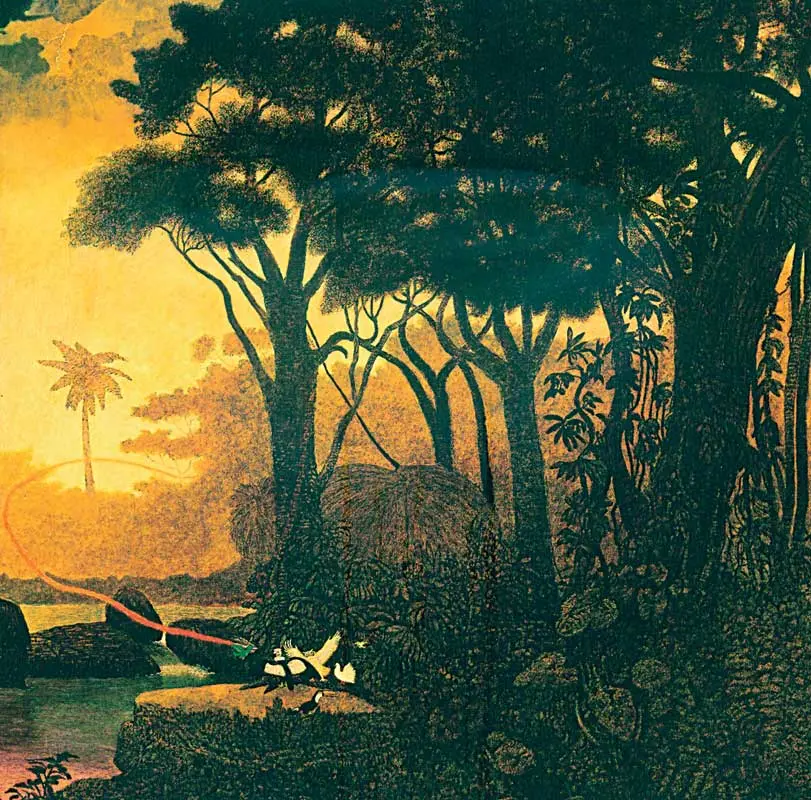
Gamarra uses a system that combines naïf and academic
elements, the former in his drawing of characters and animals and the latter in
the representation of the landscape. Extraordinarily well organized from the
formal standpoint, his paintings express nearly surrealistic situations that
connect it with the cosmogonies of indigenous people and their relationship
with their conquerors, with their rainforest environment, or with a diatribe
between present and past. It is not unusual, then, to encounter a snake, almost
extrapolated from a comic, in frank conversation with a conquistador wearing
his characteristic paraphernalia or a scene of indigenous characters submerged
in the depths of a rainforest over which flies a helicopter resembling a bird
from a distant galaxy, or a raft carrying a conquistador, or Satan, or christ,
while Superman rows. The theme is based on the subversive description of a
scene located between the past and the present, but the conceptual nature of
Gamarra’s painting, about which he spoke often and which is the most important
aspect implies transcendence from the point of view of the syntax of the
visual language it proposes and supports with rich and suggestive narrative
accents that express aesthetic values linked to the “beauty,” in quotes, of a
scene showing a “reality,” also in quotes, distorted in regard to associations
that is both vital and moral; thus, the artist presents scenes that disturb
the bucolic atmosphere of a beautiful landscape, as for example a group
including Superman, two civilian gentlemen, three soldiers, a priest, and a
conquistador that seems to pray in the middle of the forest, or an indigenous person flying with bird wings, challenging a helicopter. In his painting,
Gamarra comes across as a critic of History, he asserts that his interest is
the struggle between good and evil, something that is for viewers to elucidate
on the basis of the visual clues, Gamarra offers, the viewer ultimately
imposing his or her own judgment according to their sensibility to perceive the
Manichaean proposal presented.
Meticulous drawing, forests described with painstaking detail that resembles those painted by the traveler-artists of the Nineteenth Century, as well as characters in unexpected and somewhat arbitrary situations, themes handled by Gamarra for several years now, with increasingly insolent virtuosity, characterize the large retrospective at the Espace Julio González, located in the Art Center of the same name in the town of Arcueil, which remains, as Edouard Glissant said in 1985, “a mixture of past and present, of the organic and the industrial, of the subterranean and the aerial.” Encompassing works from private and institutional collections, the show was a compendium of the long artistic career of this man interested in topics that specifically concern Latin America. Works of different periods were seen under the light of a coherent development covering everything from drawings made at the age of eleven, to the periods when he was interested in pre-Columbian signs and symbols, to the 1980s, 1990s, and 2000s, when his large formats consolidated in the vast and gaudy Amazonian rainforests with small characters that, displaying a caustic sense of humor, represent a history, forests that, loaded with atmospheres suggestive of powerful magic, represent a “feeling” of a continent that has struggled to survive.
BÉLGICA RODRÍGUEZ