
Los Equilibristas (The Tightrope Walkers) is the title
of the exhibit by Luz Letts (Lima, 1961) held at the Lucía de la Puente
Gallery. Four years after her previous solo show, Letts confirms with this
group of medium-to-large format works the thematic keys and technical resources
that characterize her already consolidated artistic trajectory. Her figurative
proposal is based on a type of drawing that, despite this artist’s command over
the rendering of the human figure (even when creating complicated contortions),
does not yield to the temptation of incurring a redundant or dramatic truism.
Employing a mixed technique that includes the use of charcoal, acrylic, and
tempera, Luz Letts chooses to emphasize deep atmospheres and the feeling of
movement. She avoids detailing certain aspects that are frequently
conventionally conveyed. Thus, the faces of characters are barely insinuated as
they acquire anonymity that reinforces Letts’ intention of fixing the
message in universal human aspects and in their intersubjective dimension.
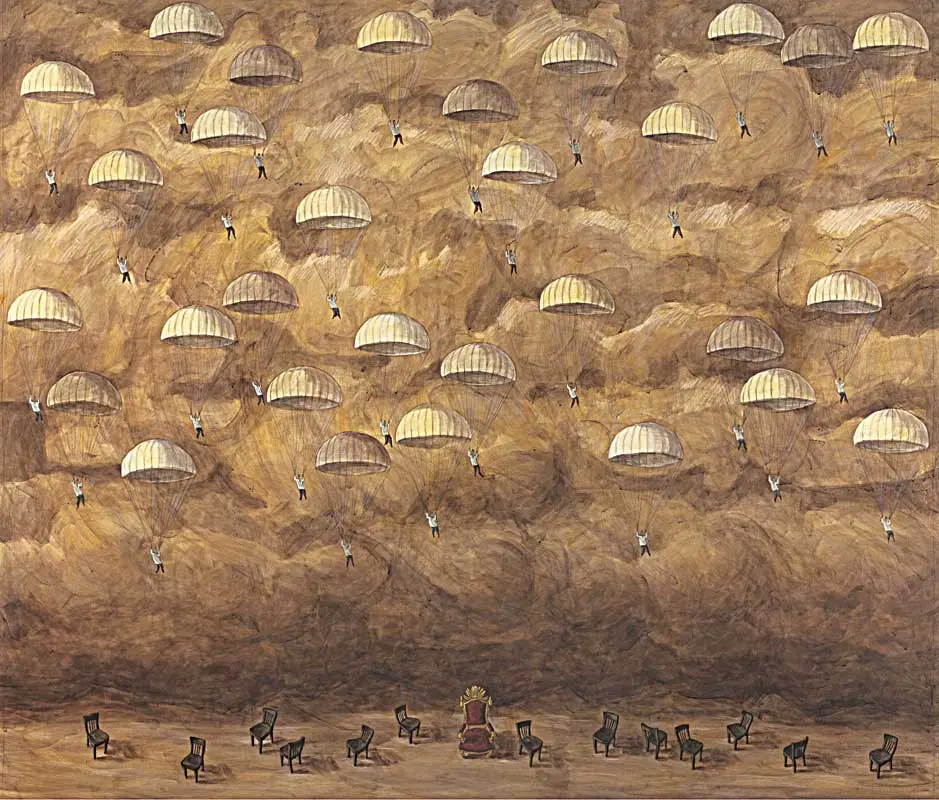
These interactions extend across the intimist and political plane. In the first instance, the men and women in Letts’ work must perform gestures and contortions in order to confront the demands imposed by desire, the expectations, and fears that arise as each of these relates to the other. These are undeniably urban individuals found in a perpetual trance to maintain equilibrium while assuming the defining precariousness of their condition. The tightrope, the shaky stools, or the swinging hammocks are the only supports for these tightrope walkers in search of security that may be impossible to attain. Despite the homogenizing forces that menace them (the inexcusable uniformity of the clothes, for instance), each character paradoxically and dignifiedly comes across as individuals. Correspondingly, the architectonic surroundings are anonymous and curiously unstable in their geometric rigorousness.
The political element is the remaining aspect that Letts addressed in her work with penetrating and ironic insight. With disregard for any literal allusions or visible ideological leanings, Luz Letts suggests a criticism of the public scene that is unstable and in need of a balancing act, as is the realm of the subjective. Power-ridden symbols, such as the couch and the presidential sash, are presented as desirable objects that in principle could satisfy all individuals who possess a talent for political scheming, or others who simply happen to encounter such tokens by chance. In El Juego de las Sillas (Musical Chairs), Letts depicts a stormy sky filled with parachutists who, upon descending to the ground, may or may not be able to wrest one of the chairs awaiting them to secure a position in the networks of power. While the hierarchy of power is evident (the person appropriating the luxurious chair will be president, and the others will have to be content with supporting him/her), the chairs´ chaotic orientation signifies the tragic nature of a republic in a permanent adolescent state, as each faces in a different direction. In La Madre Patria (The Motherland), the virgin-mountain portrayed evokes Colonial art iconography that in turn, transmits the idea of continuity from Viceregal to Republican times in terms of political shortcomings. The matron standing on one leg atop a pile of stools shelters civilian and military presidents who appear to be contemplating the secular absence of a national project passively from their comfortable chairs.
The paintings by Luz Letts capture a snapshot of movement in which its trembling characters find themselves, willingly or not. The discrete use of color (a range of greys or sepia with decisive highlight accents) reinforces an equidistant sensation that characterizes the position of this artist-observer in relation to the themes into which she delves. We observers have been invited (or seduced) to assume a complicit attitude toward this humorously charged reflective and critical gaze. Finally, Letts converts the spectator into a voyeur incited to fascination before the dense sentimental plot performed by the characters, who become our own reflections looking back at us. Likewise, Letts invites us to contemplate the political reality framing our lives as she resorts to a detached combination of irony and resignation toward the reality of a game in which we would not be able or wish to participate. Thus, the always precarious and the contingent balancing act can coexist or alternate with the two states of mind we are asked to assume as complementary: on the one hand, an awareness of a transcendent dimension that exists in our individual or collective everyday lives, and, on the other, humor-as-lifesaver (or even a heterodox path to knowledge) in the midst of the unstable surroundings in which we all will be required to test our ability to survive as skilled acrobats.
LUIS AGUSTI