Fire, gouges, paintbrushes, ink,
paper, electric saws, oil, monoprints, wire, gunpowder, rocks, iron railroad
spikes, hammered iron sheets, wood . . . one could endlessly list the materials
used by Marysole Worner Baz. A draftswoman, painter, engraver, performance
artist, and sculptor, the self-taught experimenter arrived at woodcarving
mid-career and makes her material speak in a variety of ways. Materia viva was the title of Worner Baz’s show at the Treasury and Public Credit Museum in
the former Archbishop’s Palace in Mexico City’s historic center. A general view
from the gallery’s threshold presented viewers with an installation of books on
a single, monumental base that measured ten meters long. One could identify
miniature books, small books, medium-size books, huge books, books on top of
books, perilously balanced books, books crushed against books, and books packed
up, loose, or organized on a small portable shelf created by the artist. There
were a few interfering items that weren’t books in the installation, such as a
papyrus roll carved in ash wood and blackened by fire and a bunch of newspapers
made of jacaranda wood.
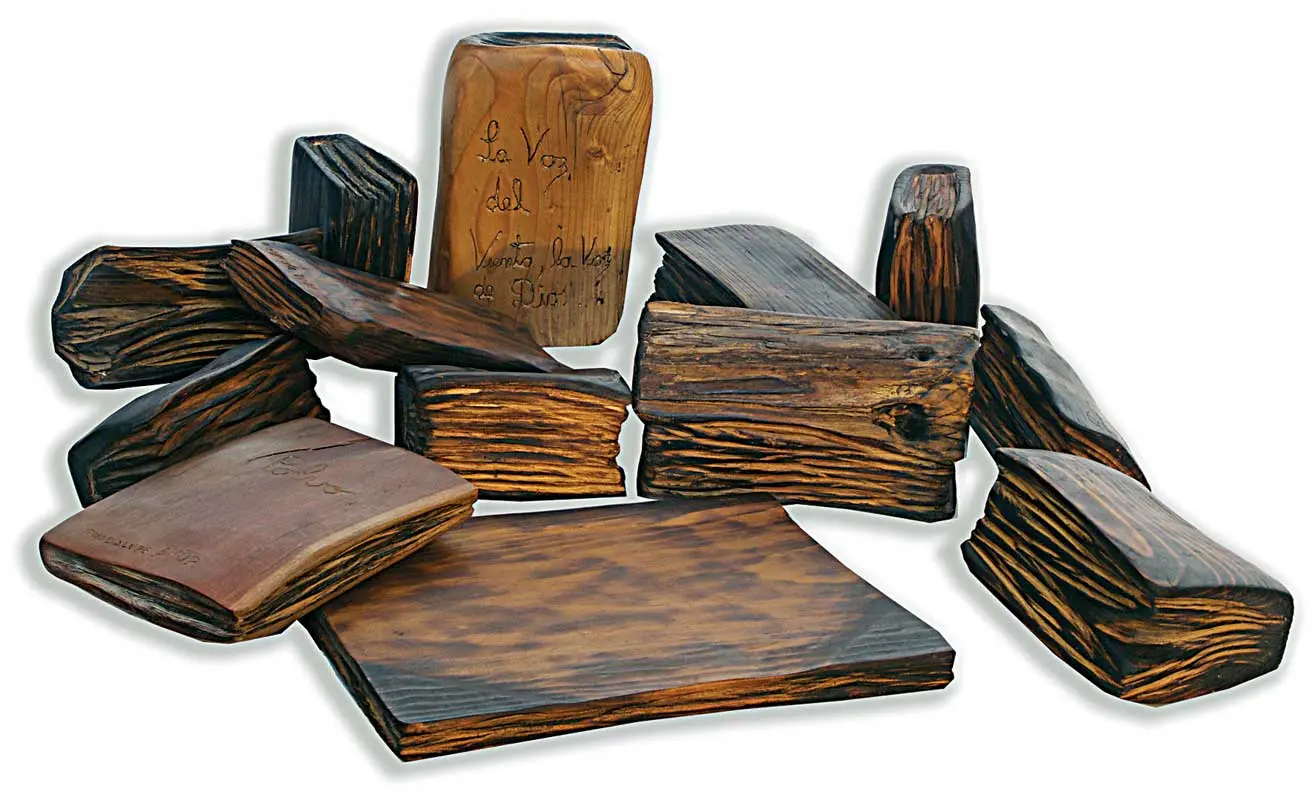
“Art is my skin and my executioner,” the artist says. “Wood thrills me, speaks to me, and is one of the materials that can be enjoyed and shared the most.” That is why there was one prescription: that people needed to be able to touch the books. Supervised by the museum’s personnel, the public touched and caressed the countless spines, pages, and soft corners of pages that incited them to evoke readings they had made. In a handful of the items, Worner Baz wrote a word, a title, or a reference to a circumstance. This highly volumetric book, with an outsize spine and worn-out pages, was a deformed form, one that was difficult to move. It was as heavy as the social load it carried: its cover emerged from the irreversible evil of violent deaths in unsolved cases. In the exhibition’s inventory, it was listed as El archivo de las muertas de Juárez, a topic known to its viewers from the news media.
Marysole Worner Baz carries an illustrious surname in the Mexican visual arts. Her uncles have been widely recognized. Worner Baz was a whiz kid and suffered under that weight, expressing it through several interruptions in her creative life, out of which she always emerged with renewed energy. She always possessed the courage to develop experimental works.
People often know Worner Baz’s work only partially. There are collectors of her drawing-focused, figurative, and almost tragic paintings in somber brown hues. And there are those who know her abstract, lively, gestural, and chromatic paintings and prints. These two bodies of work are linked by her semi-figurative paintings of landscapes, clotheslines, and maguey plants. In her sculpture, Everything moves; the articulated works, at once massive and light, are also ideal urban projects. Sculpture and drawing are intimately connected forms for certain artists; for Worner Baz, this is a fact. In works of wire, with nails, and in wood, the artist makes the material evident while the structures and contours are varied and personal. To a degree, this also occurs with her sculptures of books. The books prompt one to touch; their shapes incite the hand to caress them.
Soon after Materia viva, Worner Baz’s works were featured in two simultaneous exhibitions. Rafael Pérez y Pérez’s fittingly curated Encuentros—a selection of the same books and two new, massive groups—at the Lerdo de Tejada Library, in greater Mexico City. And some of those “characters of letters that are not written, but alluded to” traveled to Ruiz-Healy Art, in Texas.
Ebony, calabur, ash, pine, and jacaranda are some of the various woods used by Worner Baz. She refuses to destroy trees in order to carve her sculptures. Rather, she collects abandoned logs, investigates the reasons for such situations, and identifies her work with the protection of the landscape and its inhabitants. Materia viva presented a captivating enchantment of book forms whose tightly coiled secrets could be intuited between still, tactile pages.
GRACIELA KARTOFEL