
After a highly praised career in
the field of printmaking, Matilde Marín (Buenos Aires, 1948) devoted herself
almost exclusively to photography and video. Starting in the late 1990s, this
shift in technique allowed for a less abstract recording of the world,
different from series such as Incisiones (1993) and Fragmentos (1995). Direct testimony of
“reality” became dominant then, bringing into focus critical situations. In
this way, the shift in technique deepened the mimesis and made it evident that the
artist's commitment is not only aesthetic but also ethical.
Perhaps it was her continuous traveling abroad, especially to Latin America, that caused Marín’s work to be little known in her own country. Thus the interest generated around the presentation of different periods of her oeuvre in recent years (2002-2008) at the Centro Cultural Recoleta’s Cronopios gallery, as a highlighted section of the Festival of Light. Under the title De Natura (Zona alterada), the exhibition comprised videos and photographs, the latter divided into two large groups: studio works (photo performances and intervened photographs) and outdoor works (natural and urban landscapes).
The passage from the rather artisanal technique of printmaking to a high-tech one, at least in terms of the digital processing of images, gained unexpected momentum in 1998. At a time when the artist was planning the execution of a series of works connected to the ancestral “hand game” or “thread game,” she found herself having to undergo surgery in one of her hands; as therapy, she was advised to engage in, precisely, that game. The mixed techniques associated with printmaking no longer offered her a solution, so she accepted photography as her medium, and the results were exactly what she was looking for. “The transit from one technique to another,” she says, “happened without crisis, with very fast results that marked a noticeable difference between photography and printmaking, which is interesting but slow.”
Ecological Conscience
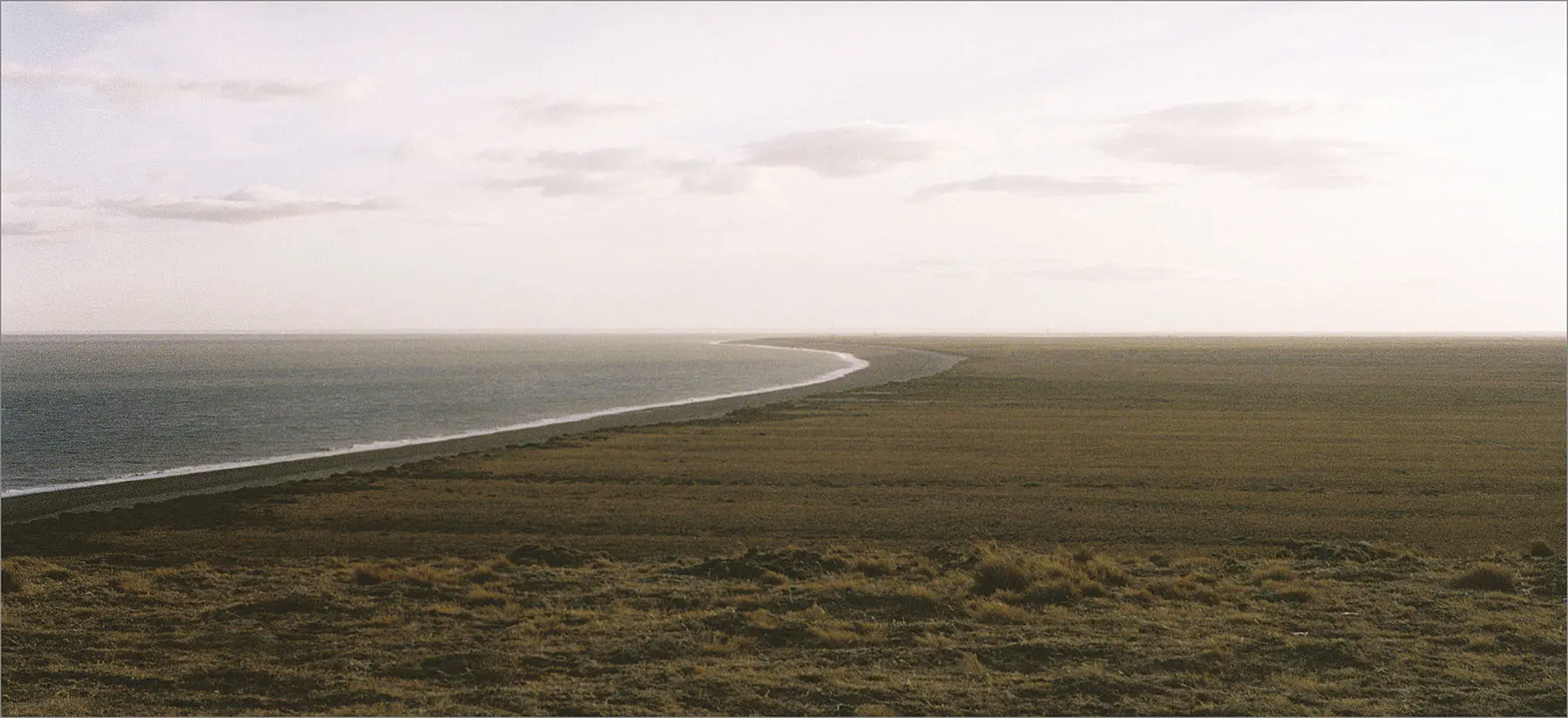
Marín the traveler had more than one opportunity to observe the landscapes of Latin America. She was confronted with the beauty and the sublimity of its peaceful skies, its impenetrable forests, its turbulent rivers, the silence of its deserts (as in Atacama). The series Itinerario, which won First Prize at the Cuenca Biennial, in Ecuador, in 2001, was created in different Latin American locales, as she projected her shadow on the ground and then photographed it
Although not always explicitly reflected, adventure has been her faithful companion in her travels, also marked by the risk involved in some of her shots, like those panoramic views that imply a high degree of intrepidness.
Her landscapes are dominated not by the order of description, but by the order of the narrative. Behind each image is a story, a tale about the drama of nature. It tells not only of its unsurpassable beauty, but also of its helplessness, the carelessness and manipulation to which it is subjected.
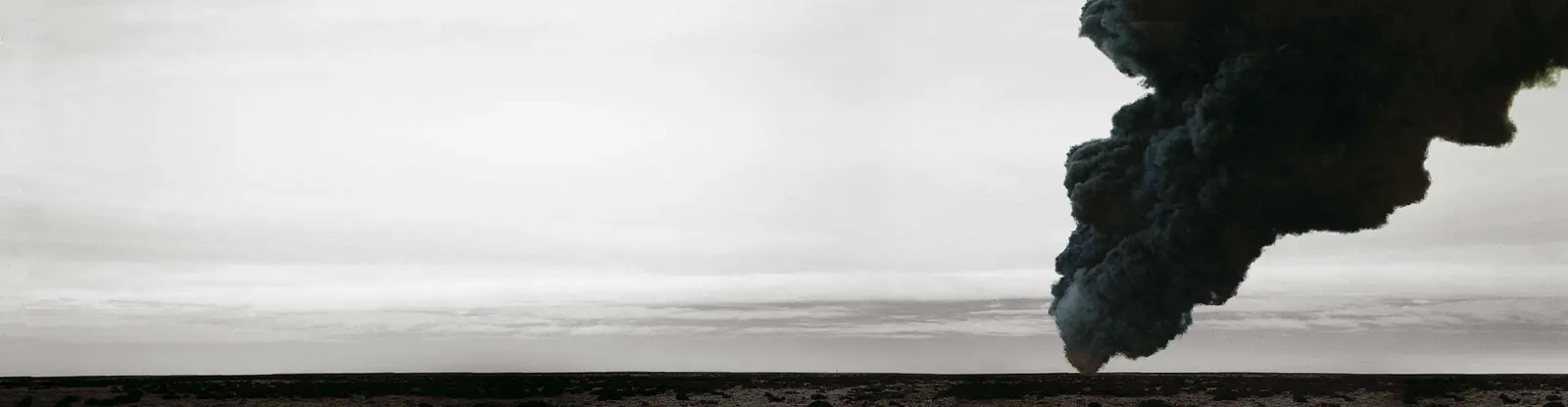
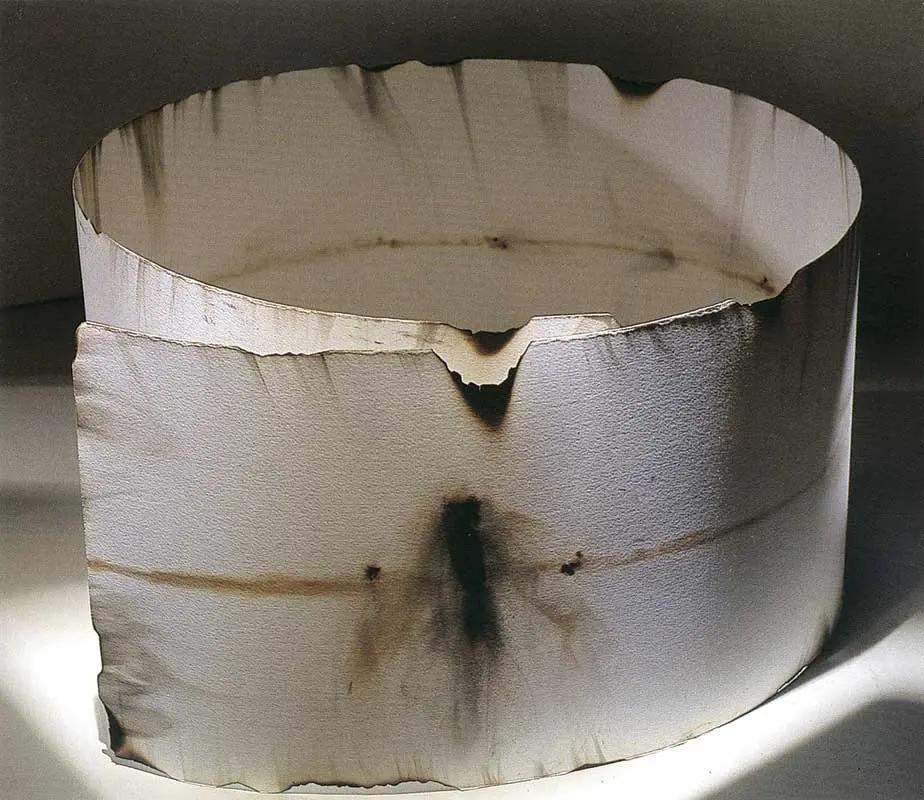
Beyond the beauty and sublimity invested in it, nature is defined in Marín’s work as an “altered zone,” a place of catastrophes (floods, fires, pollution.) Its symbol is smoke, already present in the previous series as the trace of fire on the paper’s white surface. We see this in her prints La señal (1996) and La tierra prometida (1996).
A dual drama unfolds in Marín’s protest works: the drama of nature and, in parallel, the drama of humans incapable of driving their abilities in a positive direction.
Contradicting the specific goals of liberty and happiness asserted by the Enlightenment, contemporary instrumental reason” is synonymous with destruction. It is not by chance that Marín feels, as an artist, the responsibility of offering direct testimony (in photographs or video) of reason’s “counterfinality.” She is guided by her ecological consciousness and her concern for the phenomenon of social marginality.
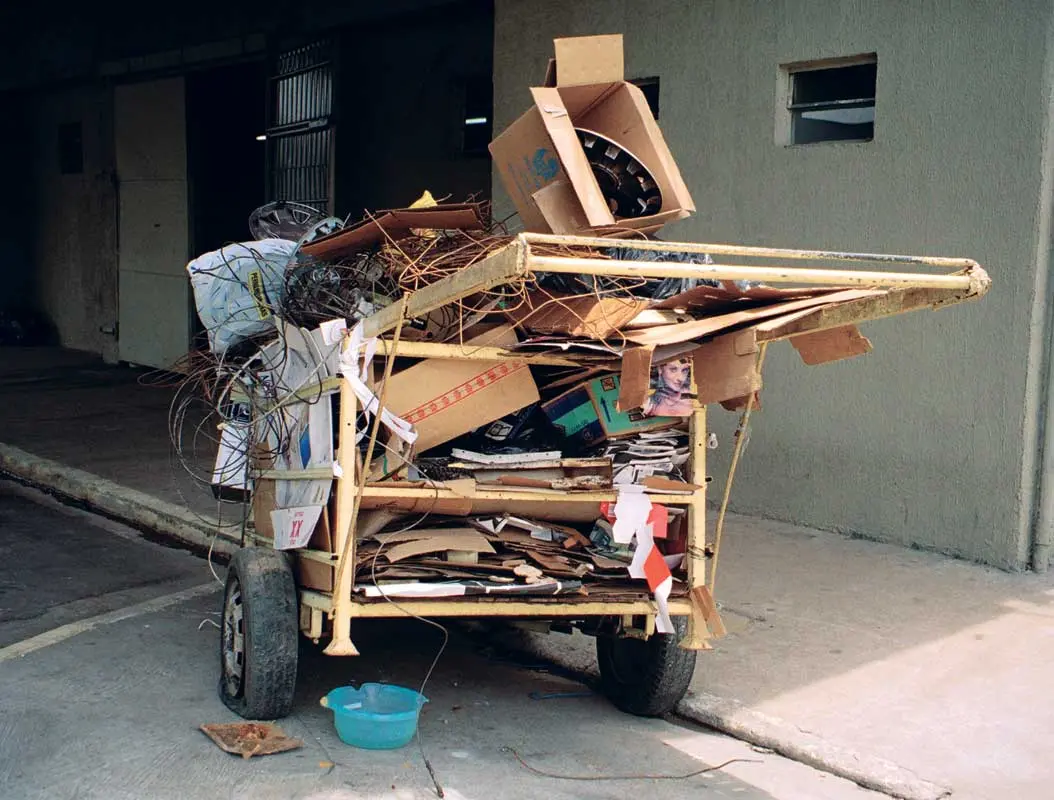
In the context of her work, unprotected nature could be seen as a metaphor for the catastrophic situation of vast segments of society that struggle mightily on a daily basis to cover their most basic needs. Such is the case of the cartoneros, people who eke out a living by recycling what others consider garbage. A product of the deep economic crisis that afflicted countries like Argentina at the dawn of the new century, these gatherers-users of garbage are able, based on necessity and thanks to their creativity, to transform it into a means of subsistence. Their daily presence in the streets of big cities like Buenos Aires changes the “urban landscape,” even if we don’t always want to see them. Indifference excludes them from the visual field; Marín feels the urgency to place them at the center of the scene. They are the protagonists of her photo series La necesidad.
Different types of cartonero carts — recorded in thirty-five photographs were taken between 2002 and 2005 in Bogotá, Paramaribo (Suriname), Santiago de Chile, Buenos Aires, São Paulo, Quito, Medellín, New York, and Barcelona — are a kind of “anthropological” work that allows for the recognition of different cultures through the spontaneous and creative way in which discarded materials are organized.
A trace of hope
Along with La recolección and La ilusión, La necesidad is included in the series Bricolage contemporáneo, started in 2001 and motivated by the social crisis in Argentina towards the end of that year.
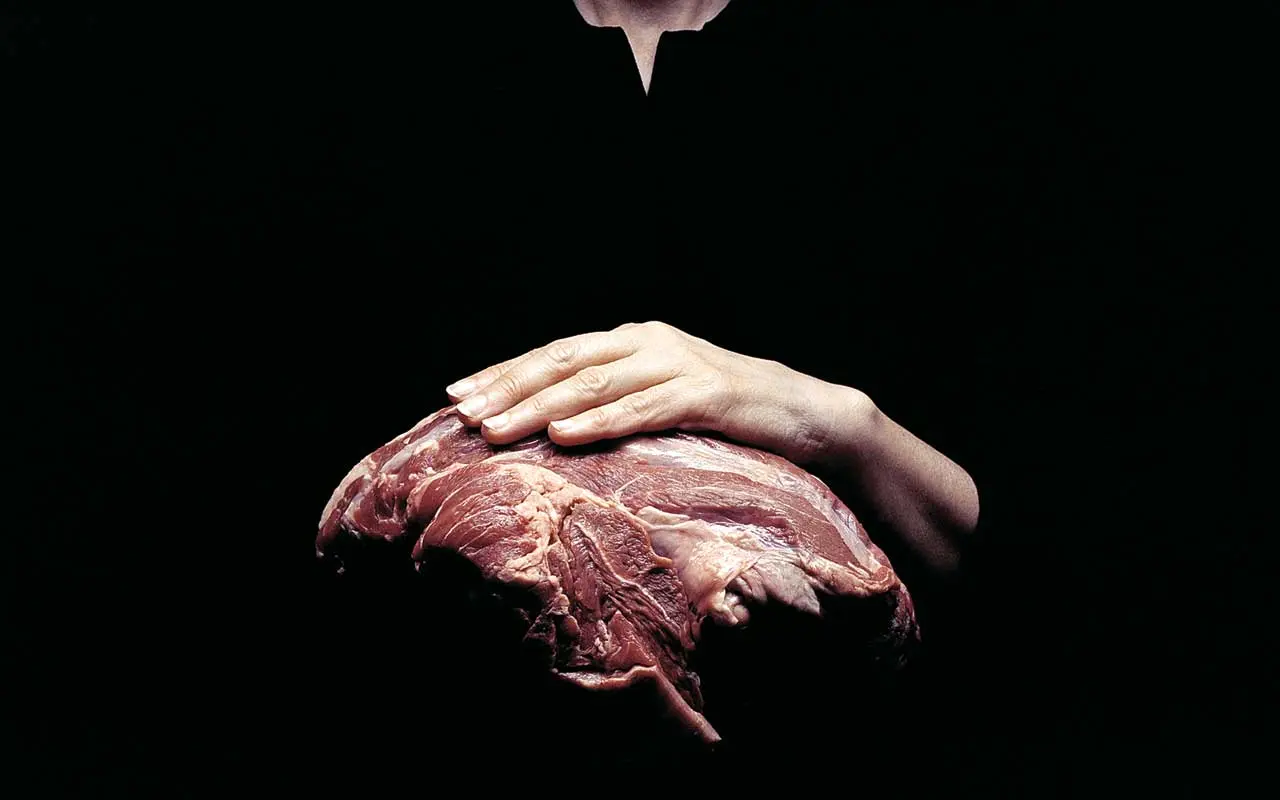
Confronted with consumerist excess and identified with those who struggle to survive with the bare minimum, in her photo performance series La recolección Marín uses simple materials and basic foodstuffs (bread, fish, beef). She holds them lovingly in her arms, inaugurating an unusual auratic ceremony of valorization of the elemental. A careful interplay of lights contributes to the “glorification” of the motif.
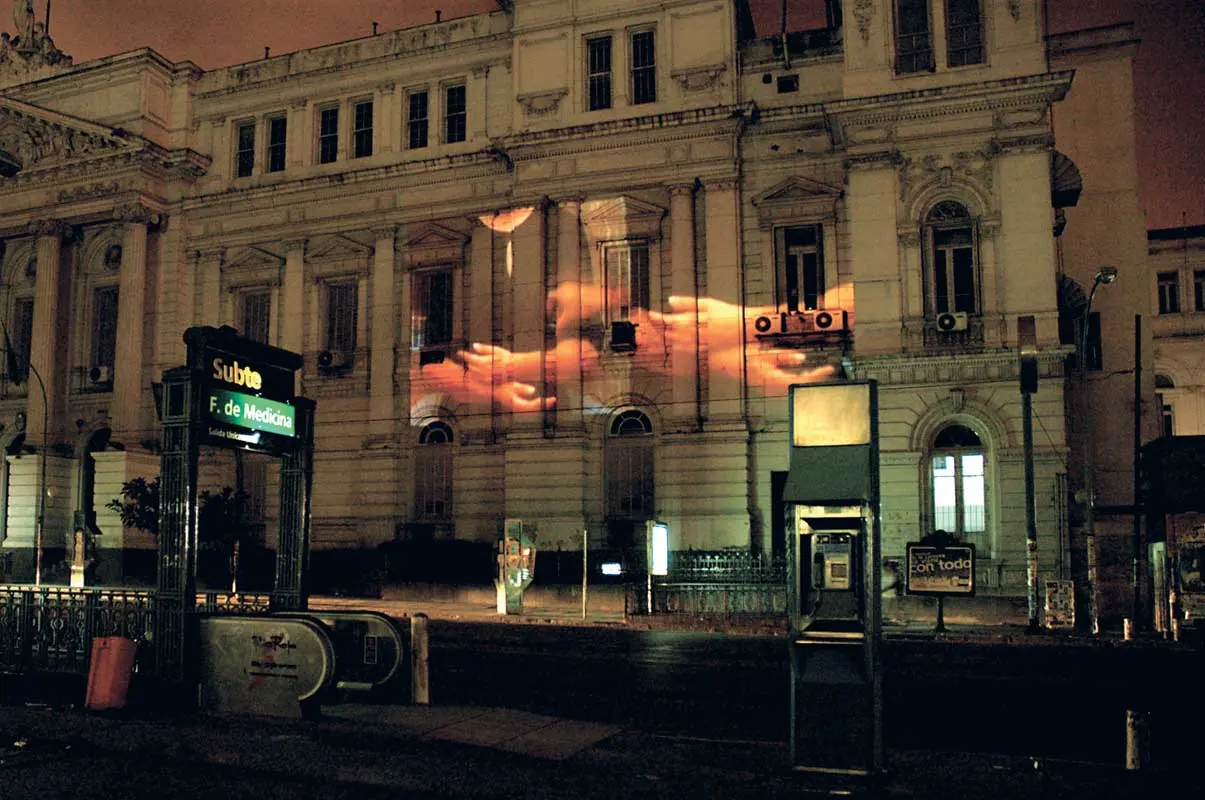
This is not the first time that Marín involves her own body. She had done so in the previous series like Juego de manos and also in Itinerarios, when she photographed her shadow on different Latin American soils.
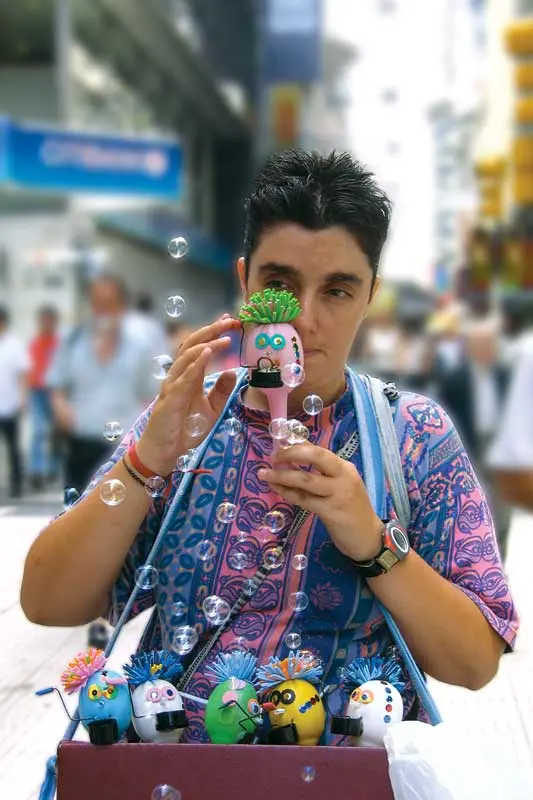
Despite the counter-utopian vision that shades the artist’s recent work, there is also a discreet element of hopefulness. We see it in the video-performance El día de Karina (La ilusión), devoted to a young woman who cruises the streets of Buenos Aires selling dolls she makes herself. She is one among the many Argentineans who attempt to survive in the midst of the economic crisis. Marín sees in her dolls a symbol of hope: they are used to blow soap bubbles that rise through the air and, ephemeral, vanish.
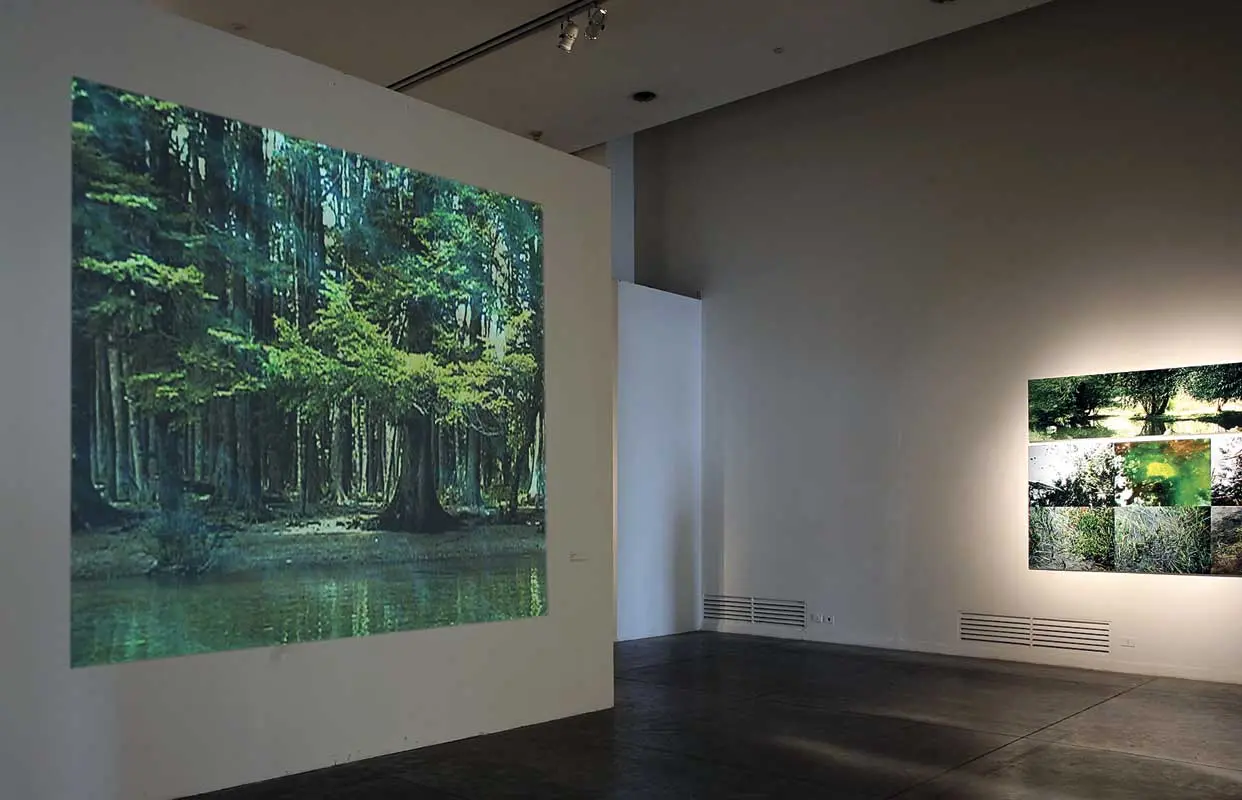
Not only hope is possible. So is beauty. Beauty is, undoubtedly, the dominant feature in her videos Río Frío (2008) and No demasiado lejos (2005). In different registers, beauty is also present in Marín’s latest photographic series. In some cases it is colder, as in Turbulencia I (2008), a suite of 9 analog photographs. In others, it acquires a more poetic tone that can turn dramatic, as in the photo performance Cuidado natural (2003), where the delicateness of the hand is contraposed to the pitilessness of a piece of raw meat. There is also beauty in the cartonero carts, the product of spontaneous natural creativity.
The Experience of Borders
(The Boundary and the Lighthouse)
E.O. Part of your work arises from a “border” experience, for example, the experience of the “end of the world”, you captured in your project Atmósfera, with the participation of critics, researchers and artists from many places. What did that experience, which altered the traditional context for the circulation of the work of art, mean for you?
M.M. I was always interested in working in low-traffic areas and the Atmósferas project was an example of that, an encounter of many art people in the Strait of Magellan, that magical point where the Atlantic and Pacific oceans come together. There you have the very clear feeling of being at the edge of the world. And the place was ideal, in its isolation, for reflection and the exchange of ideas. I think that leaving the center and going to the outlying areas — which in turn can become a center themselves — gives meaning to what I do. Art must recover its ability to ask about itself, and perhaps leaving the spaces traditionally reserved for it is a way to ask questions.
E.O. The idea of the boundary and the image of the lighthouse seems connected in your work. Is this the case?
M.M. Yes. As a matter of fact, I am now working on an ambitious project that I name Pharus, which involves a selection of lighthouses from different far-away points on the planet. I am interested in those that, for any reason, is emblematic, like Australia’s first lighthouse, which has a special history because the prisoner that designed it won his freedom that way. I am also planning to include the lighthouse Victor Hugo frequented and the one in Costa de la Muerte, in Spain. This might very well be my life project: I am working on it.
E.O. But it is not the first time you introduce the image of the lighthouse…
M.M. No, it also appears in Sueño sobre el paisaje, a photograph from the series Paisajes alterados (2008). I also filmed inside the Cabo Vírgenes lighthouse, located at the southernmost point of continental Argentina, in the Strait of Magellan. The film ended in the video No demasiado lejos (2005).
E.O. What is the value you assign the image of the lighthouse?
M.M. I am especially interested in its metaphoric value. In Latin, Pharus means “light that guides men.” In this time rife with contradictions, the notion that there might be a light guiding man seems unbelievable.
E.O. What seems interesting to me is that in your video No demasiado lejos the lighthouse is seen from inside as if what guides us is not the object that carries the light outside but the “inner light.”
M.M. In a way, it is like the consciousness of the artist that sees the world from a personal perspective and helps others acquire lucidity. From inside the lighthouse, you see the outside more clearly as if you were seeing the beauty of an infinite sky for the first time.
E.O. That work also posits a tension between inside and outside, between being guided and being our own guide, between what is far (the light that guides) and what is near (the light of our own conscience.)
M.M. Yes, there is a pointed tension, and the inclusion of Victoria de los Ángeles’ beautiful song No demasiado lejos contributes to exacerbate it. The music comes to the observer as a celebration, allowing the mind to become a clean slate in order to see and then reflect. In a sense, with this work, I move away from narrative and emphasize my interest in human consciousness. The image occupies space, and it doesn’t. I believe this video is, above all, a sensorial experience.
The Experience of Beauty
E.O. Your work shows, eloquently, that the experience of beauty hasn’t vanished from the art field. What changes, in relation to the past, is an inflection of greater distance, underscoring the fact that the work situates us in an optimal vantage point. This is seen, for example, in Río Frío. How did the idea for this video emerge?
M.M. I filmed in the Rivadavia River, in Chubut province. I had been there before and took photographs. It seemed extraordinary for a river like that to exist today, practically untouched even though it has been known for a long time, since the earliest discovery of Southern Patagonia. Now the river is black because of ash fallout from the Chaitén, a volcano in southern Chile that erupted recently, with disastrous consequences. But when I made the video, it was untouched, so this work is a tribute to preserved nature. Almost the last tribute.
E.O. The experience of beauty, dominant in your work, is expressed with different modulations and associations. If Río Frío alludes to the beauty of the past, free from any kind of contamination, La ilusión takes us to the future, to youths who like Karina, the protagonist, survive on the strength of hard work and creativity and point towards a better, more beautiful world.
M.M. In the midst of the crisis in 2001 I found in the streets a peddler, Karina, who was offering little dolls to blow soap bubbles. When I saw her, so calm, blowing her bubbles in the middle of such chaos, I felt that not everything was lost, that there was a chance. That’s how La ilusión was born, as a metaphor for a hopeful future.
E.O. Compared with what you articulated in La necesidad, the figure of Karina is concrete proof of hope. She is someone who survives thanks to her good use of will and imagination. With the bare minimum, she invents new ways of life; she recycles what has been discarded and recuperates a sense of wonder, and plays through her soap bubbles.
M.M. Yes, in a sense it is a gamble in favor of life. When I encountered her and her soap bubbles in 2002, in the midst of the great political and economic crisis in Argentina, I felt that creativity and imagination could contribute to changing the meaning of certain moments.
In Praise of Work
Although built around different images and themes, both La necesidad and La ilusión praise work. And Marín knows about such things, being a tireless worker herself. To her talent as an artist, she adds an innate proclivity for research and experimentation that allows her to achieve the best results. These features can be appreciated in the continuity of her artistic production and in vast educational projects she has developed alongside it, as a visiting professor in universities in Argentina, Santiago de Chile, Colombia, Brazil, Puerto Rico, and Barcelona, among others.
It is not by chance that Marín started receiving important distinctions and accolades from early on in her career, and that she has continued to receive them since. The International Graphic Arts Prize she won in Ireland in 1985 was followed, in 1988, by her First Prize at the Latin American Biennial in Puerto Rico. Later, in 2001, she won First Prize at the Cuenca Biennial in Puerto Rico, and more recently, in 2008, the Chilean Critics Association’s award to the best individual show in the country. She has also won many awards in her own countries, such as the Konex Platinum Award and the Video Award given by the Association of Argentine Art Critics (2002.) To which we must add her incorporation, in 2008, into Argentina’s National Fine Arts Academy.
But such awards and distinctions did not drive Marín to rest on her well-deserved laurels. Each achievement was a challenge to strive for new goals, to open her work to new questions. In her printmaking period, she explored colors, used fine Japanese papers or papers she made, experimented with metals like aluminum, copper, and zinc; she used planes and three dimensions, published “artist’s books,” and now adds photography and video to her heterogeneous arsenal of creative possibilities. Everything indicates that, as usual, Marín will go for more.
ELENA OLIVERAS
Aesthetics Professor at the University of Buenos Aires and the University of Salvador. She is a member of the Argentinean and International Association of Art Critics.