
The Central
American Isthmus Visual Arts Biennial completed its circuit with Honduras
event of 2008, closing a trajectory of more than a decade that took it to each
one of the six participating countries. In a region where economic support has
always been unstable, the existence of an event that regularly shows the work
of a representative group of contemporary artists —who are, moreover, invited
to the inaugural week, thus promoting a rare exchange in the area— is something
to be admired.
Honduras was the last country in the region to develop its national biennial. Tegucigalpa hasn’t had contemporary art institutions, save for Mujeres en las artes (MUA,) founded in 1995, which is in charge of the Honduras Biennial and, in this case, the Central America one. The small but dynamic MUA group —Bayardo Blandino, América Mejía, and Verónica Romero— organizes an impressive program that includes exhibitions, conferences, and workshops, generally free to the public. For this sixth biennial, in an initiative launched by MUA, the international panel of jurors was comprised of Félix Ángel, director of the IDB Cultural Center in Washington; Rodolfo Kronfle, an independent curator from Ecuador; and Julián Zugazagoitía, director of the Museo del Barrio, in New York City.
The Central American biennial does not employ a general curator, and the 72 works by 36 artists (six for each country) are selected in different ways; this makes it inevitable for the exhibition to have a certain medley-like flavor, and a fluctuating level of quality. If to these variables we add the differences in the available exhibition spaces, it is not surprising that each regional event has its own personality. In Tegucigalpa, the biennial was installed in the National Identity Museum (MIN), a recently created institution (with a name that lends itself to rich debate) housed in an imposing late-Nineteenth Century building. Yet, the spaces assigned for the show at the MIN produced a confusing itinerary. On the ground floor, the exhibition occupied two patios, as well as galleries at different ends of the building where the geometric patterns on the floor battled the works on exhibit for visual attention. The show continued in three galleries in the upper floor that were better renovated, but distant from each other and subdivided.
Despite the difficulties, the exhibition at the sixth Central American biennial offered a valuable artistic experience. As a general impression, it was clear that the region’s artists continue to explore the contemporary in a variety of languages, that there are promising new figures, and that some of the best-known names have been able to refresh their work. In general, each space revealed an effort to achieve a coherent museography, especially in terms of the themes of the work. Regrettably, in some cases it was necessary to separate two works by the same artist, which would have functioned better together.
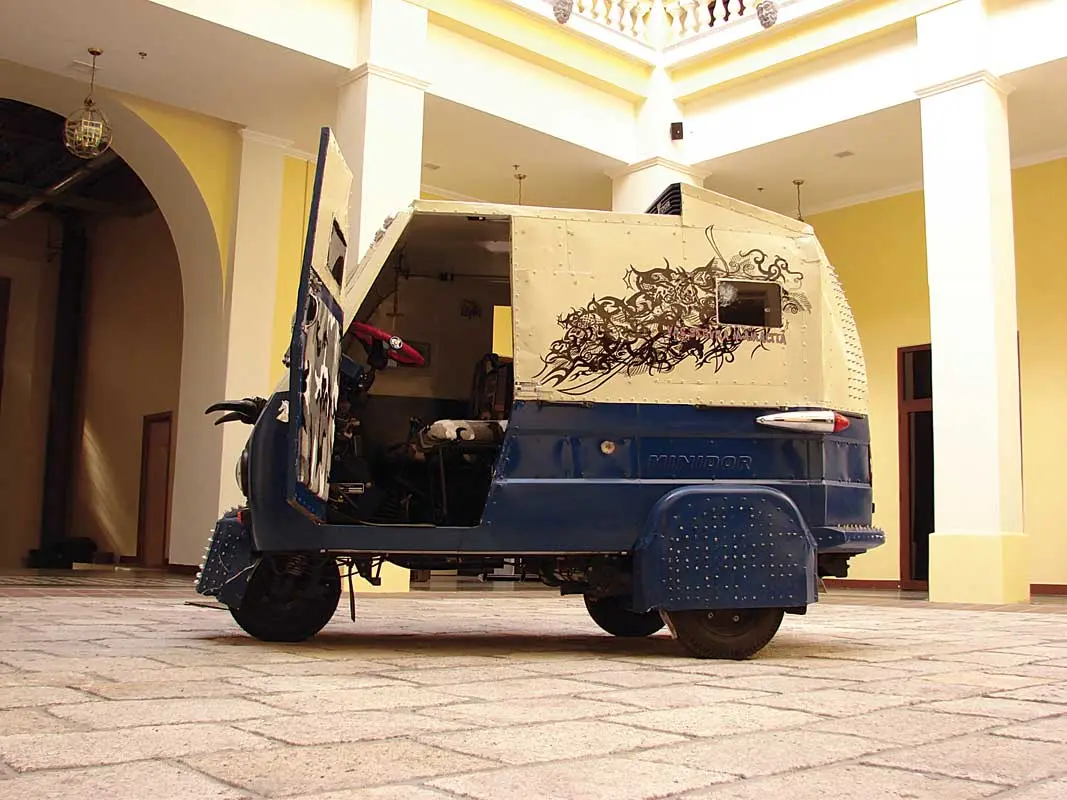
After many uncomfortable security demands at the entrance to MIN, the biennial’s trajectory began in the museum’s central patio, where the sound of distant explosions emerged from an old well, a soundscape by Walter Suazo, from Honduras. The next patio held Verónica Riedl’s Mototaxi Blindado, alongside a video of such a peculiar “tuk-tuk” promenading in Guatemala City, absolutely necessary as documentation to bring the work —Third Prize winner— to life.
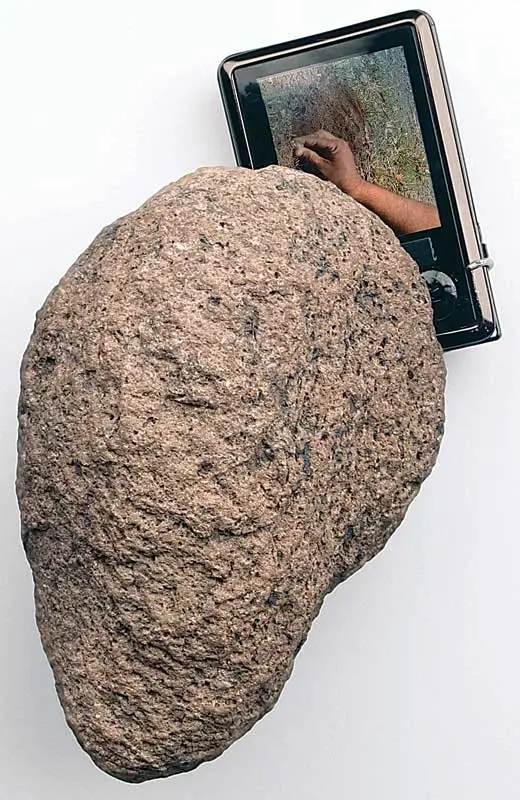
In the next gallery we found the First Prize winner, by Marcos Agudelo, from Nicaragua: the video-installation A la tumba perdida de Andrés Castro, a los héroes sin tumba de Nicaragua, comprised of a rock and a mini MP4 device with a video recorded in Nicaragua where two hands bury the rock in local soil. The work is outstanding, in the words of the jury, because “it reverts the conventions of public statuary and becomes an effective agent of historical rethinking.” Mounted near this anti-monument was Agudelo’s second entry, Desintegración, a marvelous, partially undone bedroll woven using strips from a map of Central America.
This reference to cartography and loss found a valuable complement in Mapa 3, the painting of an isthmus by Panama’s Gustavo Araújo, whose tragic death in 2008 filled the Central American arts community with grief. Absence also weighed heavily in Daniel Hernández Salazar’s photographs documenting “light-based interventions on places linked to disappearances and extra judicial executions” occurred during the Guatemalan dirty war. On a nearby wall, two armed angels by Salvadoran artist Ricardo Clement also made reference to the history of violence in the region, a reality that acquired even greater intensity in the work of Isabel Ruiz, from Guatemala, whose dramatic installation of rocks wrapped in blood-soaked bandages was on exhibit in the upper level.
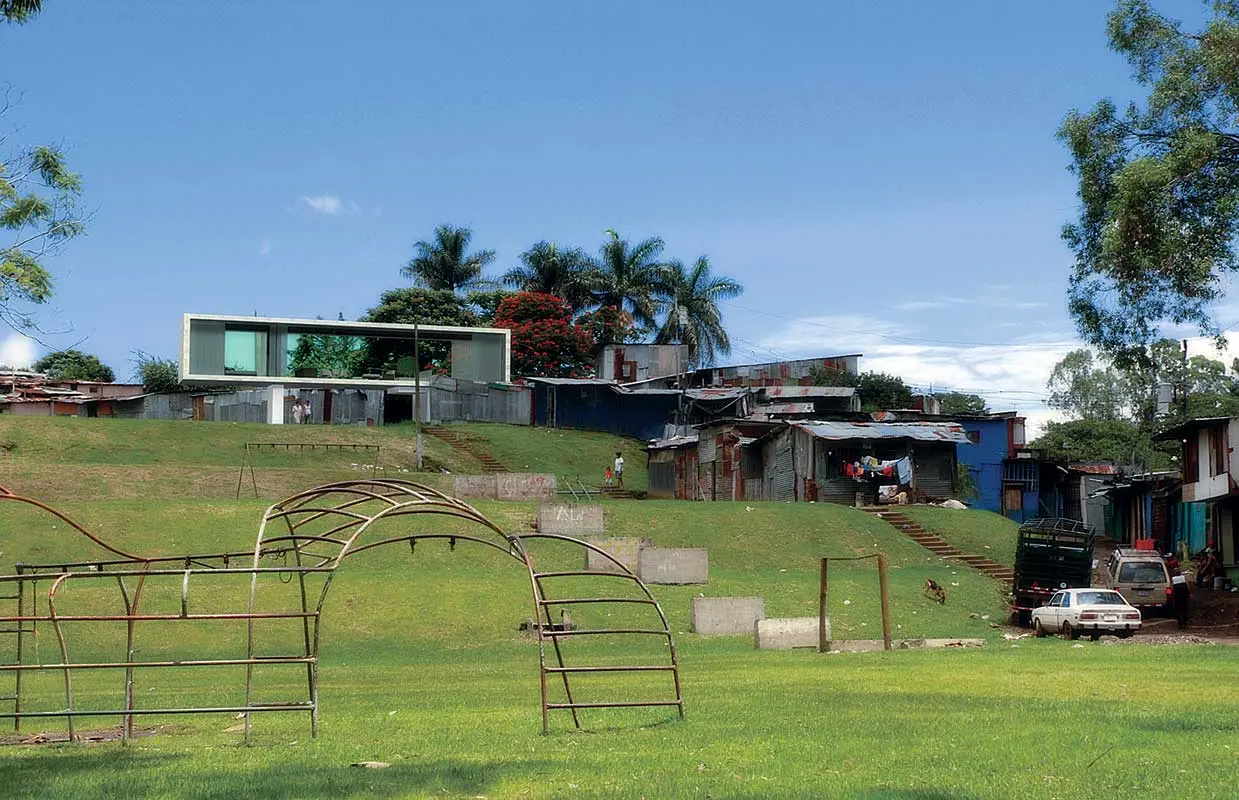
The theme of economic difficulties and poverty in the Third World connected a number of works in the exhibition. Honduran artist Adán Vallecillo’s Camillas de lubricación, with their little cans of baby oil, offered piercing commentary on child labor and child prostitution. The issues of the economy and of modernization were reflected in the work of Oscar Figueroa, from Costa Rica, which consisted of intriguing clusters of bananas created using computer mice and the video of a worker “drying” coffee grounds that were, in reality, pieces of keyboards. Errol Barrantes, from Costa Rica, winner of the single Honorary Mention, presented photos of a neighborhood of shanty dwellings in which lavish contemporary homes had been inserted, as commentary on the persistence of large social gaps. In the interactive work exhibited by Ricardo Miranda Huezo, from Nicaragua, the movements of the mouse transformed a blighted building into a luxury one.
Boris Ciudad Real, from El Salvador, intervened the gallery walls with the faint child-like drawing of a series of small houses, numbers, and sums that referred to the issue of overpopulation and overcrowding in poor neighborhoods. His conational Walter Iraheta presented Landschaft, a video where, with the sky as backdrop, electrical cables multiplied into a vision of the landscape that should be familiar to any big-city dweller. In a variation on the same theme, his Constelación, created with discarded plastic caps, spoke of a different yet equally familiar kind of landscape. The work of Cisco Merel and Francisco Barsallo, from Panama, also dealt with urban themes, the former with a cardboard crane titled Construcción prefabricada and the latter with a video, rather devoid of human emotion, about the constant destruction of old buildings in Panama City.
Some works grabbed our attention only in a superficial manner, such as the giant plush-toy penises by Diana Lagos, from Honduras, and the still lifes presented by Andrés Asturias, whose previous works at the Guatemala biennial seemed much more interesting. The photograph of an anthropomorphic chicken spitting coins presented by Jean Jacques Ribi, from Panama, implied a search for meaning —with confused results— and the works by Zenelia Roiz postulated valid ideas in careless formats. Nicaraguan artist Rossana Lacayo’s videos, while dealing with interesting topics, felt like fragments of documentaries in progress. On his part, Costa Rica’s Habacuc presented a website documenting his controversial work Eres lo que lees, from the previous year, along with a low-impact video of the same title, showing a young man reading a text he doesn’t understand.
Some works with a valuable spiritual content could have been presented in a better way, as in the case of Cristina Cuadra, whose fascinating interventions on nature demand a more vivid documentation. Similarly, the printing of photographic images for Century, an outstanding installation by Darwin Andino, from Honduras, could have been more careful; Andino’s five photo-montage works combined, with a deep sense of irony, figures and sites from different historical moments. On the same political vein, Liar-Liar, by Nicaragua’s Wilbert Carmona, displayed pictures of Bush, Ortega, Chávez, and Uribe with relevant words or symbols embroidered on top of their mouths. The topic of immigration acquired prominence in the xylographs presented by Guillermo Maldonado, from Guatemala, while Miniam Hsu used white tableware and embroidery on a piece of red silk to document, displaying great aesthetic sense, the difficulties faced by the Chinese community in Costa Rica.
On a more personal realm, self-referentiality and an exploration of the self versus “the other” dominated —in combination with a refined sense of humor— the well-rounded works presented by Sila Chanto and Jhafis Quintero, from Costa Rica, and Jonathan Harker, from Panama. Chanto and Quintero’s amusing Monumento a la emergencia consisted of a red box containing a fire extinguisher and many jars with images of works of art by each participant in the biennial. In their video Monumento antropofágico, the artists ate one another—as living bust sculptures— to the tune of Alouette, the children’s song. In turn, Jonathan Harker presented two two-sided hand mirrors with oval-shaped holes that invited viewers to see themselves transformed, and in his Hondurama he transformed himself into a variety of characters (from cowboy to male prostitute) and posed in front of rustic photographic dioramas of well-known locations in Tegucigalpa.
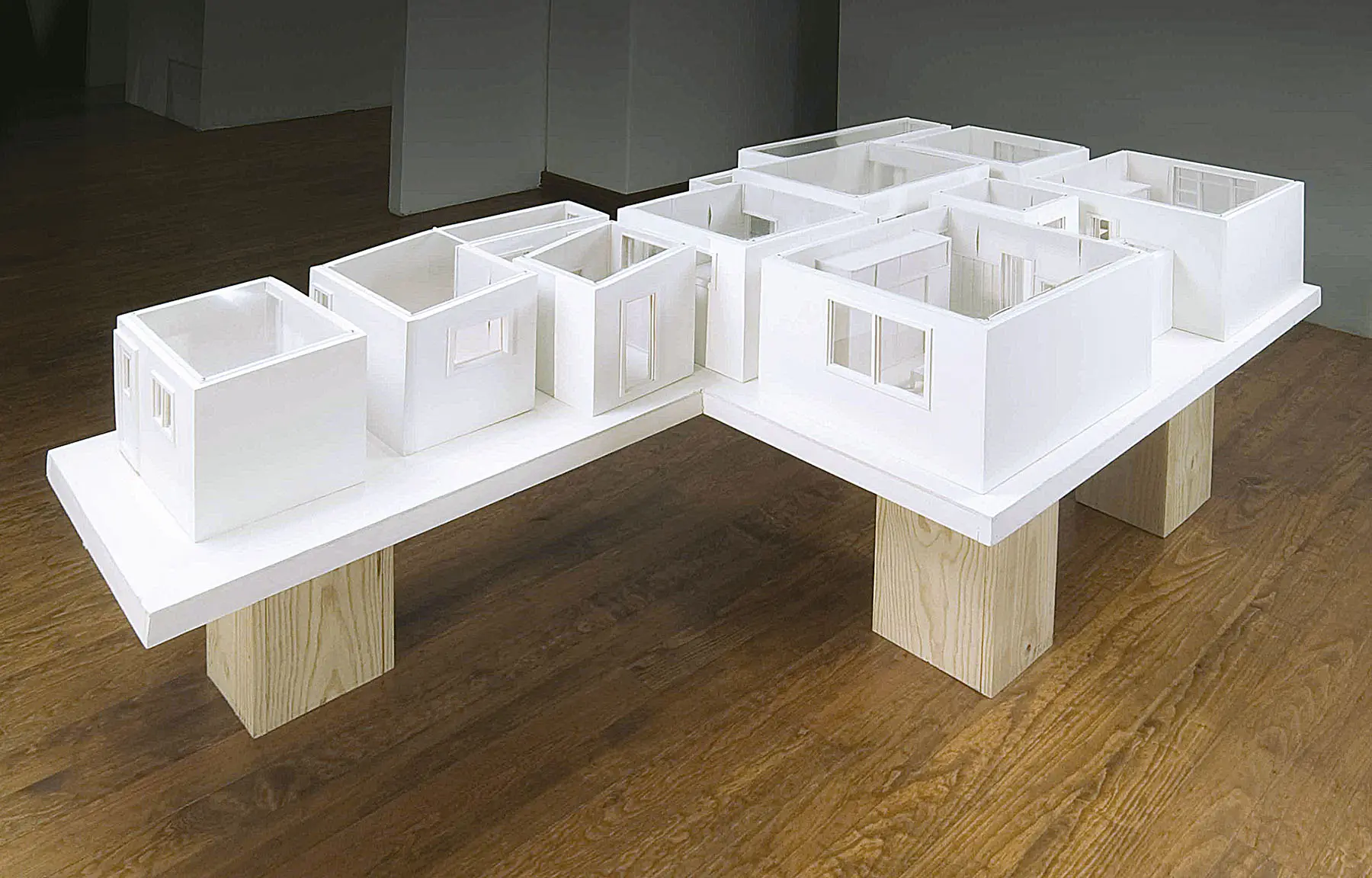
Some of the works captured our attention with their silence and sense of intimacy. Estudio para la construcción de una casa, by Esteban Piedra, from Costa Rica, which won Second Prize, presented a beautiful white model of a house in which no room connected directly with another, and whose sole inhabitants were inert insects, such as a solitary cockroach and a group of bees glued to a window. Ana Elena Garuz, from Panama, reminded us of the pleasures of aesthetic simplicity by using adhesive tape to reinterpret traditional drawing and a tangled-up mass of rope to reinterpret sculpture. Similarly, Alexia Miranda, from El Salvador, presented a poetic video in which a woman rolls down a mountainside quarry and is wrecked by the rocks until she comes to a stop, her body still.
Finally, it is important to note that the interesting work of the La Torana group, from Guatemala, was not included in the exhibition because, while their country’s Paiz Biennial accepts submissions from collectives, the Central American Biennial does not, a regrettable confusion that affected both the artists and the public of an event that, nevertheless, was definitely worth the effort required for its multi-national organization.
MÓNICA E. KUPFER