
Natalya
Critchley (England, 1963) surveys the urban landscape from the expanse of the
open skies, from a rooftop, from a variety of angles, or from a visual
perspective all her own, comprised of many facets, including the element of
emotion. The urban landscape has been an important topic in her painting, a
constant assumed in any of the spaces where she has lived, from the expansive
iron-mining industrial zone where she settled when first arriving in Venezuela
in 1981, to the very European-like Caracas development where she currently
resides. Critchley arrived in this country and stayed because the light and
colors she encountered resembled, to her, the art of the fauvists and her hero
Henri Matisse: they matched her artistic sensibility.
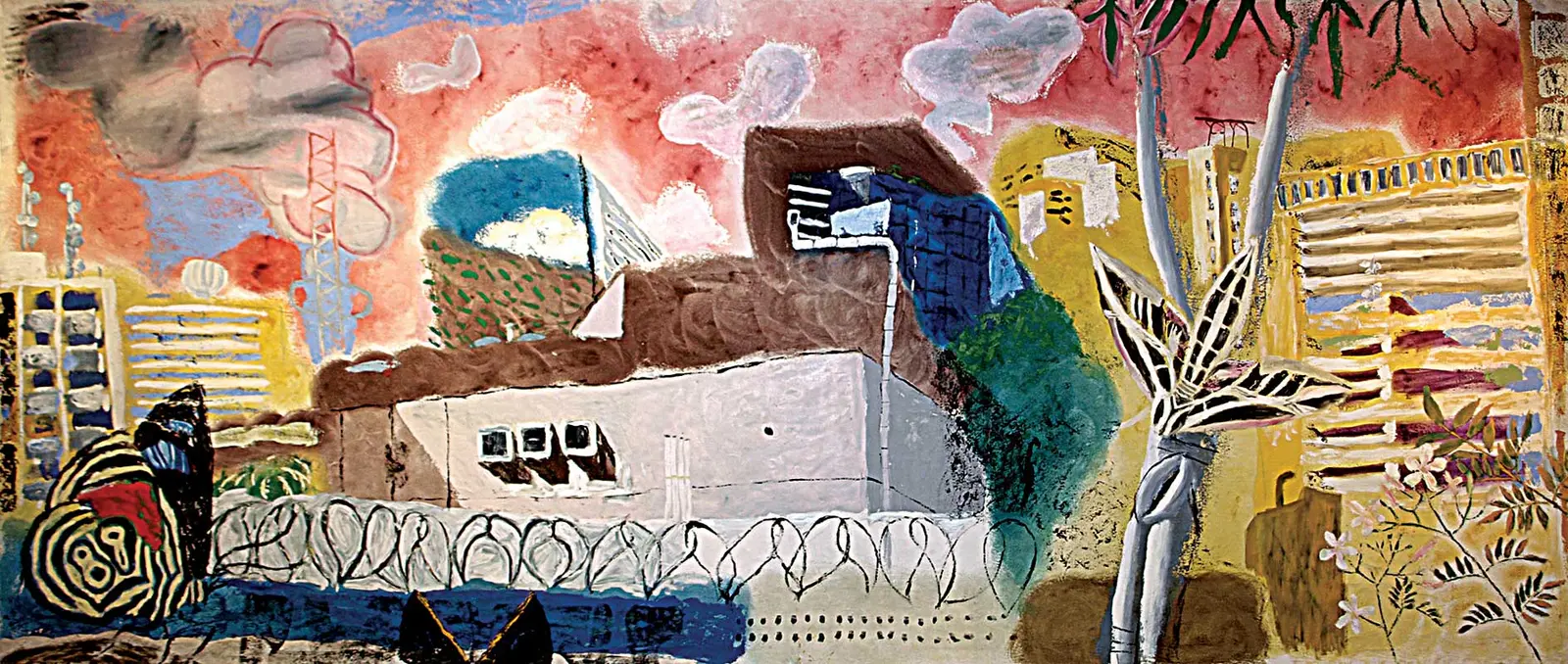
This exhibition at La Cuadra gallery included only eight large-format paintings, but they sufficed to demonstrate the artist’s skill and her mastery of painterly resources. These canvases are part of a series begun in 2004. Reviewing her own comments on the process of their creation, which seems to have been rather complex and laborious, we find this statement in the catalog: “These paintings have gone through a lot. They have been stepped on and hanged outdoors, at times touched by the rain… their dimensions are the result of a compromise between the canvas required to accommodate the gesture of the extended arm and a manageable load of painting. They are produced on floors and walls, inside and outside the studio, exposed to light, wind, and the landscape they capture. They are dried unfurled on a bed, on the floor, on the furniture… They are rolled up and unrolled for revision, time and again. But only the morning light, the dawn of each new day, lets us appreciate their colors in all their subtlety. The light I have been recording for five years in this oasis of Los Palos Grandes.” Big Sticks, the show’s title, refers to a popular moniker for the place where she lives. The artist offers her own particular vision of this world that belongs to her alone. Critchley works from inside the canvas. Shapes of buildings, trees, plazas, walls, emerge on the basis of frottage, almost always with a striking sky in the background. She transforms the canvas’ material structure into an epidermic surface, which comes forth thanks to the alignment of those images, organized spatially by color. When a defined line does not exist, it is color that makes form concrete; each shape is supported on the one next to it. What is important is that they seem to replace the sense of the real landscape with a fragmented and semi-transparent one, equivalent to a fantastic, stagecraft landscape, as the artist puts it.
Critchley’s artistic preferences, which run from Paul Klee to Philip Guston and from Matisse to David Hockney, reveal a treatment of space in terms of chromatic distribution into soft veilings of low-temperature colors. She says she enriches the surface with color and texture while adding elements derived from her interest in Persian art; thus we appeal to the pictorial sensibility of the painting’s material surface, which seems to move away from the selected model yet associates itself with an interplay of known or recognizable images that are however not perceived as real in their configuration. A great visual power, structured on the basis of the line of force represented by a multitude of images, organizes the vibrant total body of the painting’s surface with great intensity. In this way, the latter becomes a living body that develops on itself through pulses in the formal field. Seeing the complexity of this urban landscape that is suddenly here and then, just as suddenly, is not, is something quite extraordinary. The sequence of images, sometimes aligned, sometimes superimposed in a fragmented visual perspective, turns the topic into a field of visual provocation that functions as an energy matrix for perceived reality. Natalya Critchley perceives the landscape as a subjective and emotional inner map.
BÉLGICA RODRÍGUEZ