
The retrospective El otro Nedo: Más
allá de su diseño gráfico was presented at Sala Mendoza and Sala TAC from
November 2008 through February 2009. One of the project’s goals was to “rescue”
the artist’s pictorial work for the contemporary audience; despite Nedo’s
intense activity in this area, it had been relegated from the recognition it
deserves by the wide acclaim of his design work. The show made it possible for
viewers not only to see Nedo’s whole oeuvre but also to recognize the
harmonious relationship achieved by the artist between his artistic creations
and his graphic work.
Nedo is deeply committed to visual constructivism, to which he arrived gradually from various other explorations. In his career, he developed a balanced aesthetic proposal, one temporally serene and visually open. Nedo’s continuous creative effort was enriched by the dynamics of a single time, as the show’s curator Lourdes Blanco points out in the catalog. Nedo’s work connects naturally to architecture as an independent object or as an integrated element, as can be seen in an important group of murals, floors, doors, and rails.
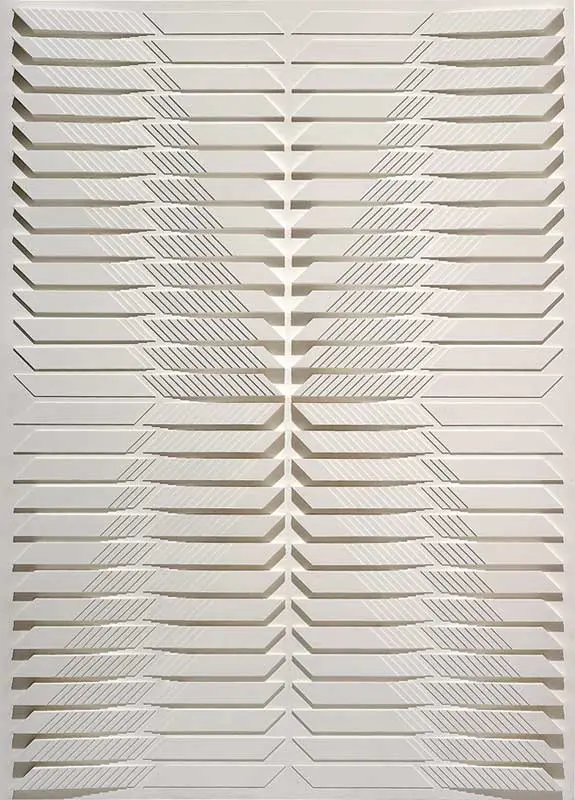
Sala TAC presented drawings, gouaches, paintings, a wide selection of medium-format works titled Reversambito, several of the Metasignosis, a proposal for the transformation of the letters of the alphabet, as well as sculptural objects and models. These works spoke of the variety and volume of Nedo’s output.
The show at Sala Mendoza included the key pieces of Nedo’s artistic oeuvre: a series of drawings and reliefs. The latter formed the largest component of the show. In these, the artist displayed his research on the topic of space, a fundamental theme that he acknowledged as a creative effort, saying, “I try to make visible something that perhaps resides only in my imagination, which is to say, I try to suppose cosmic space and its contents.” The artist’s drawings, precursors of his later work, already demonstrated his interest in what occurs in three dimensions. Looking at them, one could appreciate how the beautiful, simple images that “narrate” circus scenes were systematically transformed throughout the exhibition into a plotting of lines, planes, and complex orthogonal geometries that are at the base of his reliefs.
The systematic study of space and its laws, and their reinterpretation and reinvention, informs the constructive character of Nedo’s work. Even when one finds optical effects similar to those from a structured and serial Kinetic proposal, it is clear that they are not the main issue in Nedo’s work: they are consequences of his exploration rather than intentional products. The Cartesian discipline that dominates Nedo’s reliefs and the spare materials that form them express Nedo’s search for the essential. The cardboard strips placed one on top of the other create small ladder-like volumes: fragments of a space that the artist reconfigures into trim, manipulable elements.
These elements create progressive structures and irregular surfaces, composing on the two-dimensional plane a visual “melody.” The ascending and descending rhythm becomes more dynamic with perceived tonal gradations that shift with the light, something equally important in Nedo’s proposal. If it were possible to place the works next to one another, the composite work—articulated, shifting, reversing—would expand in a limitless dimensionality while the characteristic white hue would take it to the edge of immateriality.
In Progresión No. 60, for instance, one saw the rigorous design that preceded the work’s execution: the lane divided into quadrants made possible an order beginning from the meeting point of the horizontal and vertical axes. Four zones were created in this way, realms or spaces that responded to the same formalism; reinterpreted by the artist, they came across as differentiated and shifting solutions in the presence of light. Meanwhile, in Reversambito No. 76, horizontality determined the composition of the work, it's aesthetically articulated by thin cardboard strips in diagonal cuts; segments shrank and stretched in sequence from left to right—a solution that suggested direction, movement, an unending motion that had been briefly stopped.
Nedo, an icon of Venezuelan modernity comprising locals and visionaries from abroad, is responsible for generating and achieving a profound transformation in the country’s cultural life. He contributed greatly to the formation of an exceptional art scene, one both conceptual and formal, one rigorously articulated but expressively sensible. His work was revealed anew, now in the key of history, with lucid clarity and heightened aestheticism.
FREDDY CARREÑO