
In the exhibit by Rubén Torres-Llorca
at the Praxis Gallery in Miami titled Manual de Carpintería China (Chinese Carpentry Manual), this undoubtedly important artist in
the history of Cuban art has taken new risks with this group of scenographic
installations. This is an essay of sorts on the playing forces in the
functioning of the global world and its pervasive influence in the private
worlds of individuals.
For the last three years – in exhibits such as The Names Have Been Changed to Protect the Guilty at the Museo de Arte de Puerto Rico, or Easy to Assemble-Modelo para Armar at the Frost Art Museum – Torres-Llorca has been pushing the boundaries with his way of constructing works that function as unique pieces, artifacts that carry ideas (about art, collective history, or affectivity and the interactions it generates), and as scenes created as literary or film narrations.
How does he bring together conceptual strategies with deeply emotional content and with a vision that refers to the cultural universe (a vision that is also a clever reflection of the socioeconomic machinery upon which all artistic production depends)? Torres-Llorca induces the spectator into a gradual journey and exposes him/her to multiple levels of interconnected stories.
It is clear that an approach defined by Torres-Llorca as “a thriller” is at play in Manual de Carpinteria China. Only that the crimes here have none of the visible evidence found in literary or film thrillers. In order to investigate these works, one must take into account the political influences in art, not only as they relate to the functioning of public and/or collective entities, but also to their incidence in private episodes. The crimes in history, for instance, occur within the invisible zone of forgetfulness and denials, as addressed in the installation I Can’t Breathe with These Words in My Mouth. Here, a bust of the hero is connected with the disorganized pages missing in the story told by those in power. The dilemmas of the market, historical alterations, or the precariousness of love within that context, are now conveyed with the highest level of sophistication that Torres-Llorca has achieved to date.
He plays with the idea of the Lu-Pan-Ching – a red carpentry manual from the Tsing Dynasty – as he sets out to create pieces that function as dramatic scenes and as parts of an essay, not yet finalized, on the immediate. In the middle of the exhibit space, Torres-Llorca displays a wooden pedestal that holds the alleged manual containing construction rules and formulas for spells that were formally hidden in the buildings under construction. Hidden in this work is the true nature of this book with the flag of the Popular Republic of China on its cover. It turns out that this book is actually an issue of Life Magazine that contains between its pages a ruler for measuring, an element that Torres-Llorca utilizes for the first time and that also replaces the frames of the works in this exhibit. The image of the innocent spectator represented by the small sculpture of a child going through the pages of the book is itself deconstructed by the title of the work: Trojan Horse. In the middle of the complex game of economic forces, is it capitalism entering undetected into communist China, or is it perhaps the Chinese market imposing it's game on the West?
The clues of the crime – or the arguments in the essay – are presented to the spectator in other pieces-scenes. The brilliant work titled Made in China – just like the omnipresent label on every possible product – presents the stereotypical couple from the American Western that once represented the dream of prosperity in the U.S. – through the economic overtaking of other territories to expand its power – here, they appear to be uncertain before the menacing environment. Although she seeks protection from her strong Cowboy, the rifle he holds indecisively does not appear to be a reassuring sign. Economic uncertainty reduces him to a state of impotence. At the same time, the frame, fashioned of rulers, conveys the possibility that the title of the work – through one of Torres-Llorca’s characteristic games employed in his conceptual strategies – would be referring to the speculative practices with Chinese art. The dynamic in the elegant couple appearing in the work Elephant Talk (in reference to republican discourse) represents escape from the pressure caused by what is noted in the text box under the title “Recession”. The irony achieves maximum effect in the sculpture of an executive whom Torres-Llorca places on top of a high pedestal, in the work titled High. With his elegant suit, he drags a bag in a way that makes him resemble the image of a homeless (or of an unemployed) person who, in dire times would carry his or her belongings thus.
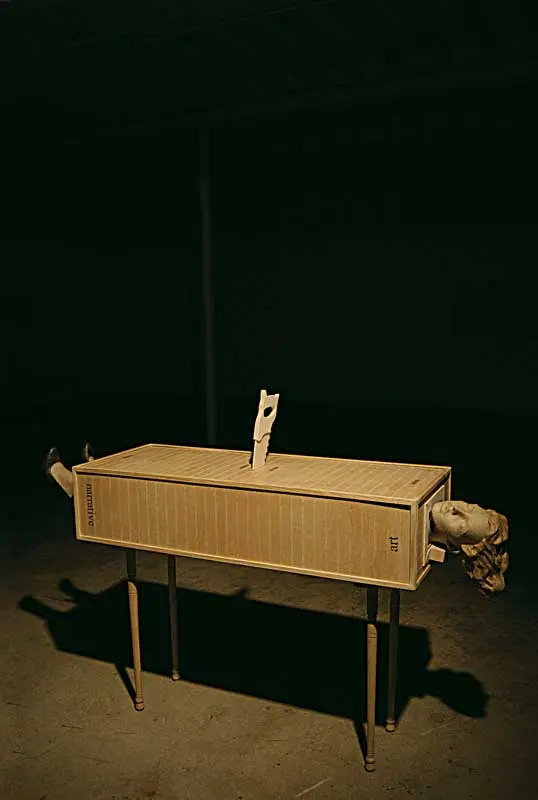
One of the most daring piece in the exhibit by this Chinese carpenter – for it risks turning into sentimental kitsch, although it is formally impeccable – is Ella Cantaba Boleros (She Sang Boleros). This title was borrowed from the legendary novel Tres Tristes Tigres (Three Sad Tigers), in which writer Cabrera-Infante immortalized a female bolero singer. Ella Cantaba Boleros displaces the sentimental drama to the kneeling masculine figure with long feminine hair. Also masterful is the way in which the artist combines metaphysical with affective reflections on the feminine nature of sculpture in his work titled Excalibur/Narrative Art. The feet and the beautiful face of a woman lying down inside a box protrude from this box at the magic trick’s highest moment of tension: the instant the magician is about to cut her into pieces. The title makes the handsaw appear to be a tool that evolved from the sword. The meaning is displaced from the legend of King Arthur and the feminine myth of waiting for the only man capable of saving her (Excalibur). The text inscribed in the work – art, narrative, wood, shape – transforms the piece into a proposal that pushes its own boundaries and the nature of the language it uses. Torres-Llorca confronts the spectator with the relationship between iconic elements of drama and the certainty that there are other latent senses not dependent on visual elements, but rather on a grouping together of cultural references. The artist has put together narrative scenographies that far from losing their strength in the multiplicity of possible arguments, put forth an essay on the uncertainty of the contemporary world.
ADRIANA HERRERA