
The city is the enunciated space in Yoan
Capote’s work. It lurks in the spirit of his objects/sculptures, loaded with
the “imprint” of that energy that finds its confrontation in all cities.
Tangible and intangible signs outlining human beings as individual entities and
as the core of the collective.
Ten years have passed from the humanoid “machines” of his Traganíqueles series, whose design and engineering allowed for their manipulation on the part of the public, able during the inauguration of his first individual show, Tracc Bakk Track, in 1988, to drink soda or rum, or cut with a knife —to eat afterward— pieces of a salami bust from those artifacts. Capote captured there an everyday life marked by scarcity and social symptomatology given to obsession in certain areas, such as sexuality. The hybrid nature of the objects summarized our psychology of subsistence, so prone to recycling and (re)invention. It was noticeable already back then that his works, full of contextual arguments, were able to transcend their local anchoring.
Yoan Capote has just presented his most recent work in a show titled Psicomorfosis, at Havana Gallery (December 19, 2008 – January 31, 2009.) His ability as an artist to (re)design or (re)invent “bodies” —be it the human body or the body of everyday things— with the purpose of revealing their particular ideas, unfolded in twelve sculptures, two drawings, and seven projects.
The journey began with Maleable. Three puzzles constituted the first portrait of multitudes. A minimalistic approach to a manipulable social matter that can become a toy in the hands of power. The metaphor arose from the mechanical contortions of a Rubik’s cube. Capote substituted photographs of crowds for the flat colors that typically cover each one of the cube’s sides, and congealed the possibility of movement by arranging the cubes inside urns.
Paranoia and Lote (retrato de la masa) belonged to the same segment of collective psychological states transformed into portraits. In Paranoia, the profiles of anonymous faces have been incorporated into the bars of protective metal railings. The set (two windows and one door) recreated a particular transgression of security. The counterfeit shapes on the metal bars shattered the original sense of protection by making us perceive the faces profiled in them as intruders. In Lote, the masses were represented through ears carefully sculpted on stone blocks. The individual voice of collective mankind has been lost, and they are recognized solely as receptors.
In Secreto (mucho que decir), the coldness of glass-reinforced the drama of incommunication, in contrast to the warmth of wood and the distortions of the self (or hyperbolic selves) seen in Erección and Top Feminist. All of these sculptural objects framed emotional conflicts of the individual, as did a second section that included Stress and Autorretrato (cada uno de nosotros). Privileging the psychological condition under which individuals live, as he had done previously with the multitude, Capote subverted in these works the strategy of reproducing physical appearance and other details. The human datum in Stress was concentrated on bronze sheets forged from anonymous dental impressions, while in Autorretrato it was on lower-limb bones created in the same material after molds taken from eight corpses. The remaining symbolic functions of the portraits were fulfilled through the arrangement of pieces of concrete and the force of gravity.
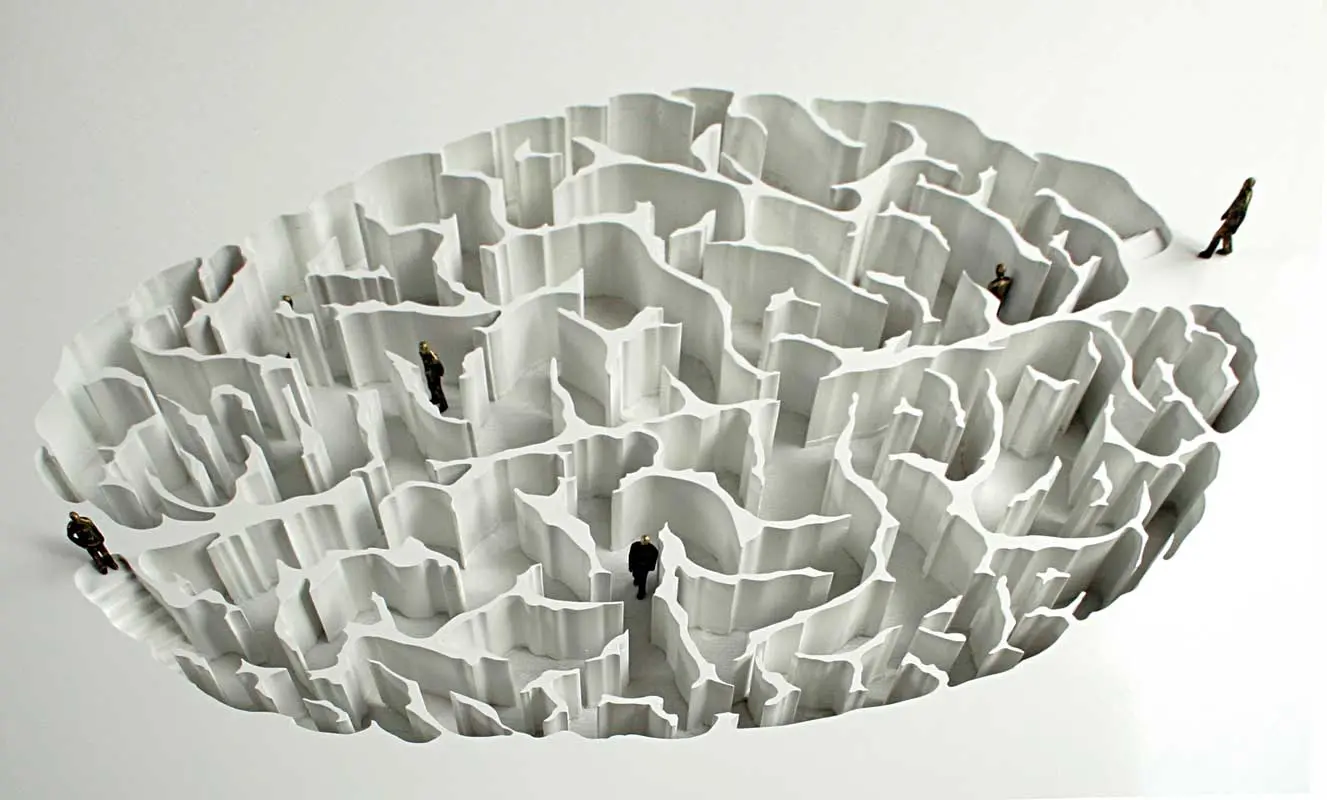
The third space in the gallery was devoted to procedural issues. Alongside the drawings, we saw here the materialization in PVC of Open Mind, centering the action, and the lightbox titled Libido (Trilogía sucia de La Habana). Touch and Voluntad de poder functioned as an epilogue, the former praising the sense of touch and the latter exploring the paradoxes of power. The sexual allusion and the political reference in them underscored the malleability of Capote’s psychological focus to approach a variety of topics.
In Psicomorfosis, Capote achieved what he had envisioned: full physical forms revealing intangible mental experiences. A reflection that can be seen from the earliest days of his career and which is now built on the compatibility of the psychological with a fluctuating local/universal meaning.
With his limpid, precise works that dialog with the human scale, this conceptual sculptor takes the greatest possible advantage of the symbolic qualities of his materials, of the possibilities of play, of the pertinence of humor, of emotions, making us feel the course of the present times without losing sight of the beauty of the forms that, privileging the sensorial, he (re)creates.
From that connection he awakens a transitable brain in Open Mind, a mind open to the change that is required (inside/outside): to an understanding and comprehension where all will be included. It will be possible to feel this space in the main exhibit at the 10th Havana Biennial, where the work will have its first phase of living interactivity, another distinguishing characteristic of Yoan Capote’s discourse.
CARIDAD BLANCO DE LA CRUZ