
The
relationships of the art market to the original/reproduction/appropriation and
fine arts/applied arts have always been relevant when approaching artworks and
appraising them as aesthetic and valuable objects. Pan American Art Projects,
located in the Wynwood district of Miami, offered interesting reflections on
these themes in an exhibition of works by Francis Acea, Ana María Pacheco, and
Tracey Snelling, which was on view from November 29, 2008, to January 31, 2009.
Snelling (born 1970, California) delighted the viewer with her characteristic scenes inspired by American movie posters from the 1950s. Snelling’s images of motels are full of the urban symbols so dear to that period and turn the viewer into a voyeur peeping through the windows.
The paintings by Francis Acea (born 1967, Havana, Cuba) welcomed viewers as they entered the gallery. These monochromes were polished signs with visual tensions that sharpened the critical sense of the observer. Acea’s work played with the assumptions about fine arts and applied arts and the line between the fields. The viewer beheld graphic works but, because of their execution in acrylic on canvas, one had to accept them as pictorial works.
Acea presented graphic icons that projected simplicity and purity and prompted a quick reading. Nevertheless, the symbols he proposed, as well as the messages these conveyed, were ambiguous and contradictory and led the viewer to repeatedly revaluate the proposed codes.

Acea’s installation D.B.A. Joe used the legal phrase “doing business as” to underscore the abstraction that exists in commercial relationships. One work, consisting of a rug made of 140,000 one-cent coins, invited the viewer to walk on it. Here, Acea played with the relaxation of two sources of tension. On the one hand, there was the viewer’s reluctance to touch and interact with a work of art and, on the other, the feeling of instability and the playfulness arising from moving on this capricious carpet.
D.B.A Joe addressed the commercial relationships in art and the fortuitous mechanisms that determine the value of a work of art. Thus, money became the constitutive element in the work. Categories such as practical value, real value, acquired value, and speculation were handled masterfully. Money is the symbol for the commercial relationship; it is valuable in itself. Nevertheless, once incorporated into the work—outside of its usual context and rarefied by the gallery space—money was stripped of its practical purpose and intrinsic value. Thus, money was distorted, extrapolated from its original context, and transformed into something else in the work—that is, it became the work. Once within the gallery environment, it lost its original ideological aesthetic purpose in mercantile relationships, in which the determining element would be the acquired value of the work.
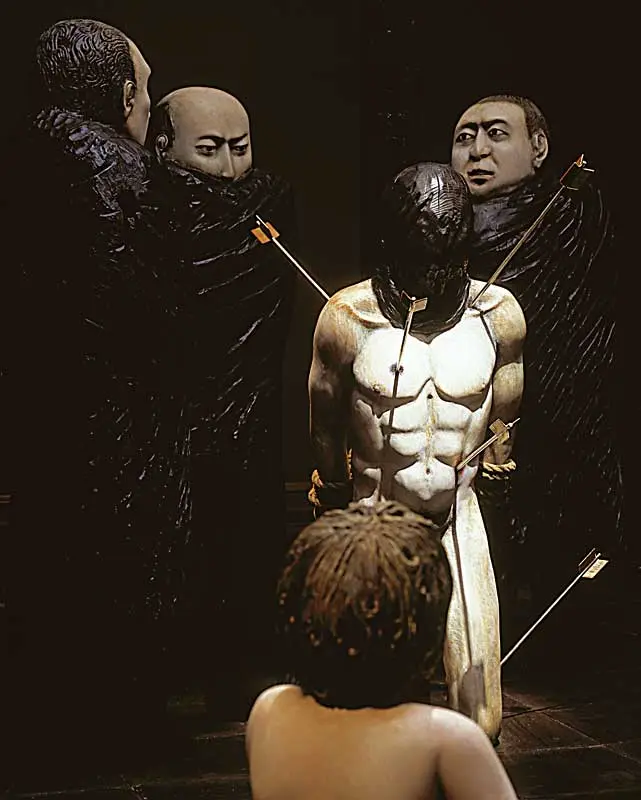
An impressive installation in the project room welcomed the visitor: Dark Night of the Soul, a work by Ana María Pacheco (born 1943, Goiás, Brazil). Inspired by Saint Sebastian and fashioned of polychromatic wood, this was such a vivid piece that the viewer was immediately entrapped by the gazes and disconcerted, even anguished, expressions of the characters inhabiting it. There was very little light in the room, and the mob in the work appeared to be flabbergasted. It was not clear whether they were fleeing a scene or arriving at it. At first glance, confusion dominated the scene. Moving closer to the work, the viewer found himself trapped inside the crowd. The figures’ eyes and teeth made of resin were uncannily realistic. The fact that these characters were life-size rendered the work more overwhelming.
Dark Night of the Soul dealt with power relationships based on the figure of the Biblical martyr. There were also allusions to the relationship between the Old and New Worlds, which has been central to Pacheco’s artistic proposal, and to the manipulation, extortion, and abuse that are ever-present elements in the artist’s work as a way of distorting interpersonal relationships.
The works by Francis Acea and Tracey Snelling in the main gallery and Ana María Pacheco’s installation in the project room was brought together under the same thematic thread: Money and power is the regulating force in social relationships. These two terrible, channeling mechanisms usually function to distort instead of mediate and appear to prevail in our interpersonal relationships.
JANET BATET