
From November 18 to December 20, in
commemoration of the Thomas Cohn Gallery’s twenty-fifth anniversary, young
artist Andrea Rocco presented her first solo exhibition in the Mezzanine space.
Collages and mixed techniques, watercolors, and needlework formed the body of recent works that this artist chose to include in the exhibition.
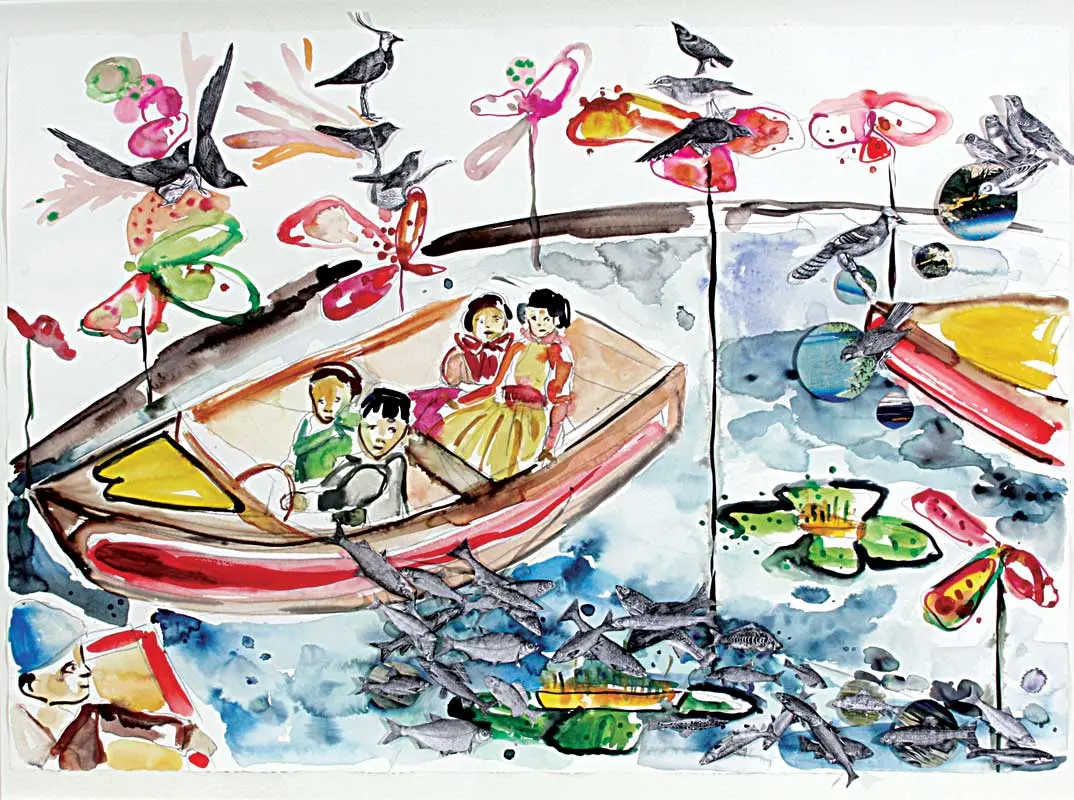
The fantastic figures born of Rocco’s fertile imagination take the shape of several ornamental embroideries that accentuate the real weight of lines and color areas, enabling the images to emerge from their traditional two-dimensional frames and become three-dimensional. The iconographic repertoire fluctuates in the space and draws our attention to each of the works before us. We believe these figures to be of “this world” because they generate “worlds” or parallel universes. The group of pieces included in this exhibit resembled a choreographic and profuse graphic puzzle. Each work represents a link designed by Rocco to generate a sophisticated game of placing fragments from stories in continuous transformation. The insistence in attaining some degree of figurative representation induced Rocco to generate a coherent artistic and truly poietic (poïesis) gesture. This facilitates complete reliance on certain clues to access the images, be they from a formal perspective or from the content found in her collages, mixed techniques, and embroideries. Missing is any type of literal message, but instead, Rocco is able to develop an aesthetic of the enigmatic with several layers of meaning. On the one hand, the importance she places on the several chromatic systems she applies is evident. On the other hand, she appears to be attempting to hide or entangle in a web the lines and embroideries from other sets of colors superimposed to the tectonic surface of these objectual works. At the same time, her intention is to make these ambiguous objects (objets ambigus) navigate in a more carefree, anti-dogmatic, fresh, and innovative pictorial discourse. To comprehend this reassembled fragmentary barroquism, we must understand that Rocco elaborates a type of figuration by using elements that can adhere or not adhere to the world (realism vs. abstraction vs. pictorial decorativism). At the core, we always encounter certain figurations that belong to different epochal registries (varietas), whether they are mythic, citationist of Barroque and Rococo, still lifes, animals, children scenes, etcetera. Then, these same figures are placed on an empty space that becomes gradually more complex, although we never lose sight of its proverbial depth of field. There resides the shortcut that enables Rocco to redefine the status of contemporary painting. Consequently, space or locus is covered – sometimes through the use of planes of color, lineal interplays, and subtle ranges of color – to the point that the figures and the background lose their respective individuality. Finally, the purpose of the tracings and markings from this original representational maniera, is to underscore the presence of another handcrafted materiality, achieved by rendering the structures of some of the paintings in a three-dimensional manner. In the majority of cases, the figurative motifs are based on the silhouette of the ironic, provocative, erotic, and even sweetly perverse images. Formal and amorphous elements propose a powerful instability, given that Rocco indistinctly resorts to two strategies: disfiguration and transfiguration. Reliefs and details possess an important role here as mechanisms that reject the residual plenitude of orthodox pictorial works. Relenting to generous doses of pleasure and obsessive and recurrent delirium, Rocco’s opus becomes increasingly physically, gnoseologically, and aesthetically thicker each time around. The works are inflated, non-planar relief paintings, rendered with a free and curved brushstroke technique of progressively thicker colors, as if they belonged to a sort of pictorial automatism. Because of the subtle figurative contrapositions, the spectator’s perception and touch replace the paradoxical formal uncertainty. We interpret the sometimes mimetic structures as doubtful and perceptive conjectures that, nevertheless, produce effects of instability, hatched with wise tricks to achieve a sensation of similarity and plausibility.
Contradicting the slogan Al Principio fue el Título (At the Beginning Was the Title), the exhibited works do not have titles, perhaps rightfully so, so as not to provide much information to the public, thus facilitating their interaction with this abundant operistic group of works.
A catalog with a critical essay by Agnaldo Farías accompanied Rocco’s eye-catching exhibit. Farías underscored the prolific character of these quasi-maniacal compositions. As this Brazilian critic points out, it is not a question of the figures per se, but rather of the manner in which these are presented and placed. In other words, the interesting question concerning Andréa Rocco is how she approaches her work. Every possible and impossible combination of multitudes, couples, arborescences, houses, lagoons, boats, and birds – all allusions to landscape art – rendered “as suspended in the air”.
For Rocco, the title is beside the point (de trop), because the overabundance of a discursive metalanguage that would tautologize the works is not necessary.
Instead, she counteracts this tendency by creating rhetoric procedures much more effectist and sophisticated that, as pointed out earlier, ranging from humor to sarcasm, from paradox to hyperbole, from metaphor to metonymy.
CLAUDIA LAUDANNO