
Bogotá’s Gilberto Alzate Avendaño foundation has been interested in quite some time in presenting historical exhibitions intended to bring back to the limelight forgotten figures in Colombian art. At the bottom, this is an attempt to retell the history of Colombia’s art from a different point of view, and it grows in importance as it widens the genealogies of the country’s artistic production, making the latest generations all the richer. My only criticism of this laudable project would be that history needs to be told from the present. This is to say, it is not a question of reaching into the past as if it were just there, lying in wait, but of bringing the past to us, because there are holes in the present. Historians who live in the present, who maintain a critical distance with the present, who suffer the present, harbor a secret wish: to bring back a figure from the past and install them in the contemporary conversation. The historian evaluates the present’s symbolic need in order to inscribe oblivion. To launch a series of historical investigations would require, then, to promote a History workshop, History being one of the disciplines that has evolved the most and has shaken foundations in order to think through the concept of deconstruction.
But that is a different matter. It is important to see again the work of Beatriz Daza, impeccably restored by the same institution — impeccably, I say, because the restaurateurs respected the passage of time. It is similarly important to revise and study a catalog as exhaustive as the one published for the occasion, and to savor its images.
Beatriz Daza was born in Pamplona, Colombia, in 1928. She studied visual and decorative arts at Universidad Javeriana, in Bogotá. In 1946 she traveled to the United States and took some university classes in Washington and St. Louis, Missouri. She also studied at the San Jorge art school in Barcelona and Rome’s fine arts academy. She lived for a time in Paris, and according to María Elvira Iriarte, the core of her education was in painting.
It is not difficult to conclude that in those years Beatriz Daza entered into contact with a rich visual world, one that is clearly recognizable in her work. I would say that the presence of Gaudí and the ceramic skins he used to cover his buildings are evident. Daza’s works also, bring to my mind American artist Joseph Cornell’s boxes and assemblages; Cornell, born in 1903, exhibited his small cabinets of curiosities in glass boxes throughout the 1940s, as an interpretation of the broadening of sensibility and the estrangement of the everyday world proposed by the Surrealists and by Max Ernst.
Beatriz Daza’s work contributes to the identification of Surrealism as an influence in Colombian art, an influence that perhaps goes unrecognized because the story is told solely on the basis of the avant-gardism of relevant figures like Dalí or Man Ray, rather than the opening-up of sensibility fostered by others like Cornell, Wols, Dubuffet or Fautrier. Marta Traba saw Daza’s work in connection with informalism and with a mythic pre-Columbian history.
Beatriz Daza returned to Colombia in 1958 and presented four individual exhibitions, two in the Colombian Society of Friends of the Country (1959 and 1961) and two in the Museo de Arte Moderno de Bogotá (1964 and 1966.) She participated in many National Salons and won First Prize in Ceramics at the 15th National Salon in 1963, with Crisol para Prometeo. She died in 1968.
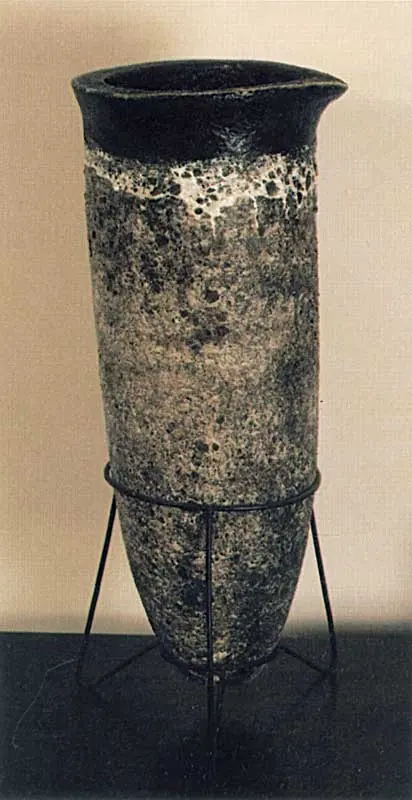
The show under review brought together almost the totality of Daza’s oeuvre, allowing us to see ceramic works from 1959-1963, collages on plaster from 1961-1966, oil paintings from 1966, and an ample selection of oils and acrylics on printed fabrics dated from 1966 to 1968. Her work with ceramic materials began with basso-reliefs that show parades of peasants, reliefs of essential contours where, nevertheless, the figures evince constrained emotions, gestures, postures, combined with magnificent, strangely alive flowers and bushes. These reliefs display Daza’s solvent, talented draftsmanship. Later came her vases, which in fact are sculptures at the limit of the proportions between the utilitarian and the symbolic object; the shape of pre-Columbian funerary urns is present in them, but with a small shift in proportions they place themselves beyond any categorization. (It would be great for that contemporary art that is closest to documentalism to be more attentive to such minimal shifts in proportion, so as to evade classification.) The surface of these vases is a true crucible where fire actively intervenes to invent textures. Such is the case of Crisol para Prometeo, national prize in 1963. It is a phallic crucible, very attentive to details for instance in its edge, which turns outwardly and is irregular, and with a complex texture that is the most forceful tribute to fire. María Elvira Iriarte says of these vases or sculptures that they are enriched by their metallic supports, and it is true. On those supports, the shapes are even more separated from the utilitarian, yet, since the supports are not heroic but of something like homegrown minimalism, they make it possible for the sculptures to be not fully participant in modernity, not entirely given to space; rather, they express an intention of remaining close to the workshop and to the artisan’s home.
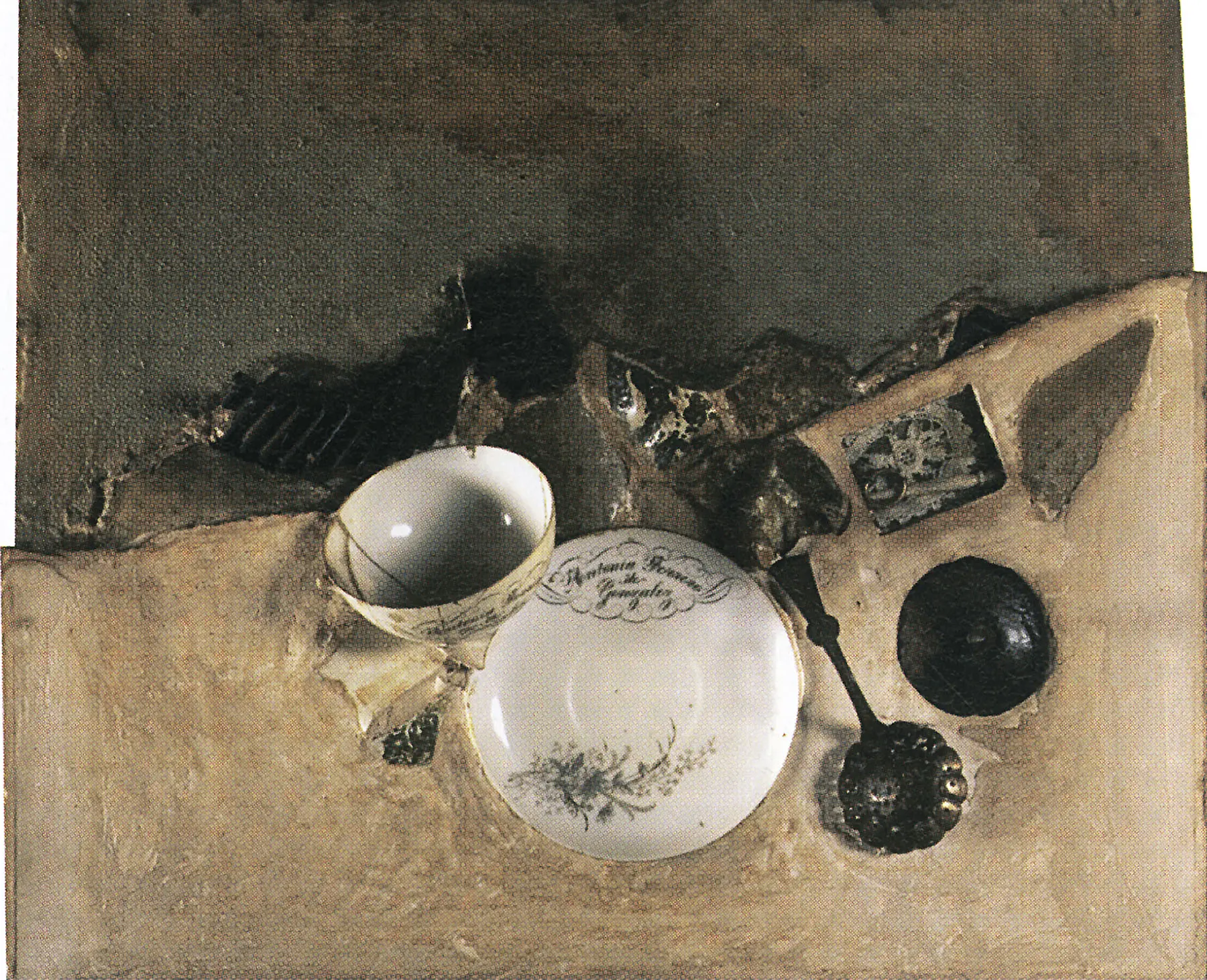
I must confess I was enchanted by Daza’s oil paintings. In the catalog for the show, we can see some very interesting paintings from 1966: urban landscapes of coffee cups as their solitary protagonists on tables, in paintings where the artist is an observer of her surroundings; the protagonist of these paintings is hidden and silent but has left traces in a private space that is subtly threatened by the city. These early paintings are done in cold hues and with sparsely detailed shapes that nevertheless stop short of abstraction. Rather, these forms come closer to Torres García’s constructive universalism, enveloped in the climate of London or Paris, with filtered sun. To me, paintings that capture an atmospheric and emotional climate are always welcome, and I think that in them Beatriz Daza displayed her skill as a narrator, arranging all the elements in order to tell the story of someone that is never revealed. It would seem to be someone who just takes note, half-hidden in a café, protected by objects.
The story goes that around 1960 Beatriz Daza built a ceramic mural in the house of painter Antonio Roda; the three-dimensional collages she is best known for started appearing in her work right after that, in 1961. These are plaster surfaces, like rectangular frames, and on them, Daza encrusted ceramic fragments and pieces of utilitarian objects, and even a small butterfly seemingly encased in time. These walls are like inventories of things, of breakfasts, of tea-time conversations; they are inventories of moments. Some of their titles are very apt, as they suggest situations: Jarra incrustada en mi memoria; Acontecimientos del sábado; Cosas y también la manzana; Hace mucho tiempo. They are like small visible moments of a contained story that was surely revelatory, but remains secret.
Equally interesting is Daza’s two-dimensional works, pieces of print fabric attached to cardboard or canvas. The fragments coexist with drawings of pitchers or melons that at times resemble the work of Amelia Peláez. Beatriz Daza’s drawings appear simple but explore inverted points of view, aerial perspectives, agglomerations, and repetitions of patterns. These paintings/collages, some of them in large format, possess the charm of the commonplace that becomes an inevitable presence, and because of that allows us to test different descriptive experiences. It is interesting to think of Colombian artists like Beatriz Daza and Olga de Amaral, who in the 1960s combined an interest in the most primitive textures and materials, such as clay and natural fibers, with structuralism derived from the knowledge of what each material was able to achieve. Perhaps this would have been a good moment to invite the many Colombian female artists who explore, in their own way, life in their own home; I say this, at any rate, as part of what I wrote before about creating tension with the present. Whatever the case, it was good to see again the work of Beatriz Daza, for its narrative capacity on the basis of a small fragment of every day: the set table that is always a ritual. For the way, she leaves her stories in a place filled with many emotional possibilities, without turning the work into a manifesto. For the colors and superpositions of points of view that give her work the structure of simultaneous conversations. For her touching utilitarian objects. For her limber yet well-informed draftsmanship, and for her way of experimenting with technique without painting herself into a corner. This is an open, erotic kind of work, ready to be revisited.
NATALIA GUTIÉRREZ
Professor at Universidad Nacional de Colombia.