
(In)Seguridad, Tipos de Guardaespaldas en
América Latina is an ongoing
photographic investigation. The main purpose of this project by Carla Verea
(born in 1978, Mexico City) is to document individuals who devote their lives to
“guard” others in exchange for a salary. In order to focus on these people and
honor the privacy of those they “protect,” Verea gives them nicknames and
blocks the surrounding context with a white panel, centering the viewer’s
attention on the individual in each photograph. The portraits have been shot
outdoors, like a field-research project, under natural light, and in medium
analog format.
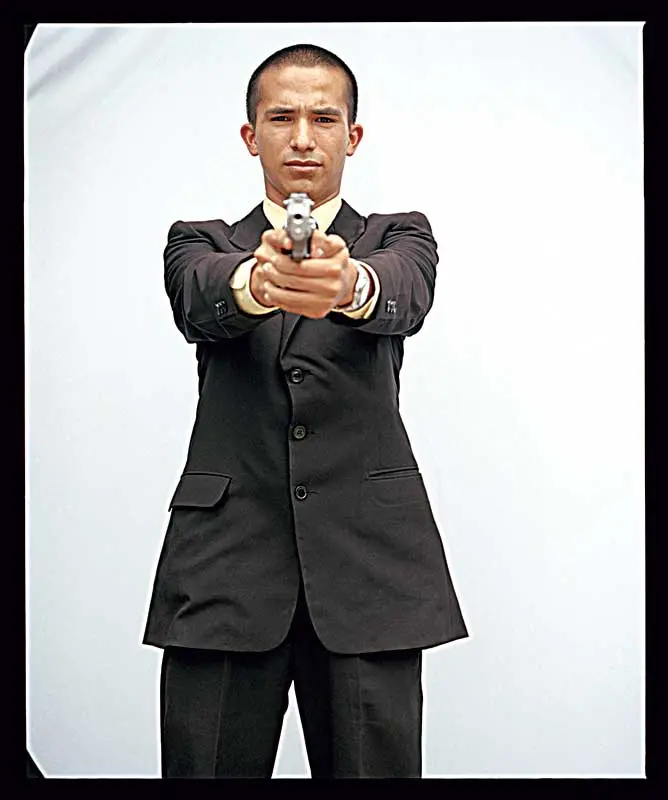
In this series, Verea has sought to document the wide spectrum of people that compose the growing workforce of “protection.” They run the gamut, from the most improvised to the ultra-trained, from rural to urban, occupying different socio-economic strata and varied in their skills with weapons and knowledge of security strategies. They range from those who protect hacienda managers with humble rifles formerly used by guerrillas to the highly trained and highly armed people in charge of security for potentates, statesmen, and presidents. Since 2003, Verea has photographed more than 250 bodyguards in Guatemala, Mexico, and Colombia as part of her project.
Verea’s recent exhibition occupied the first two galleries of the Álvarez Bravo Museum in the city of Oaxaca and included five small-format photographs, three monumental works, and a couple of slide-projection works. All of them belonged to the project’s first stage, which was shot in Guatemala.
As an introduction, the first gallery displayed the five small photographs: El tecnológico, Humilde, En Bici, Castro, and El Fox. Printed in color at twenty by twenty-four inches and placed behind glass in black frames, these provided a first impression of the content of the series. In this first gallery, which was accessed through black curtains that blocked ambient light, the spotlighting and the seriousness of the portraits highlighted five examples of bodyguards displaying their weapons, some boastfully. This illustrated the potential of the force that these individuals projected in their portraits. The scale of the prints made the subjects seem almost tame; they held and displayed the tools of their trade in a serious and very confident manner. The fact that the photographs were printed, framed, and placed behind glass made them seem like a catalog of “examples” of personal security. A small monitor displayed a slideshow of more portraits from the same series.
The discourse shifted radically in the second gallery. Here, three examples were aimed directly at the viewer. The monumental prints, measuring over two meters in height and presented without a boundary between photograph and viewer, generated a completely different feeling. Here, insecurity came into play. Now liberated and augmented in size, the individuals who protect and were protected behind glass in the first gallery boldly pointed their weapons at the viewer in the second. The attitude was entirely new, in both the scale and the way of presenting and understanding the images. Here, reflection took a radical turn and the observer was forced to rethink the ethics, morality, places, and spaces where these individuals carry out their work.
On some nights, some portraits were projected from the inside of the museum onto the window that overlooked the street. These projections interacted with public space and expanded the show’s borders, inviting people to look at the portraits without entering the museum. The projected images seemed to be behind the bars that protect the museum’s windows, which offered new meanings and readings of the work and complemented the ambivalent discourse about such individuals in today’s society.
The title of this exhibition has changed since its original presentation. With different selections of images, it has been presented and won awards in a variety of places since 2005, when it won First Prize for serial portraiture in Mexico’s Photojournalism Biennial. In 2007, the British Journal of Photography gave its annual award to Verea’s work, along with an exhibition of part of the series at the Association of Photographers Gallery in London. In 2008, the exhibition was selected for the SCAN festival’s Talent Latent show, which originated in Tarragona, Spain, and will travel during 2009 to several museums and cultural centers in Catalonia. The series has been selected for the thirteenth Photography Biennial in Mexico City in 2009.
FRANCISCA RIVERO-LAKE