
Paintings
by Delcy Morelos have always alluded to the body and to painting. The body
becomes present through the rendering of paint by means of the artist’s very
singular approach for generating transparencies through the accumulation of
pigment, the tones and colors she chooses, and the matter that is produced as a
result. Red hues would explode onto the white surface of her earlier works, and
the skin tones of her most recent pieces are achieved through the infinite layering of transparencies that turn in a dense pigment resembling blood, skin,
or internal organs of the body. It is also through this approach to painting,
the imagery created, and the dense matter gave rise so that Morelos is able to
establish a connection with pictorial traditions. At times the subject of such
great inquiry in the case of this artist, paint expands over the surface of
walls and envelopes us, becoming more alive than ever.
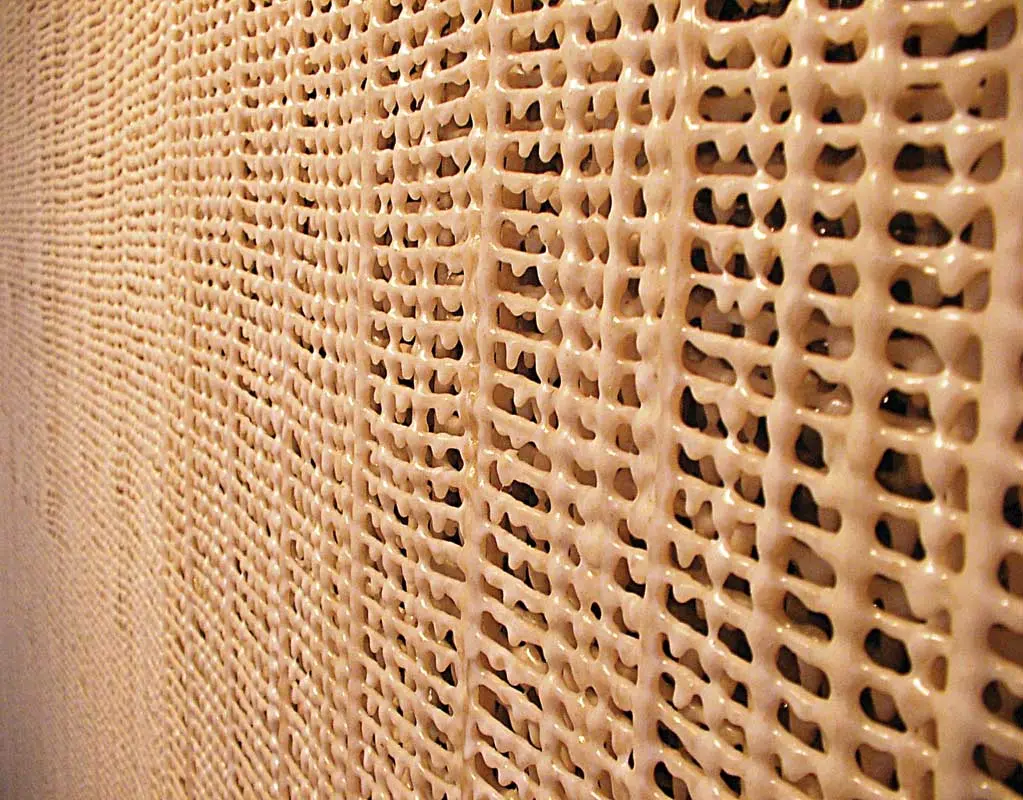
In her previous exhibit titled En la Trama Personal (In the Personal Weft, 2004), the structure from its very title becomes another essential element that addresses the theme of the body. It was in this exhibit that Morelos began stressing the idea of the weave: its thread expanding horizontally and intertwining with other vertical threads, as the warp was transformed in the central principle of the textile weave. The tissue in our bodies represents a similar structure, and our soft and bone tissues are contained in La Doble Negación, Morelos’ most recent exhibit at the Alonso Garcés Gallery.
As with her previous work, this exhibit is the result of a long and slow process in which the physical elaboration of the work—the craft—plays an important role. The support for each painting, thread, and the warp was handcrafted by Morelos in a handloom. Rather than working on a canvas, she constructed an orthogonal structure of little density, a sort of cotton mesh. Using a very soft brush, she then began applying layer upon layer of acrylic pigments. Tonally different in each painting, a saturation of the colors is achieved through the build-up of the transparencies, through the pigments layered one on top of the other. Once the color dried, it appears to have coagulated, and very thick layers of the bonding agent applied to the works cover the threads and pigments with a whitish, nearly transparent substance, similar to the manner in which fat covers our body tissues. The four walls in the main exhibit room were covered with varying tones of red paint ranging from light to dark and alluding to the soft tissue that encases our internal organs; inside the other smaller exhibit room, a sole wall was utilized to install a group of ivory-tinged paintings that similarly suggest human bone tissue. This organic quality can only be perceived when the spectator is within a very close approximation of each painting. Observed from a distance, the works do not convey the same effect.
On entering the exhibit space, the paintings included in this show appear to be monochromatic surfaces. The canvases, or more aptly, these very thin weaves overlaid in paint, have been installed on the lowest section of the very high gallery walls, creating the effect of a horizontal band wrapping the space. We feel as if we are before a very rigorous minimalist work.
The paintings are placed atop one another, generating a singular type of transparency, in a process that creates a sort of wall that effectively conveys the texture of a weave, but also of painting. It is through these transparency-sparking conversations on the color that I am able to understand not just references to the body, but also other references to painting and to the pictorial tradition. While in Morelos’ previous exhibit, En la Trama Personal, her work was associated with Bacon’s for the way of rendering the matter, the reference to the flesh, the openness of the body; and as well with Mondrian’s, due to the construction of grids and the wefts structuring her paintings; this time, there is something in the atmospheric quality of the installation that reminds me of Rothko. The horizontal band that wraps the exhibit room up in color makes me think of this great master of transparencies who resorted to minimal forms, opened the door to color field painting, and then to minimalism. The first feeling one has upon encountering Morelos’ installation is one of being within a vast color field immersed in a silent atmosphere. It reminds us of Rothko’s canvases and of the way these convey expanding chromatic spaces due more to their quality more than to the surfaces themselves. Rothko created backgrounds by washing the canvas time after time with transparent pigments that also covered the edges. Morelos’ horizontal bands floating over the surfaces were sometimes painted from the center toward the borders, at other times in inverse fashion, but always by blending the applied color with the background. This process has given the artist’s work a certain ethereal and spiritual quality. Notwithstanding this, the accumulative building of layers also bestows upon the work by Delcy Morelos a certain material quality that bonds the body with the paint.
The atmosphere of Doble Negativo, with its moderate color transitions and sober spatial disposition underscores the prevalence of paint as it expands over the walls. There is a desire to cover the spaces, to surround us, while at the same time pointing at the matter of our bodies and at nature of paint.
MARTA RODRÍGUEZ