Animal Farm, the huge installation by Federico Uribe at La Comunidad, in the
Wynwood district of Miami, Florida, contains a life-size farmer family
constructed of colored pencils and shown within a room, with flies hovering
above and framed images on the walls, depicting flocks of birds (fashioned with
pliers) in flight across the sky. The remaining exhibit space is filled with
several farm animals and a couple of imaginary beasts, such as a vacallo, a hybrid of a cow, and a horse. These creatures are created from
an assortment of objects, from clothes hangers to corks, pencils, sneaker
soles, and screwed-in pieces of wood. There are also trees and gardens
constructed of gardening tools. Some of these forms draw from earlier
installations by Uribe, such as Garden on Gardening
Tools, Por si los Moscos..., and
Human Nature.
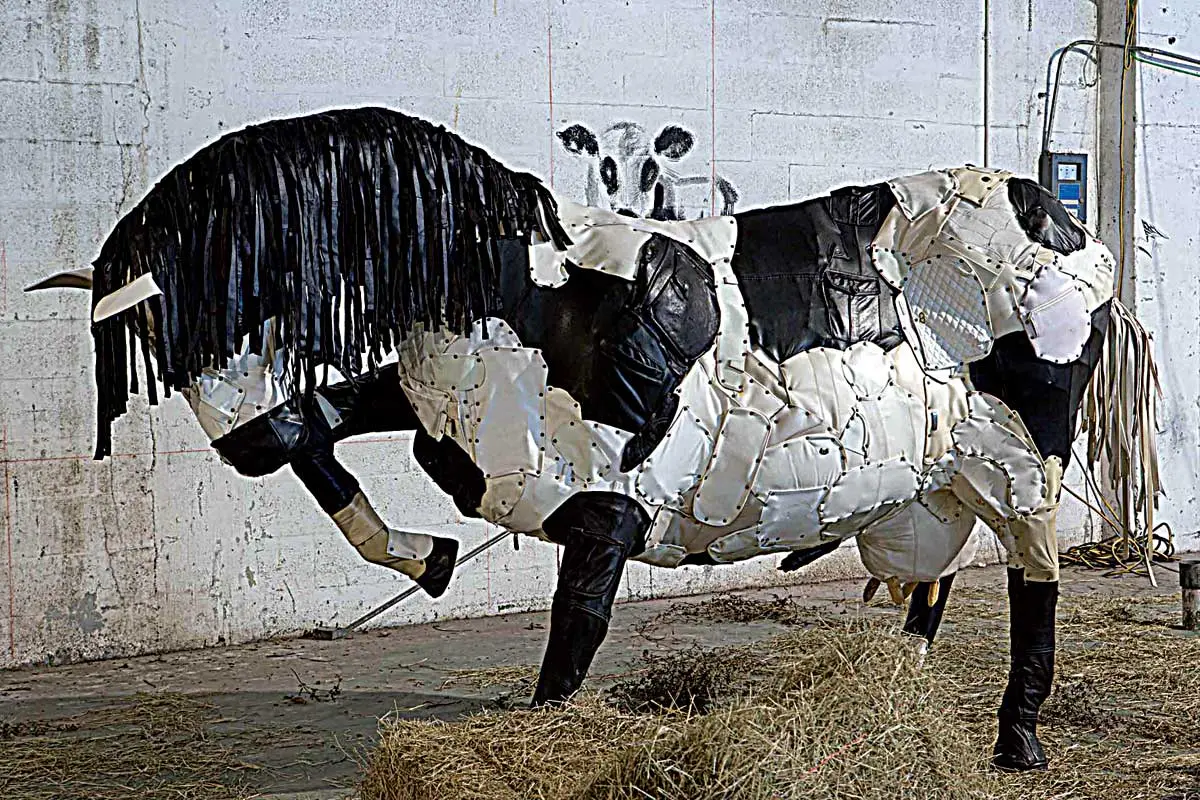
This mix-and-matched installation of materials, gender representations, and crossbred species evokes the unique characters in George Orwell’s tale but not the novel’s satire about the ruling political power. Hence, there is a donkey created out of red shoes and a sheep constructed of ping-pong balls. These are different from Uribe’s works with colored pencils from 2005 that satirized art historical figures from Ingres to Lautrec, depicting couples with perfect stances while other elements in the works contradicted this appearance. Here, there are no hidden, meta-artistic allusions or tensions in the family scene of this installation, unless the viewer reads something into the gender ambiguity of the mother figure.
This work, to date, the closest to a total world created by Uribe blends in a singular way the aesthetic freedom, humor, and playfulness of cartoons and an unusual relationship to the objective character of each piece. Uribe steps away from the iconographically valuable but emotionally distant relationship that Pop art had with objects. Instead, he establishes an intimate relationship with these objects, one charged with personal memories. The concept of a self-portrait is always present, but instead of appearing in the middle of the scene, Uribe—who is aware of the theatrical nature of his work—plays all of the roles: the creator of the characters, the assembler of the costumes, and the manager of the scenery, all the while drawing the viewer into a self-referential universe in which the artist is the mastermind.
Uribe resorts to the form of a theatrical set to recreate his vivid memories of the decade he spent on family farms, the only places where he could find fleeting happiness during his adolescence. Contact with nature mitigated the severity and strangeness that Uribe perceived in the adult world. In the company of farm animals (he treasured an old horse as his greatest worldly possession), he felt liberated from the group pressures of the school world that he hated. Uribe survived everyday urban life by creating for himself a universe of objects that he arranged as he pleased.
The nine years during the nineties when Uribe resided between Guadalajara and Mexico City was the same period that marked the work of Francis Alÿs and others, a generation that turned Mexico City into an arsenal of found objects and a conceptual workshop. This period was defining for Uribe due to his rediscovery of objects such as the hands of dolls, infant pacifiers, clothes hangers, and screws that he utilized to construct his installations. Animal Farm demonstrates his mastery of an idiom of great, spontaneous freedom that could be associated with certain aspects of French Neorealism or Pop. Nevertheless, Uribe’s work plays by its own set of rules. Relying on his memories and on a strong connection of his craft to everyday materials, Uribe fashions sculptures that generate a parallel world. There, cartoonish and unrefined simulations of reality merge with his game’s objective: to trigger the complex mechanism of emotions and to represent the human condition as it relates to its environment.
Each of Uribe’s figures possesses a symbolic meaning that is activated through interaction with the audience, not only through sight but also through touch. The function of the materials used is also powerful: Uribe not only wishes to generate memories of animals such as dogs, donkeys, or chickens (and characters in children stories and illustrations) but also desires to trigger unconscious associations through the materials that fashion such animals. He knows that every child had an early relationship with colored pencils and that the child possibly imagined or created objects from cork as well.
Uribe’s approach is against a Duchampian indifference to found objects; he is in search of precisely the opposite. Instead of exercising a disdain for the functional aspects of objects, the artist displaces their functions in the same manner that a child transforms an object under the guidelines of his/her imaginative play. Something that fascinates Uribe, which is evident by the care exuded from each finished piece, is the unity that can be achieved while making each object out of other objects. The emptiness that follows the work’s completion and separation from the artist can only be filled when the viewer is seduced to gaze upon it.
Uribe had painted an image of the vacallo roughly a decade earlier, before he found his identity as a sculptor. He nevertheless applied volume to his two-dimensional works to address a question he often asked as a child: why is it that two species cannot be crossbred? The sculptural version of the vacallo—created, as he says, “with great affection” and evocative of the beauty that freely roams the countryside—also addresses a transgression of established gender roles, a proposition that is diametrically opposed to the religious guilt present in Uribe’s paintings. The milk-giving horse offers a whimsical and liberating approximation of homosexuality.
Through a skillful rendering of the objects, masterful incorporation of materials, and a defiant playfulness (the headless donkey made of books is an allegory for intellectual discourse that fails to humanize), Uribe takes possession of space. He transmits his desire to generate an emotional experience, to attain through his work something he has experienced from dramas and narrations in which he finds beauty: “To take possession of the spectator’s soul.”
ADRIANA HERRERA