Recently
at the Thessa Herold Gallery, Gabriela Morawetz’s third solo exhibit (after two
others in 2003 and 2005) confirmed her mastery of the photographic medium. Over
time, Morawetz has developed a personal aesthetic treatment that is very close
to the painting. The elements of her mise en scène—nature (branches, trees) and
objects (mirrors, glass, fabric, and lace)—are constructed around the human
figure that is so central in her work, creating a poetic universe in which
transparency becomes a vehicle for illusions and dreams. The dreamlike thread
recurs and continuously weaves meaning through the mysterious universe that
this Polish-born artist has developed for many years. This phantasmagoric
atmosphere reminds one of the wonderful and menacing woods that appear in tales
from central Europe. At times, the landscapes rendered with chiaroscuro, veils,
fires, or branches immerse the viewer in a sort of labyrinth whose threads
provide rhythm for the permanence of an ancient time.
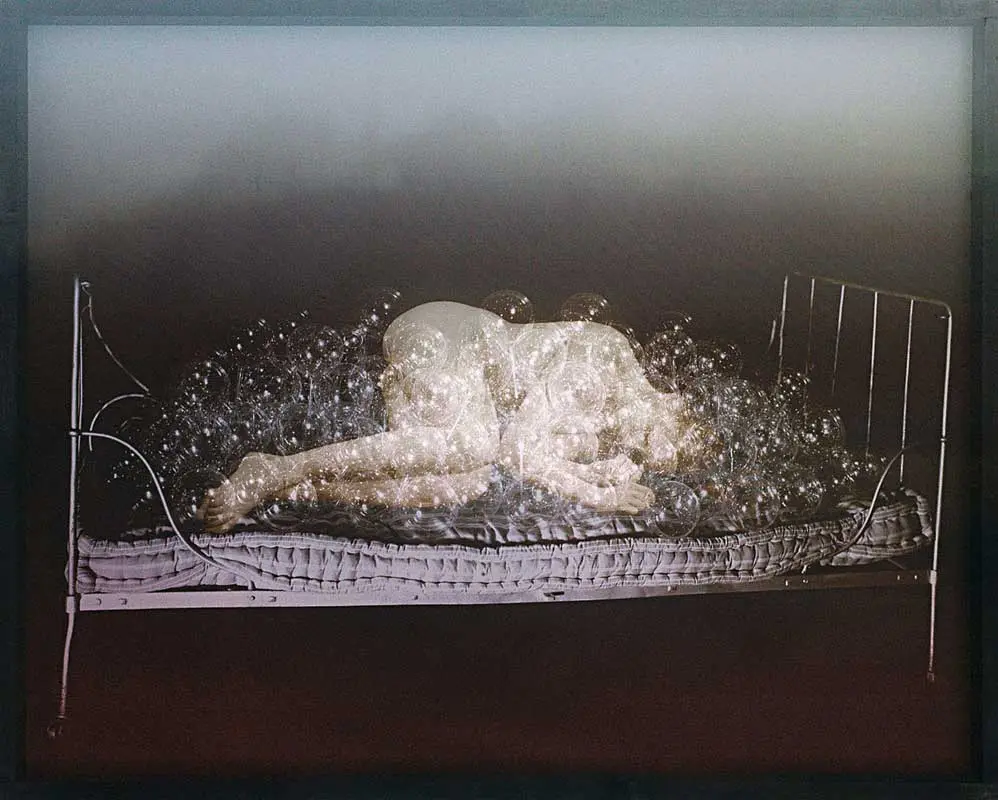
For this exhibition, The Sleeping Self, Morawetz chose a theme that is dear to her: dreams (as experienced when asleep) and their unavoidable expressions through illusions and fantasies. Life is a dream, as in the drama written by Pedro Calderón de la Barca, and Morawetz brought together life and dreams in her creations; her atemporal images could be perceived as parts of an adventurous voyage through the mundane. Whether her work was about daydreams or dreams from the depths of sleep, the reality of the displayed elements did not make her works esoteric or obscure, even as the images were surrounded by nebulous haloes that created ethereal atmospheres, ones full of secrets waiting to be revealed. Morawetz’s work invoked a meditation on the ambiguous relationship of dreams to reality.
Despite the modest size of the two exhibit rooms, Morawetz, and the gallerists designed a beautiful arrangement that focused the viewer’s senses on the quality of the forty-two exhibited works. The artist manipulated her two favorite media, photography and video, like a medieval alchemist. She modified the intensity or opacity of the light and transformed the images with pigments. The theme of dreams was already budding under a different form in her previous exhibit, Glancing Game. In that show, the contrasts between day and night, stability and movement, and mirrors and crystal balls introduced a phantasmic universe that was fully expressed in this most recent exhibit. In Glancing Game, the recurrence of concepts such as vertigo, background, angle, sky, sleepwalker, soul, or memory outlined a reflective and profound connection to the world, whereas in The Sleeping Self, anguish and fear were overcome through dreams.
In this exhibit, the crystal ball, the female figure, and the bedside book found their destiny as well as their origins in the bedroom. This bedroom was not only for dreaming; it also represented a scenario for pleasure and suffering. In this perpetual game between the mystical and the unveiled, between shadow and light, there was the woman dreaming of metamorphosis. The Sleeping Self VIII (pigmented photograph on canvas and veil, 104 x 130 x 8 cm) evoked water, with crystal balls as bubbles, and a literal and figurative immersion of the body. The Sleeping Self V (pigmented photograph on canvas and veil, 104 x 130 x 8 cm, 2008) suggested something like weakened intentionality; the face was obscured, as in every work from the series. The viewer could draw a parallel to another interior world, that of Bill Viola’s subaquatic videos. But Morawetz’s poetic escapade was even more palpable in The Sleeping Self II (pigmented photograph on canvas and veil, 104 x 130 x 8 cm) and The Sleeping Self I (pigmented photograph on canvas and veil, 104 x 130 x 8 cm). In these works, the body disappeared, giving way to the levitation of a sculpted head resting upon a pillow. Under a white sun or cold light, the bed and therefore the sleeper was transported to another natural place of hibernation, where leafless trees were nothing but lifeless silhouettes, witnesses that the passing of time has also been altered.
What holds the key to Morawetz’s dreams? The two words that she chose for her titles, “sleeping” and “self,” speak of the splitting from the body that begins with unconscious dreams. What is the evasive action to which she is referred? What was she attempting to say with these levitating, suspended, and floating states, in which figures were separated from the floor and appeared to take off—places where the air paradoxically created the density for a spectral universe? Escaping reality and observing from a distance, from above, to better recreate it: this is the true challenge that dreaming presents. To Morawetz, nature imposes itself as an integral part of an imaginary flight through a space that often bears a certain weight—represented by stones, hanging cords, hair-like nets, etc.—with very real limits.
For Morawetz, the bed is like an island. This was also the title of two of her works that featured text (printed on convex glass), and it was also present in her series Bedside Books, small photographic montages that included glass balls, wrinkled sheets, and body fragments.
Undoubtedly, one of the most powerful moments in the exhibit was the grand installation consisting of black-and-white photographs: a set of three “altars,” each with a large photograph (140 x 100 cm) and another eight to ten smaller photographs placed below the larger ones. The three installations titled I Dreamt That… (II, III, and IV; each 140 x 100 x 50 cm), immersed the visitor in a vertigo induced by the huge vertical images. The dialogue between evasion and confinement, and between fluidity and density, turned this Bachelard-esque universe of water and fire into an incendiary matrix, in which opposing and complementary forces were engaged in a continuous struggle.
CHRISTINE FRÈROT