
I must confess I have been a follower
of Jacobo Borges since the time he had his shows at Galería Estudio Actual, in
Chacaíto, around 1979, or in the early 1980s. Some works by Borges are
veritable landmarks in Venezuelan art, like La Coronación de Napoleón, Ha
comenzado el espectáculo, Todos a la fiesta (FMN-GAN Collection,) or also shows like La
Comunión, or his works referred to La
Montaña y su tiempo.
We have followed his trajectory since then, and it has been studied by intellectuals as prestigious as Traba, Juan Calzadilla, Roberto Guevara, Dore Ashton, María Elena Ramos, Bélgica Rodríguez, among others. Jacobo Borges has always been an ingenious and prodigious artist, not only as a painter but also in film, photography, video, and cultural spectacles, as when Caracas, his native city, turned 400 and he prepared Imagen de Caracas. Now, after shows in Germany, Austria, and New York, and visits to Barquisimeto, he returns for a week, with greatly increased vigor, to present us with a beautiful exhibition in the “duborcon” technique, based on color and the eminently virtual aspect of the world of computers.
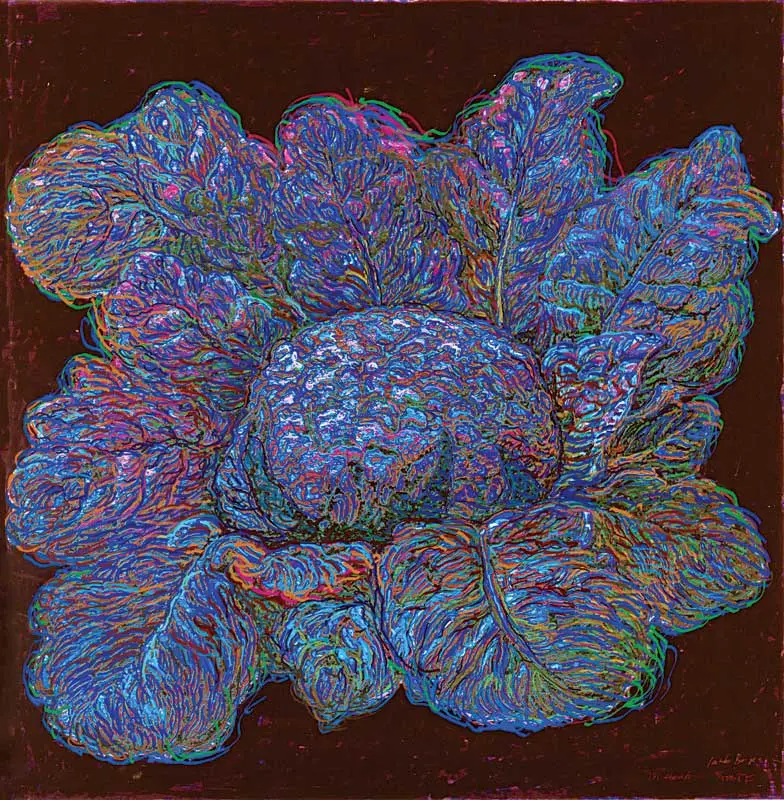
The exhibition of these recent works by Borges, titled El color en un observador de hojas aserradas y bulbos was presented at Galería Freites. He once again surprises us as a versatile, astoundingly imaginative artist. Without abandoning his painterly craft, he enters fully into technology, into the virtual, in the same way, Alejandro Otero did in the 1990s. Only that Borges comes to us in a most informal way, unique and possessing a transcendentally playful and joyful character. A valid and special facet, in that it brings forth and contains innovative, frank, decidedly abstract visual proposals, despite the fact that abstraction is not his main quest or his most necessary goal.
In this case, what we have is a tribute to nature, to organic life, based on contemporary technological media. He explores and achieves surprisingly plastic effects from multiple plottings of color, like tracings and lines that accumulate, remake themselves, disappear and appear at once, in order to generate pathways and infinite sojourns, conflagrations, and movements that are self-concentrated as epicenter, centripetal, and centrifugal forces that turn volatile, volcanic, and break into pathways to remind us of figurative scenes. However, this isn’t either the painter’s main leitmotiv.
Borges throws a party based on color, on the sign, on calligraphic elements that become ideograms of infinite and even cosmic spaces. He creates a unique, versatile cosmogony of color and of informal drawing, from the primeval of Man who returns to the origins of the child, to the source of lines that move like chromatic spermatozoa seeking the uterus and life.
The revealed or hidden idea carries a whole value charge regarding the trade of being a painter, and the creative the potency of our Borges; a Borges who never ceases to play with chromatism and peeks into the everyday character of the detail, as well as what is transcendent and original in a line repeated ad infinitum. Figuration and abstraction are left behind, and what appears is only color, life, a microscopic and vegetal world, the holistic and natural vision of cabbage, a flower, a leaf, an invention of the purest and most genuine graphism, nervous, unconscious, unpremeditated. Spiritual essences, cores and centers of the universe tend to unfold and fill all available space to bring forth an unusual, even infantile Baroquism, created with the wisdom of the Master who carries in him a knowledge acquired in the long journey of his life and artistic trajectory.
The entire universe is concentrated in each one of these irreverent and significant works, emblematic in their graphism, color, and line, filled with overwhelming force. What is surprising is that in Borges, as in all true artists, there is always the possibility of achieving masterful works from nothing and everything. He innovates and investigates constantly, and is now allied to the new means for artistic creation.
WILLY ARANGUREN