
There is a
French expression that refers to memory and learning: apprendre par coeur. Its literal English translation means to learn by
heart. It is a certain manner implies an affective relationship with that being
learned and evokes the idea of “showing goodwill”, in other words, doing
something with sincerity.
The exhibit of drawings by Juan Mejía titled Des Artistes Français que J’aime alludes to these interactions between rationality and our affections. The drawings, fashioned like school chalkboards, propose a survey of the artist’s affections toward the history of French art, art the majority of us have come to know through book reproductions and slides, with all the obstacles this implies. We assimilated it through stories related to us by a professor or an author. In other words, we received a translated version with the same level of interpretation as Mejía’s drawings.
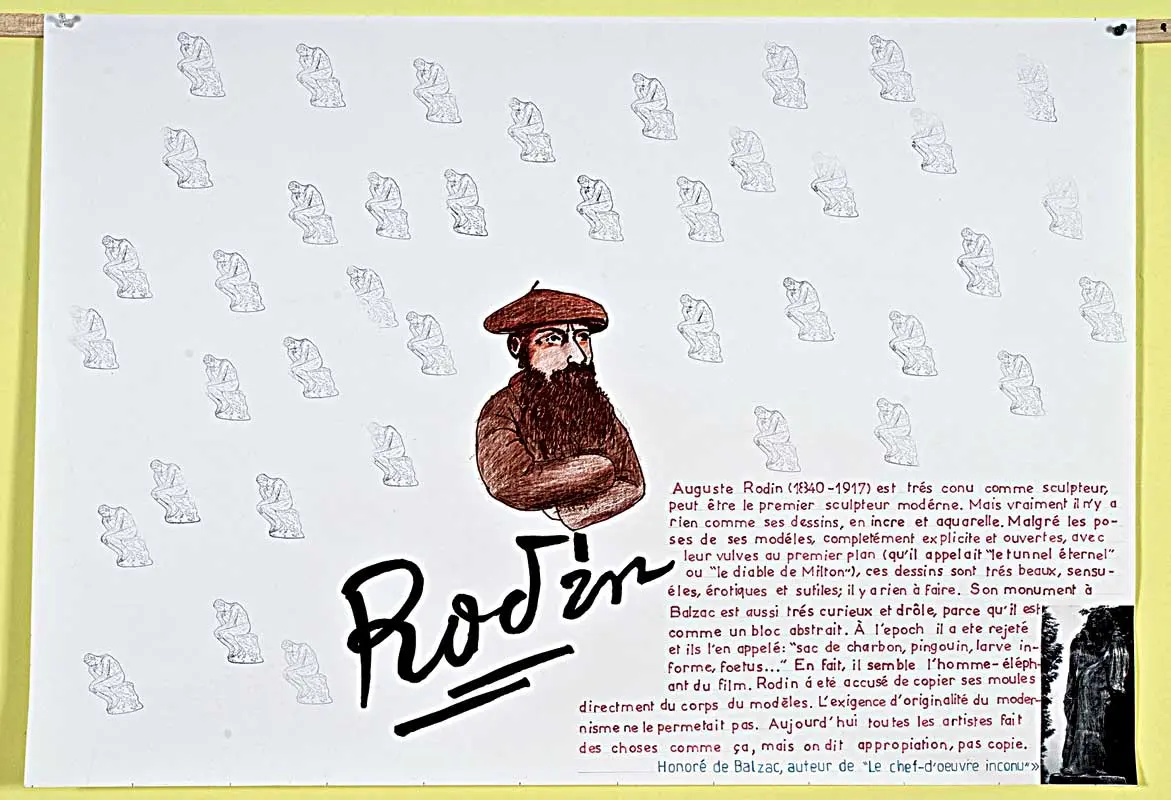
French art – understood as the art that determines notions of good taste – was taught to illustrate Brazilians during the times of João VI. This is the art that can be observed at the Louvre and at the George Pompidou Center; these examples of “good art” represent what is at the center of Juan Mejía’s proposal. Mejía addresses this art from a non-official perspective – in a manner of speaking – as he candidly describes and illustrates such art, having rejected the rigid structure imposed by the history of classical art.
To an artist such as Juan Mejía who has a long-standing tradition in drawing and in being an avid student of art history, it must be difficult attempting to rid oneself of an academicism that could permeate the stories he tells, the way in which he narrates them, and the execution of his drawings. This act of revisiting – after the passage of time – something already known and to approach it with a fresh gaze, without prejudice, as it is drawn from memory, is something that characterizes the artist’s work.
In Des Artistes Français que J’aime, Mejía utilizes drawing as a mnemonic mechanism as he sets out to trace information back based on the image source – a mental image first, and then the physical one. It can be said that he is not only drawing from memory but also that he is rendering the image in the same fragmented, sometimes incoherent way that memory does. Mejía’s thoughts on French artists unfold onto the paper as he treats each of them in the same manner: as an assignment. He resorts to French to write on his boards, and it becomes evident the language is not his mother tongue. Ideas that are sometimes presented as specialized knowledge are stated with a certain degree of clumsiness that strips them from any erudite pretenses. His mistakes in French are highlighted by the corrections he requested from professors at the Alianza Colombo-Francesa in Cali and in Bogotá. With that scholarly intervention, Mejía sets in motion through this learning process the relationships of power between teacher and student all over again.
One element underscored in this series is the issue regarding “taste”. What rules it? What determines it? Is it true that the vision of a few can guide that of the rest, as proposed during the Enlightenment? Or, is it something we all possess?
It is generally accepted that French museums and French art set the standard when it came to educating us on what “good art” is. Notwithstanding that Juan Mejía refers to the French artists he likes, he introduces this notion of taste with a hint of irony. One is not completely comfortable with his descriptions and reproductions: there is something somehow unpleasant in the drawings and also in the notion of transferring the art of such erudition onto Bristol boards, or seemingly choosing to exhibit the works at the Alianza Colombo–Francesa – because of its standing as an educational institution. Mejía approaches the art class from another perspective. In showing us only the affections he has toward the works and rejecting their canons – and everything else that supposedly makes them masterpieces and that turn artist into great masters – Mejía provides us with a clue to his critical approach.
Mejía transforms French art from a symbol of refinement into school images that are, at times, naïve. His drawings explore, with a somewhat innocent gaze, “the artists he likes”. Immersed in the art world – often hermetic and complicated – and its history – frequently written with scientific detachment – Mejía recuperates this pleasure from that a first fresh look at the French works, as he describes some by Duchamp, Buren, Manet, Delacroix, and Monet, among others, according to what he knows and remembers of each and the things that interest him about the artists and their works. This sometimes anecdotal approach enriches the exercise: it is not art history from textbooks; it is definitely a history of French art par coeur.
MARÍA CLARA BERNAL