At the time of his death, Julio Zadik
(1916-2002) was practically unknown in the Guatemalan art world. He had been
widely active between the 1930s and 1960s and was one of the few Guatemalan
photographers of the period to gain a level of international recognition, but
his early retirement from public life as an artist had condemned him to
obscurity. After his death, some members of his family promoted the cataloging
of the extensive archive Zadik left behind and made it available to
specialists. The result of this process was a recently published, exquisite
book about his work that includes critical texts and an exhaustive chronology,
as well as the present exhibition.
This exhibition works as a kind of retrospective, although that wasn’t the initial intent of the project, which doesn’t include photographs from every period in Zadik’s oeuvre. Focusing on works from his most productive period as a photographer provides an overarching and almost complete account of his career. The outstanding quality and quantity of the works left by Zadik allowed the show’s curator, Valia Garzón, to select samples from a vas pool. The painstaking care is taken in the compilation of the archive also plays in favor of the study of Zadik’s work. The impeccable preservation of the archive made it possible for posthumous prints of some of the negatives to be made.
Calle empedrada, from 1952, stands out for its lyrical quality. The image is, it seems, that of a sunrise in a small Guatemalan town, with a group of traditionally attired indigenous people en route to their daily chores. The scene was captured by Zadik’s lens just as fog descended and enveloped the landscape. The resulting photograph reveals a meticulous study of light. Its diffuse effect softens the image, giving it an almost mystical aura. The bodies become silhouettes and the contrast in tone is very subtle, integrated in a highly natural way.
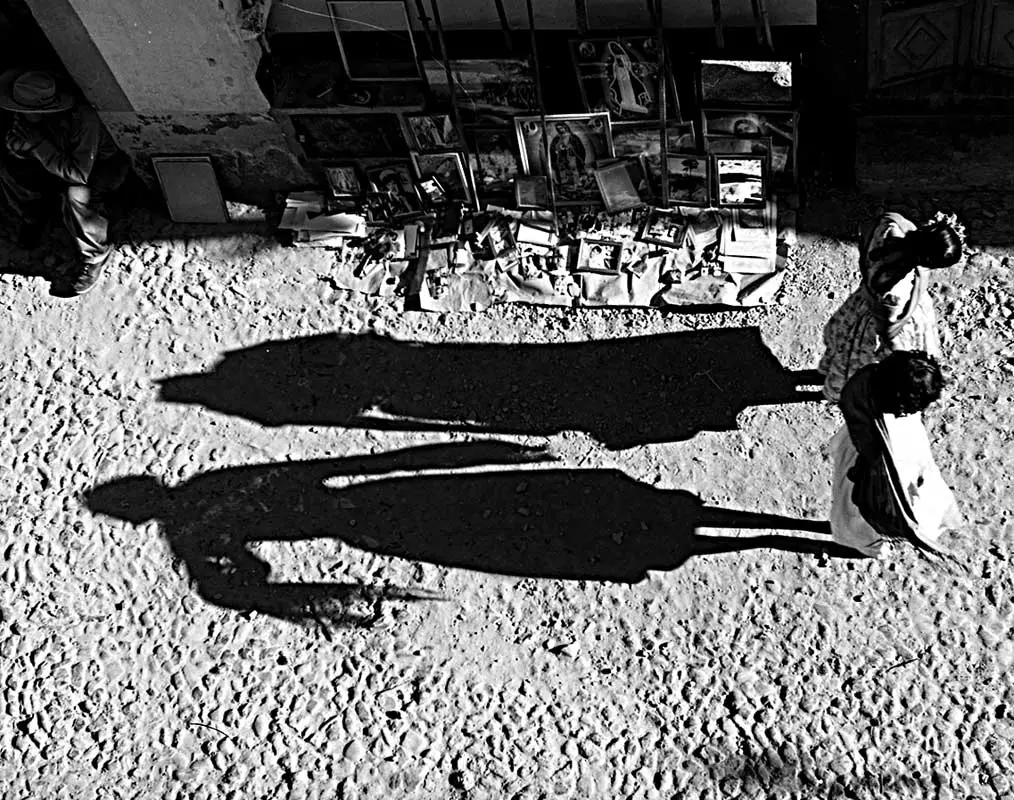
Another stirring image is Viaje Mexico Taxco, from 1958, a view of a narrow street filled with religious images. Two indigenous women walk as their elongated shadows are projected on the street. The picture was taken from a high angle, maybe a second story, an unusual perspective that gives us the advantageous position of a solitary and omnipresent viewer, an observer that remains unnoticed by the characters in his photograph.
An interesting subset of Zadik’s oeuvre is his studies of Guatemalan nature. Although nature photography may seem clichéd and more interesting to amateurs, Zadik’s is a case apart, with very elaborate and professional compositions. His nature work captured the beauty of the Guatemalan landscape and includes photographs of indisputable aesthetic value. Going beyond conventional vistas, Zadik included unusual elements such as the trace of raindrops, prints on the sand, the movement of water, and fragments of plants. His selective gaze drove him to create several nearly abstract images, revealing his desire to experiment, to reach beyond the “well done” photograph.
Judging Zadik’s work as a whole, we see that was highly unconventional for the time in which he lived. His interest in the human form resulted in the production of a remarkable number of male and female nudes, images that he explored as a theme and form to his entire satisfaction. The kind of lighting he used and the contrasts he achieved in many of these photographs reveal the care he took for their composition, which makes evident his respect for the human models. These works are exhibited here for the first time.
Zadik’s photographs are also graphic witnesses to a specific period in Guatemalan life, to many places and customs that have vanished. His images, while reflecting the social environment, do not imply a critical attitude but a calm approach to the theme and an appreciation for its diversity. Zadik found in photography a means of personal expression and didn’t intend to make large pronouncements about reality. What placed him behind the camera was his curiosity and eagerness for the new technology.
This careful selection of 95 photographs offer an encompassing, complete view of Zadik’s work. Besides presenting us with an excellent opportunity to study his oeuvre in particular, in a way it also proposes the revision of our ideas about Central American photography in the period and a revaluation of his practitioners according to their context.
IRINA LEYVA