
This most
recent exhibition by the Argentine artist, at a young and dynamic gallery
located nearby the Georges Pompidou Center, offers a limited selection of
works: two installations, three laser-perforated stainless steel sculptures,
and four photographs. Despite the limitations of the space, a great aesthetic
and intellectual coherence, at once rigorous and sensible, imposes itself on
the visitor’s gaze. For some years now, Marie Orensanz’s project has been
founded on the search for a dialog with the viewer. A subtle, at times
subliminal message, never emphatic yet ever-present, materially or otherwise,
traverses the space of the exhibition. This space, which Italian artist Claudio
Parmiggiani calls “blood of the work,” has, emotionally speaking, a dual value
in Orensanz’s art. She has been playing with geometry and space since the 1960s, which has allowed her to experiment, to excellent results, with many
materials (paper, Plexiglas, cardboard, etc.) Today, what is double
interrogated is empty space, through the act of perforation operated on the
steel or aluminum in her recent metal works. Indeed, it is truly empty space,
that open space in the matter, that creates the site of meaning. There resides the
intelligence of this dual work where text and matter, thought and form,
emptiness, and fullness cross paths and mesh with each other.
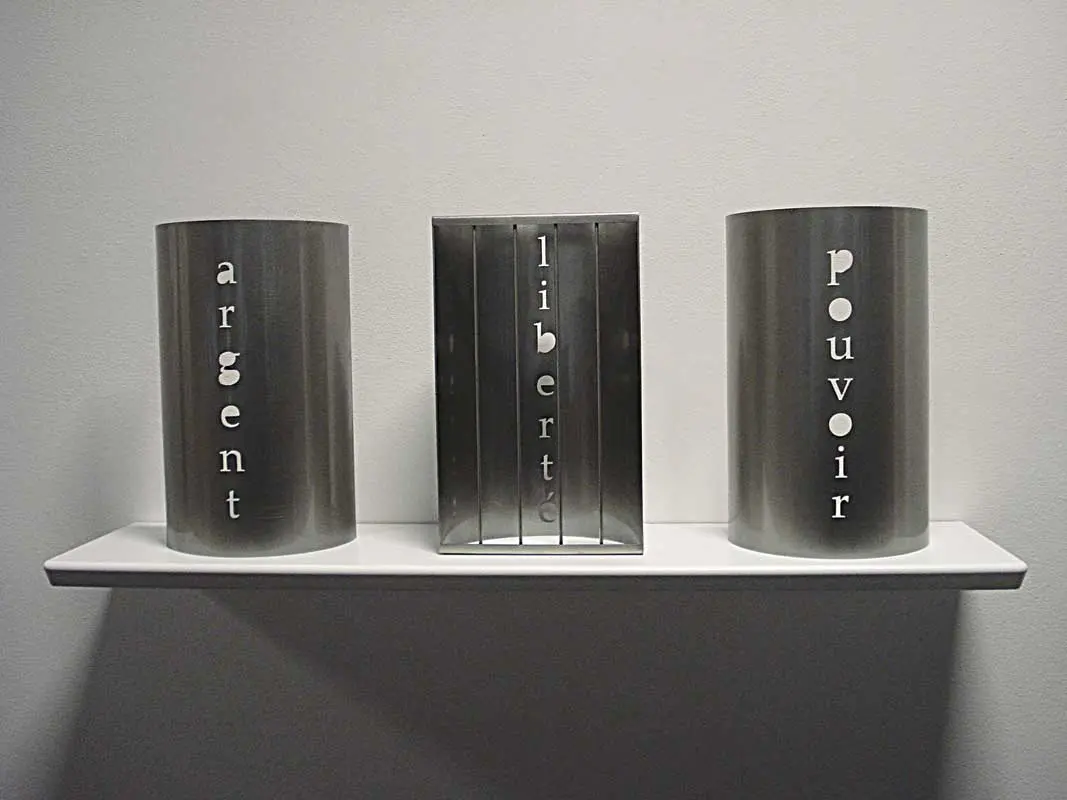
The artist demands effort on the part of the viewer to approach her perforated sculptures, as well as to understand her installations. In the empty space left by the incision there appear letters, words, and phrases enunciated in the manner of aphorisms that are “launched” into space, “thoughts offered to air,” as Marie Orensanz described them, “impalpable and immaterial,” asking for the viewer’s attention, opening up a path to an almost unmediated perception. In this artist’s work, eternal themes such as violence, fraternity, power, freedom, or money, possess an unquestionable political dimension, which one critic recently dubbed “militant humanism.” As far as mirrors, reflection, and transparency, they share the same discursive logic. The relationship created between them constructs an interrogation about illusion, loneliness, and vanity, by means of a great lucidity that at times develops a varnish of irony. But this is not a negative kind of thought, even when dominated by doubt. Behind the questions are certitudes, and the materialization of these themes expresses, in Orensanz, a permanently alert consciousness. The show shows clearly that these ideas, while dispersing in space, are the links in a wider-scope thought articulated by Marie Orensanz for many years, a “fragmented” thought that is reconstituted and ends up forming a whole in vision and reflection, partaking of that theory of “Fragmentarism” that the artist developed in the 1970s, on the basis of pieces of marble.
Several works in the show grab our attention. First, the installation ¿Para quién?... los honores… (13 white glass bells with perforated steel tongues,) already shown in Buenos Aires on the occasion of the great retrospective of the artist’s work in 2002. There she deals with the issue of the contemporary artist’s condition and the social contradictions to which she is subjected, while in another, a more metaphorical installation she speaks of the inevitable confrontation, not just visual but mental as well, with oneself. … Nada más que… (2007) is comprised of one-half of a wooden bridge that the visitor can climb. The structure is in turn supported on a large mirror. In this way, it shows us a dead-end path, metaphor for illusion, a mirror in which one can be lost, bedazzled, and blinded by one’s own reflection.
The aluminum sculpture Dinero, Libertad, Poder (perforated stainless steel triptych, 38 x 17 x 9 cm, 2008,) is comprised of three semi-cylinders, two of which are convex ("Money " and "Power") and one concave; in the latter, the word "Freedom" appears behind what seems like the bars of a prison cell. One form of meditation on what constitutes the pillars of contemporary society, with the risks attendant to the very desire of possession. The show’s four photographs (59 x 49 cm, 2004-2008) are montages based on everyday objects, mostly old, and the image is accompanied by a related elliptical or interrogative phrase. The clash generated by the confrontation of objects and text induces meaning. In Fraternidad there are knives stuck to a wooden support. In E.N. Escalada we are shown an open toolbox containing a revolver, a pretext to symbolize the increase in social violence, while the initials evoke a hypothetical actor of such violence. The photograph titled Era … hora attempts to evoke the return to democracy in Argentina. The artist used the pendulum of an old clock, bought in France, inscribed with the letters R. A. To Orensanz, these initials could mean República Argentina. This is what allows her to inscribe on the side of the photograph of the object the words: era… hora. In this way, the artist meditates permanently about the state of the world, and the show she offers, subtle and precise, invites us to never lose sight of the fact that her art, thought through both in form and content, is in complete harmony with its era, and in consequence, it naturally imposes itself as contemporary.
CHRISTINE FRÈROT