
To the
Wayúu, Maleiwa means “Creator of the Universe”. According to the legends of this
indigenous group, Mareiwa (or Ma.lei’wa) was the creator of human beings,
animals, and everything in the universe. It was he who distributed the cattle
among the different clans. Each clan brands their livestock with a stamp made
with the hot irons that Maleiwa has provided them. This mark distinguished each
of the Wayúu clans. This is why these social groups are dependent upon this
supreme being never beheld by human eyes.
The name Maleiwa carries profound significance for this culture. It is no accident that Milton Becerra’s most recent exhibit at the Centro de Arte de Maracaibo Lía Bermúdez (Lía Bermúdez Maracaibo Art Center) is named after this deity, for this conveys, according to Becerra, the idea of creation in its highest and most sublime sense. It is also a way of speaking directly to the Wayúu people, on their own turf, about essential aspects of their mythology in terms of contemporary art. It is noteworthy that more than 60,000 Wayúu people live in Maracaibo. This group is also disseminated with no regard for borders across Colombia and Venezuela, throughout the vast and arid Guajira region.
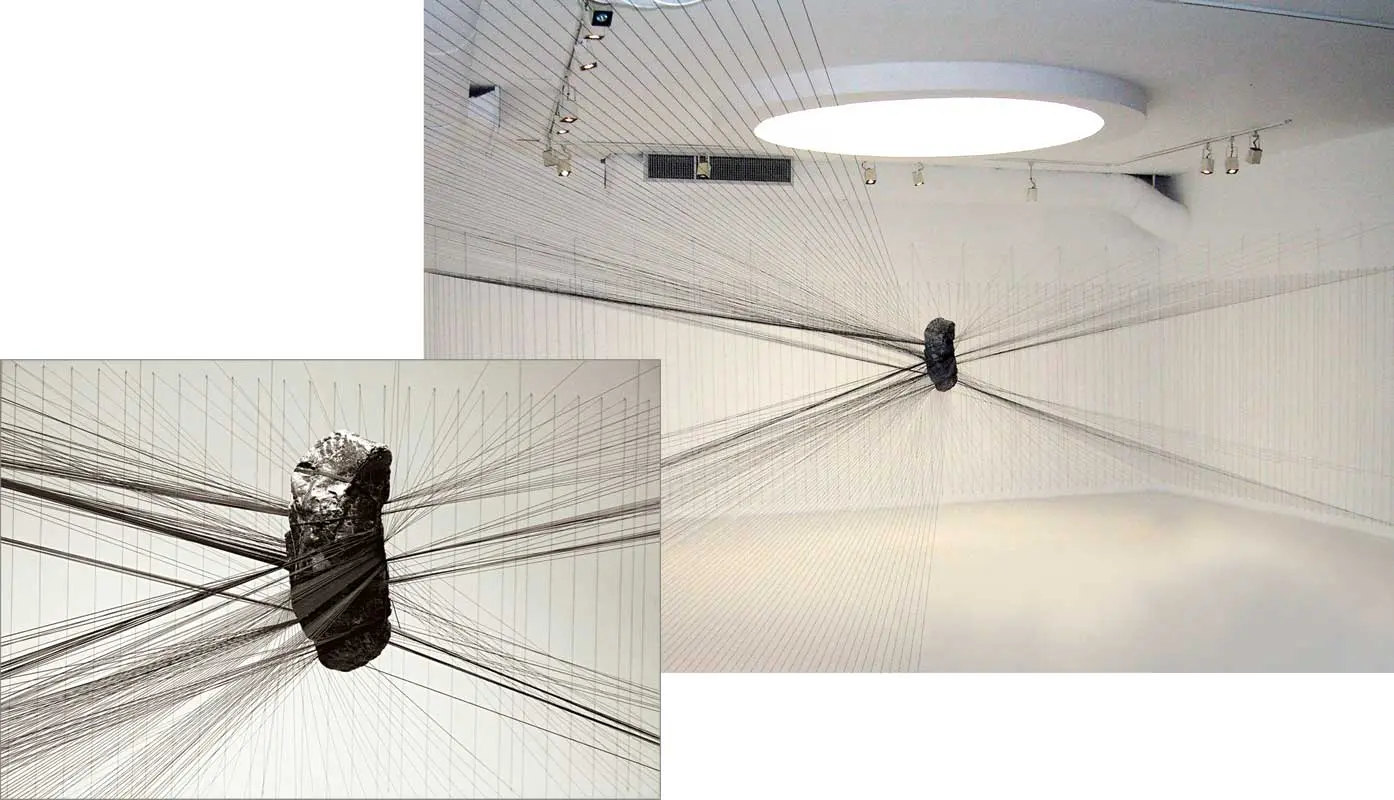
Since the decade of the Seventies, Becerra has been immersed in research on the origins of creation, using as reference our ancient past. In this particular instance, he has assimilated Wayúu mythology and the reality of art. In this series, Becerra adopts and reinterprets all the elements in nature created by Maleiwa. In Exhibit room 3, Becerra presents bi-dimensional works fashioned with weaves and stones that underscore several aspects of the natural world: Sükapülairuwa (Thunder); Jolotsü (Morning Star); animals such as the worm in Jokomairuwa and an object such as the collar in Aüliijunaa. In all these works, the artist has focused on one of the precepts that motivate him to continue employing weaves. Becerra affirms that “To me, creating can be found in the blood and in the secrets kept in threads; it is the art of expressing life. Geometrical transformations represent an intellectualized way of seeing the world”. Weaving is a form of metaphorically expressing life in its perpetual occurrence. It is also, structurally speaking, the organizing element of things: the thread ties the stone – the center of energy and points to where the gaze is pulled – but it also organizes the pictorial surface and space itself. This can be observed in Becerra’s masterful installation titled Línea Continua (Continuous Line) of 2006, at the end of the exhibit room. A jadeite stone suspended with numerous cords acts as the vanishing point of a projection of lines drawn into space. These simulate the rapid orbit of a meteor as these also render a measured grid on the walls of the exhibit room. Once again, Becerra defies gravity by conferring lightness to the stone and in so doing, the installation becomes one of the most aerial and immaterial proposals he has ever created.
The weave effectively intellectualizes a vision of the world; because it organizes it. This artist has assimilated the teachings of Venezuelan masters of kinetic art such as Jesús Rafael Soto and Carlos Cruz-Díez. Somehow, this tradition is evidenced in the utilization of threads as structural elements in many of Becerra’s pieces. Nevertheless, these are not rationally constructive, precisely because of the specific autochthonous references he uses. This is the characteristic that distinguishes him. In works such as Constelaciones (Constellations) and other mobiles fashioned of wire and weave, for example, the experience with levity and immateriality reminds us to a certain extent of the drawings without paper by Gego, created during the Eighties. However, the utilization of natural fibers and weaves is unique to Becerra’s style and discourse. The manner of knotting and working the forms are trademarks that easily identify this artist. He succeeds in integrating indigenous identity with the abstract-geometrical tradition so central to modern and contemporary Venezuelan art. Aware of his constructivist formation, Becerra applies it toward maintaining a connection with the central theme of the exhibit and as a clear way to address the Wayúu culture. Weaving happens to be an essential activity for these communities.
Cattle husbandry is also a central part of the way of life and survival of the Wayúu. Thus, the last exhibit room presents works and installations fashioned with skins. Becerra trims the skins, weaves them with skin strips, and creates mounds and several other forms; he hangs these as if they were meat hanging on hooks, or also carves on them fictitious maps. In these drawings on skins, there is also a geometrical approach that intuitively alludes to indigenous graphs.
In Maleiwa, Becerra approaches the world of the Wayúu with a reinterpretation of their real space, myths, and symbology, as he delves with contemporaneous vision into the roots that identify such a world.
SUSANA BENKO