
There is a
new generation of Puerto Rican artists, who are mainly in their mid-twenties,
whose aesthetic and ethical discourses are very different from those of the
previous two generations, the internationalized Nineties Generation (such as
Allora & Calzadilla, Jesus “Bubu” Negron, Chemi Rosado Seijo, Nayda
Collazo, Rambranat Diaz, Ada Bobonis, and Aaron Salabarrias) and the Turn of
the Century Generation (such as Michael Linares, Melvin Martinez, Aby Ruiz,
Cacheila Soto, and Radames Figueroa). These new young artists express
themselves in very different
ways, from postmodern Pop paintings, to socially, ecologically, and politically
charged three-dimensional works of art, from surrealist and/or existentialist
videos to gallery graffiti. They use all the freedoms they have inherited to
construct a healthy eclecticism that intelligently communicates their feelings
at this difficult globalized present.
With humor, sarcasm, irony, lyricism, and a postmodern, romantic approach to beauty, or the use of local and world history and politics, these artists present an extremely complex and at times a grim view of the present and future. Nonetheless, although they do not fantasize in the way artists did in the 1960s and 70s, most of them believe in a better future and are driven by hope.
One of the artists that truly stands out in this group of newcomers and is re-defining the visual arts in Puerto Rico is Ramon Miranda Beltran, who was born in 1982 and graduated from the University of Puerto Rico, Rio Piedras Campus, in 2008. Miranda Beltran uses historical photographs of Puerto Rico from the 1950s and the 60s to remind people that social and economic development during this period was complicated, controversial, and even disastrous, and that while everything seems to have changed, much has remained the same. His work evokes themes of Plato, Aristotle, Machiavelli, and Nietzsche.
Miranda Beltran has become an original, effective, and provocative visual “historian” and a controversial socio-political chronicler who mines one of Puerto Rico’s most important growth periods of its history, and especially of the twentieth century. This period was marked by the initiation and development of modern democracy in Puerto Rico and the difficult process of semi-industrialization commonly referred to as “Operation Bootstrap” (Operacion Manos a la Obra), the change from a poor agrarian society to one of mechanized work in newly created factories.
Art lovers and art connoisseurs did not realize the originality and excellence of Miranda Beltran’s work until he was chosen to exhibit two of his four-feet-square pieces in what has become the most important annual contest for young artists in Puerto Rico. His reputation has grown especially after his successful recent exhibition at Viota Gallery, titled Ramon Miranda Beltran: Todos Llevamos por Dentro Alguna Clase de Guerra Civil.
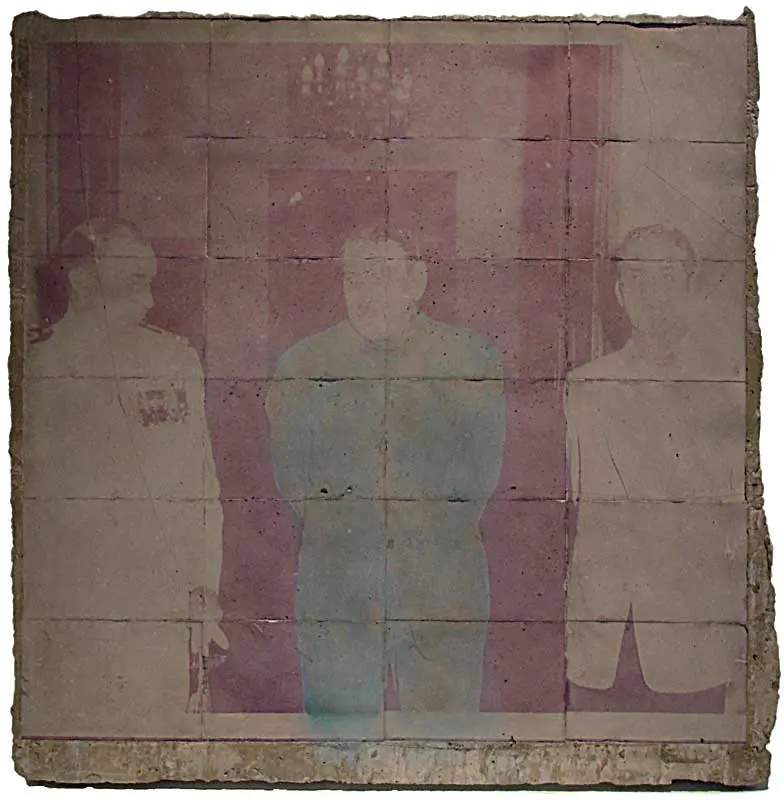
An artist who creates photographic three-dimensional works, Miranda Beltran chose a group of dramatic images of the most important man of twentieth-century Puerto Rican history: Luis Munoz Marin, the founder of the Popular Democratic Party, the first elected governor of Puerto Rico in 1948, and the architect of the island’s unique political status: the Commonwealth of Puerto Rico (el Estado Libre Asociado de Puerto Rico). These photographs capture key elements in the contemporary history of Puerto Rico: from Munoz Marin receiving control of the island from American generals to the process of semi-industrialization; from Munoz Marin pictured with the shoeless campesinos (jibaros) to the construction of cement houses; from images of Munoz Marin and his family to the moment he retired after sixteen years (four consecutive terms) and the “betrayal” of his personally chosen, innocuous, and dull successor, Roberto Sanchez Vilella. Miranda Beltran enlarged these photographs to epic proportions and transferred them to unorthodox cement panels. Why cement? According to the artist, “Cement is an urban element.” He says we are suffering a kind of civil war between cement and nature, between socio-economic selfishness and ecology, between madness and the green movement, between survival and death.
During his advanced photography classes at the University of Puerto Rico, Rio Piedras Campus, Miranda Beltran experimented with photographic images and their reactions to different supports. After the natural process of trial and error, guided by the photographer Guy Paizy, this daring young artist played with different cement surfaces and he developed what he has humbly labeled “fresco photography” or “photographic frescos.” Then he experimented with the different textures produced by cement and how they reacted to photographic emulsions, making each of his large photographic panels unique. Miranda Beltran had, in just one year, discovered a world of possibilities in which the photographic image (in this case, Puerto Rico’s history during the Cold War) and cement (which defined Puerto Rican progress from the 1950s) told part of the history of this complex island in the Caribbean.
At this period of his artistic career, Miranda Beltran has decided to share with the public some important moments in Puerto Rican history. These include the establishment of democracy in Puerto Rico—an island that up to the first decades of the twentieth century was poorer than Haiti—and the island’s development from a rural agrarian society to a semi-industrialized society. Although the artist clearly presents some of the advantages of these changes, he honestly questions whether, in the process, the island—and especially the idiosyncrasies of its people and the ecological beauty of La Isla del Encanto—suffered irreparable damage. The effects of these changes caused Lady Bird Johnson, the wife of former US President Lyndon Johnson, make her controversial and sad statement when she flew over the capital of Puerto Rico: “San Juan is a cement jungle.”
MANUEL ÁLVAREZ LEZAMA