Mundus Admirabilis e Outras Pragas (Mundus Admirabilis and Other Plagues) is the title and
connecting thread bringing together the pieces of the new and most surprising
series of works by artist Regina Silveira (1939, Porto Alegre, Brazil) in a
solo exhibit at the Paulista Gallery, which remained open from November 8 to
the middle of December 2008.
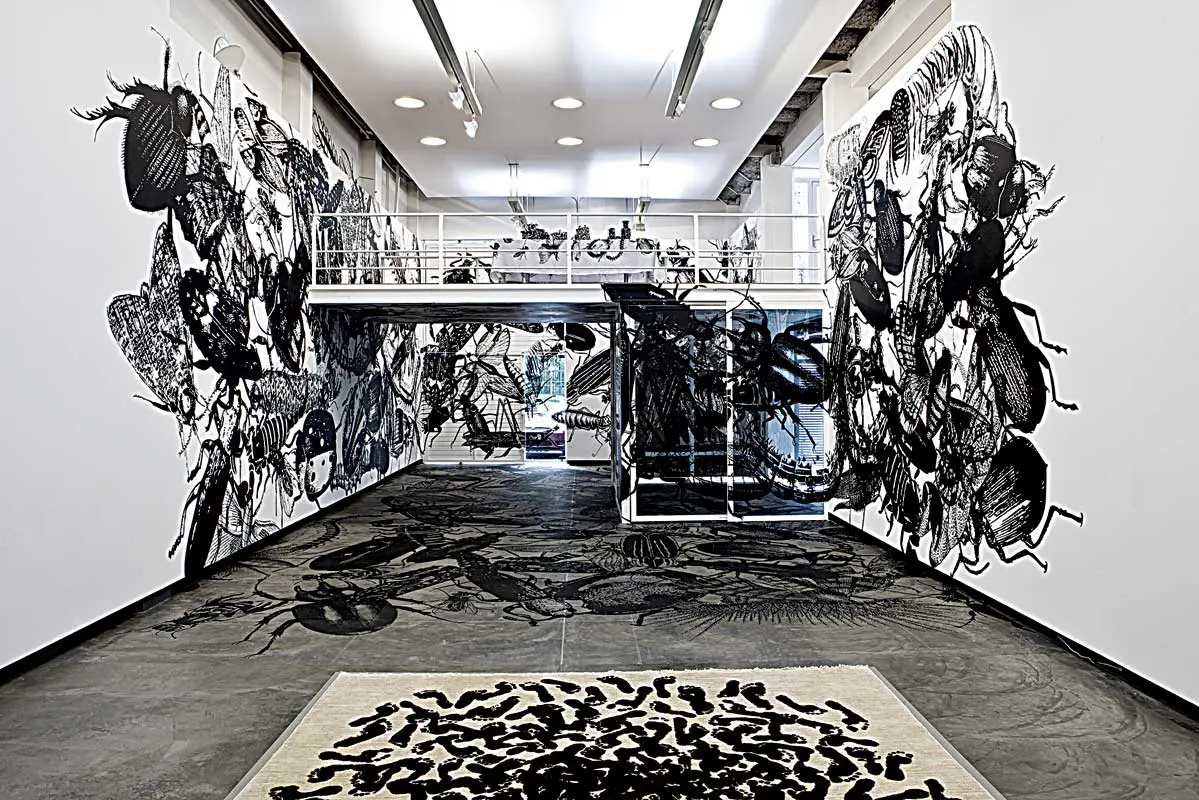
On this occasion, the works exhibited present a highly impacting aesthetic component that merged with Silveira’s proverbial taste for paradox and eclecticism. There are also in these works formal and stylistic citational elements, drawn from other “encyclopedias” and iconographic repertoires that helped Silveira to create a dis-verse diversity, aimed in multiple directions. At the same time, opposing elements would unify these through the magic and explosion of trompe l’oeil, as a post-conceptual chain of accurate interplays of whites and expansive blacks.
Mundus Admirabilis e Outras Pragas is a landscape of sensations, or yet better, of aesthesis – a term that already includes in its etymological roots a connotation of physical aestheticism.
The materials employed to display an accumulation of ideas of absolute contemporariness, despite the création vagabonde and widespread visual response these works generated at first glance as they invaded the exhibit space. They presented various ranges of distortions and perversions related to certain cultural objects from the past, despite that the works are closely connected with a markedly current tempo. Industrial paint on wood, prints on black adhesive vinyl on an expanded field, acrylic, polystyrene, porcelain objects covered in liquid glass, steel, embroidered linen, intervened rugs, luminous projections, and digital videos: all these represent a decisive departure from Silveira’s epistemological nature and the transitive character of her previous works, given that the order of the elements here and of the meta-narrative itself is inverted, purposely unbalanced in relation with the logic followed in previous Centuries. These high-voltage works contain a measured “all- encompassing” chaos that is very complex and that opposes any strategy toward finiteness. They effectively represent the art of premeditated disorder, as also observed in Apeiron (limitless and with no boundaries), in which the overpowering figurative universe of insects acquires deceiving forms through the multiple uses of materials – some of which are decisively technological and cold, while others are “simpler” and even “modest” not only because of their economic signifiers, but also from a creative standpoint. The notion of infiniteness that is efficiently incorporated is also dependent on the machinery of the installation. Such a notion promotes openness and a multi-vocal ability to regenerate itself.
A dream of transmuted materiality – under the influx of a hyper-baroque nuance – together with elements considered non-aesthetical or anti-aesthetical by tradition – converge in this recent opus by Silveira that becomes a sublimity of excess. Grandiosity and aesthetical gigantism are evident characteristics in this clearly site-specific installation, conceived for the Brito Cimino Gallery mounted with cutouts and black adhesive vinyl. The exhibit clearly reintroduces Silveira’s modus operandi by utilizing, for instance, large-scale plotted vinyl, a central element in installations including Jardim do Poder, at the Centro Cultural Banco do Brazil (in Brasilia) and Ficciones, at the Museu Vale do Río Doce (Espírito Santo), both from 2007. On the other hand, there are micro-situations created by the site-specific objects themselves that act like the machinery for such a metonymic net.
This is the case of works such as Fábula (Fable), a sculpture-object fashioned in wood and covered with industrial paint, an audio device, and a self-adhesive vinyl cutout of an enormous insect glued to the roundness of the black protuberance; In Memoriam, done in vitrified porcelain; Mea Culpa, a micro-installation consisting of three ready-mades intervened by the artist; Rerum Naturae, a table with a linen tablecloth and a porcelain dinner set printed with images of various insectivore species, a sort of horribly sublime bestiary. Rerum Naturae reminds us of the verses by Rainer Maria Rilke in his Duino Elegies: “for beauty is nothing but the beginning of terror…”.
Moving on to works that continue to generate series within a central and globalizing approach, we find pieces such as Corruptio and Mácula, which surpass the boundaries of the installation as they become representations of an acting temporal and spatial infinitum. We should, nevertheless, remember that to Silveira, these represent stages or instances belonging to another infinitum, a potential infinitum, containing all the variations originated by the semantic and figurative matrix of certain revisited presuppositions from entomological science.
Continuing with more examples, we find other paradoxical effects – and the ambiguous channels of this complex world that Silveira creates – in new objects with instructions for their use and ulterior interpretations, such as in Infernus, a black cylinder sitting on a black wood pedestal that closely resembles an earlier piece by the artist titled: Mirante.
In Infernus, we find ourselves before a wooden object covered in industrial paint, with an internal monitor that contains a digital video and a sound recording by Alejandro Gómez-Upegui. Then, Silveira once again insists on the silhouette, geometrization, and the spectral effect of the objectual world, with her piece Post-Scriptum, created in metal and covered with black adhesive vinyl to achieve the autonomous expansion of the sculpture.
Bestiarum, a luminous projection that employs dichroic light – directed onto a wall – of variable dimensions and based on a small- scale work on wood that is placed on the same wall; it confronts us with the horror of emptiness; it proposes a centripetal scheme that generates fabulous and oneiric monsters probably extracted from a medieval manual. It is a sort of “wall of paint” on a white watermark that is immaterial and rife with powerful figural expressiveness. Time after time, Silveira tests the pleasure and knowledge that sight can offer, while at the same time setting clever traps for the conceptual certainties of our vision.
The exhibit was complemented by the careful edition of a bilingual (English-Portuguese) monographic catalog-book that contains reproductions of the works exhibited and several partial and general images of the installation. Also in this publication are a critical essay by Adolfo Montejo-Navas, updated biography of the artist, and a list of her most important individual and collective exhibits.
CLAUDIA LAUDANNO