In trying to understand a culture, we often look to the images it produces to learn how its people live and think. But what about the images that are lost, never to be seen, doomed to invisibility, and discarded? Without a concerted effort to preserve them, images dissolve and disappear unless one takes imaginative leaps, fuelled by a visionary impulse, a desire for what is seemingly impossible and for its achievement. Finding ways to resurrect and create images —how, say, to float images on smoke or to present hundreds of archival photographs— is what interests Rosângela Rennó. This Brazilian artist who originally trained as an architect now prefers to deal with “issues of humanity, by different manifestations, cultural, communication, religious, social facts, and effects.” Rennó began her career in Brazil in the mid-1980s when traditional media forms such as painting were considered essential, and conceptual art practices were dismissed as mere experiments. Resonating with that time, the role of the photograph as a conceptual muse marked the beginning of Rennó’s artistic development; from this perspective, she created a productive space between the legacy of artistic collaborations with people and communities (in response to the repression of military rule) and the contemporary authorial and documentary photography that dominated the art scene in post-dictatorship Brazil. Against such a background, the conceptual uses of photography became a way of thinking, a way to construct photographic arguments and a way to develop the artist’s visual language.
Rennó’s early work represented a quixotic effort at capturing silences or obscure illustrations of in-between structures, spaces, and peoples. Investigative in approach, the work drew upon an endless archive of found images from family albums, discarded studio portraits, aged negatives, and movie stills that seemed to the artist to be “empty signs waiting to be filled with different characters and stories.” Rennó’s interest in what was usually ignored and cast aside offered singular moments and viewpoints that felt eminently familiar, sending the viewer on an associative journey, which Rennó referred to as their “own mental archive.” One poignant example is Error de Concordancia (Congruous Error, 1988), which casts an upward glance at the bridegroom and best man and prompts one to consider the traditions and dictates of society and the passive adherence to gender roles. A persistent visionary, Rennó went on to produce work that has become emblematic in its fierce emphasis on life, not disparity, and that characterizes individuals and communities faced with anonymity as a result of the rapid neo-liberal reforms in post-dictatorship Brazil. Uninterested in simply collecting imagery and pointing out inequities in order to generate compassion, Rennó preferred to activate the meaning, breadth, and consequences of one of society’s most potent reservoirs: the visual repositories, the archive.
The reinvention of the archive in contemporary Brazilian photography was significant. During the dictatorship, documentary photography often intersected with systems of state oppression and rhetoric marked by nationalism, crime, civil unrest, and ethnic conflict. One example of this is Rennó’s work Imemorial (Immemorial, 1994): After several intense weeks of investigation alongside a team of eight archivists in the Public Archive of the Federal District in Brasilia, Rennó drew on this trove to craft an alternative history of the city and its aspirations. From 1956 to 1960, Oscar Niemeyer and Lúcio Costa devised an ambitious program of modernist architectural and urban design to build a city of the future. Underscored by the Herculean effort involved in mobilizing an enormous workforce to construct the new capital city, Brasilia’s nostalgia and sense of aesthetic privilege are still prevalent in recent debates about Brazilian history. Despite this historical resonance, Rennó envisioned a new archaeological stratum in Brasilia to resurrect this point in time. Within the archive’s filing cabinets, among an infinite number of images doomed to invisibility, the artist found traces of the troubled history of Brazil’s capital city in the incomplete files of workers who died during its construction. As a memorial, the enlarged identification photographs of the deceased were installed on the wall and across the gallery floor. “In a general way,” says Rennó, “archives reflect how it is often convenient for both citizens and the state to privilege oblivion over memory.”
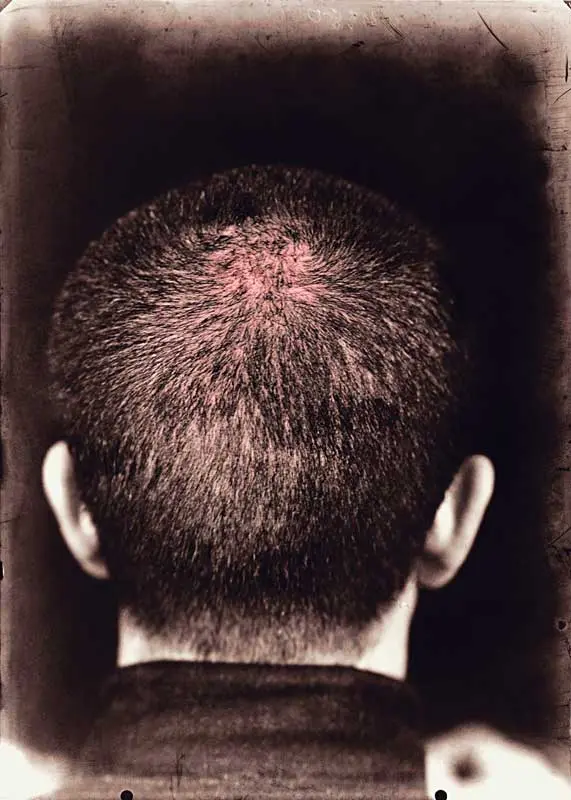
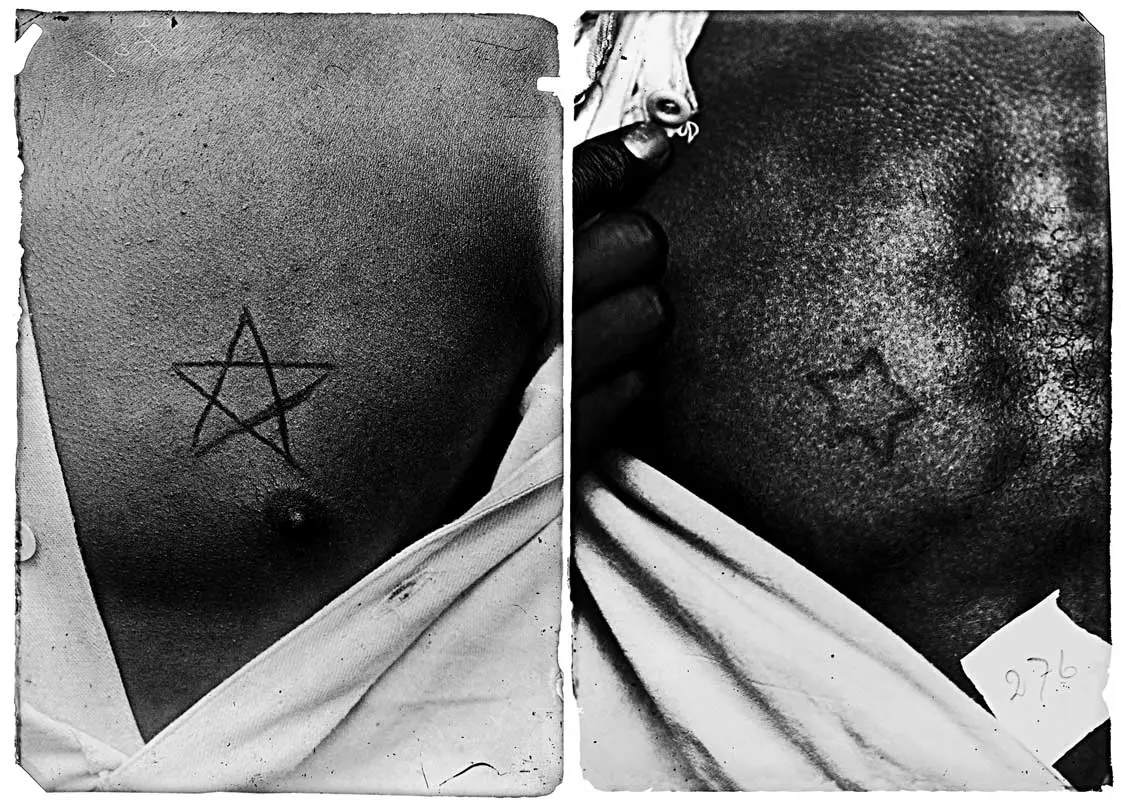
In 1996, on the other side of Brazil, Rennó responded to another archive, of negatives from the Penitenciário Paulista in São Paulo, with the same sense of fearless inquisitiveness. Following tense negotiations, Rennó was given permission to use some of the no longer relevant prisoner identification photographs from the 1920s to the 1960s. After looking at twenty thousand glass and nitrate negatives, Rennó produced Scar Series, 1996-97. The artist made a selection of strikingly straightforward photographs of prison tattoos and enhanced them, drawing one’s attention to the rawness of the original images. From this vast, essentially solitary undertaking —a complex analog to her earlier work in Brasilia— Rennó produced another series of large photographs based on images from Penitenciário Paulista, titled Série Vulgo (Alias Series, 1998-1999), in which the artist marked photographs of the backs of prisoner’s heads with a faint red. For Rennó, this gesture offered “more possibilities than just the violence/brutality” and “reminds us of the life, of the violence, and of the violence against life of such a place.”
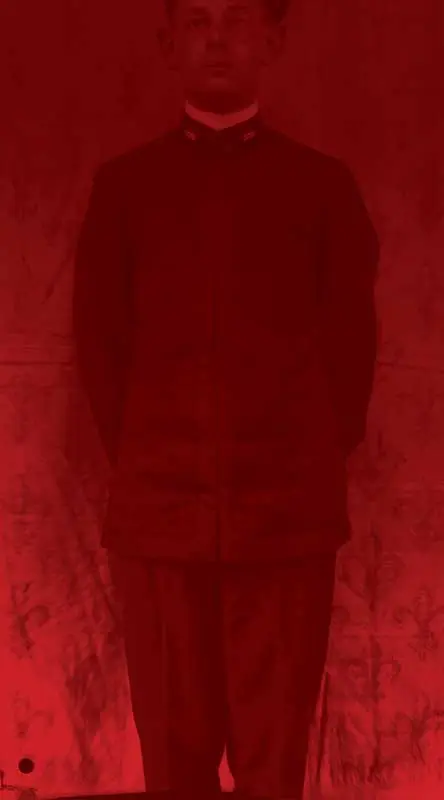
Rennó’s continuous refusal to use the archival photograph in its original state compels the viewer to see the past in the present and to re-stage history in the mind’s eye. An evocative example of this approach is Série Vermelha (Militares)(Red Series, 2001–2003), which was exhibited at the Venice Biennial. This work comprises sixteen images from a collection of family albums found in different countries, in flea markets, second-hand shops, and the streets. Hovering above eye level, these enlarged and transformed images feature individual men and boys wearing military uniforms that evoke heroic narratives and a romantic sensibility. However these militaristic images are saturated with a dark red, which suppresses specific details and visual information. What remains of each image suggests state and military violence while at the same time being wholly anonymous, as if the subject is about to fade into history, abandon its brief moment of subjectivity, cease corporeal representation, and revert to a conceptual erasure that is nothing less than death: the obscure and the unnameable.
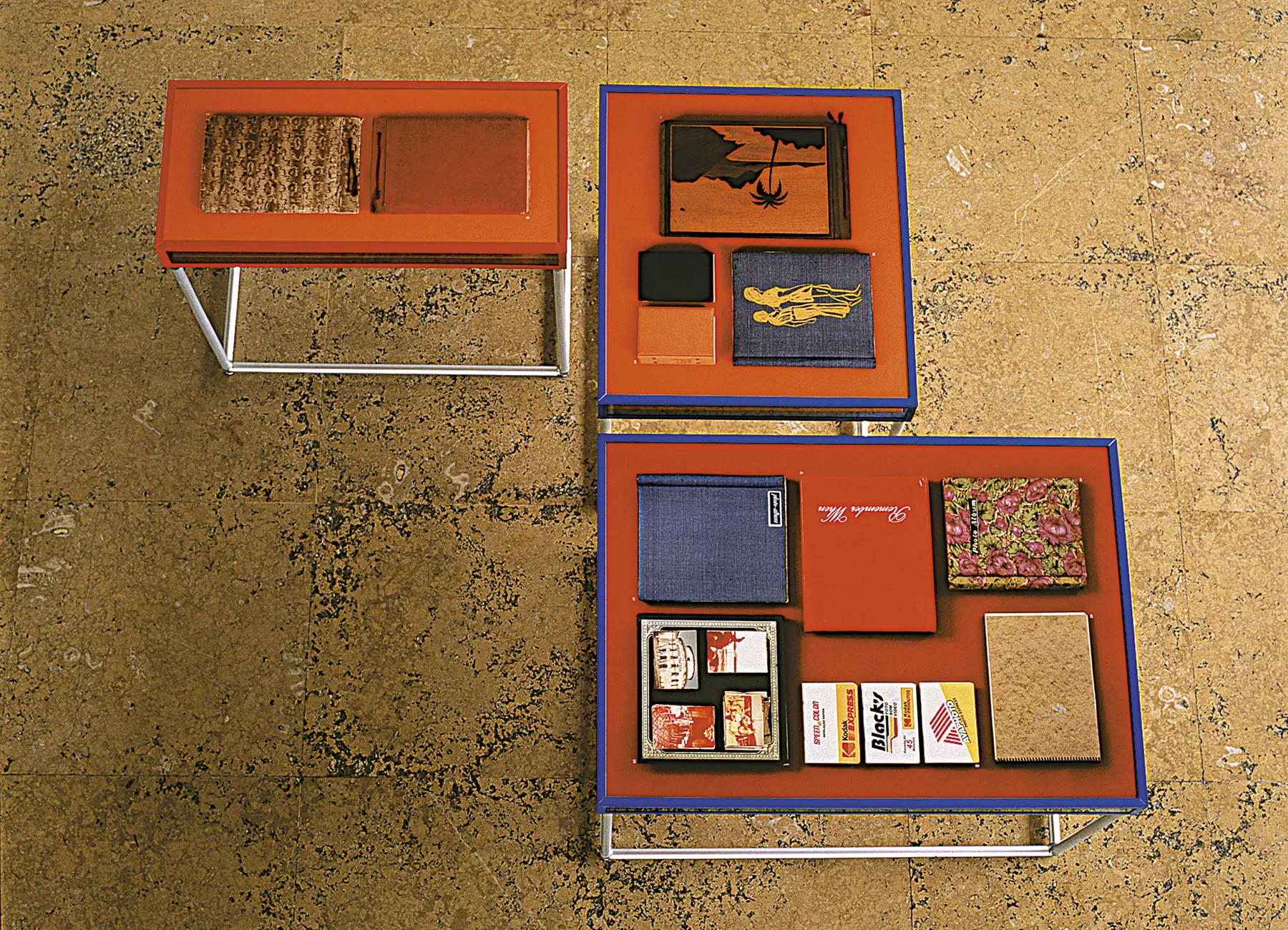
Using the gallery to explore forgotten lives, nameless places, and irrecoverable moments, as a form of critical engagement with the world outside its white walls, Rennó chooses not to replicate archival systems but rather to use them as starting points: to choreograph text and images through rigorous imagination, idiosyncratic correspondences, and an intuitive taxonomy of apparitions. An example of this highly developed sensibility is Rennó’s ongoing project Arquivo Universal (Universal Archive, 1992), which features newspaper excerpts in which the journalists refer to particular photographs. Stored in the artist’s computer, this series has been manifested in a myriad of formats such as groups of texts etched on walls or assembled with photographs. Another installation, Bibliotheca (Library, 2002), comprises one hundred photography albums from several sources, sheltered in museum vitrines and unified by color codes; an associated map traces the locations where the albums were collected by the artist. The visitor can view written comments by the artist but looking through these personal archives is not permitted; the books are sealed like the state archives —formerly inaccessible to the Brazilian public— dedicated to controlling information and anything else deemed inappropriate for public knowledge and consumption. It is often assumed that visual images can portray a life more vividly than language, yet Rennó’s use of realist conventions, detailed descriptions, chronological segments of narrative, verbal references, and temporal markers in her accompanying texts —all of which have a revelatory effect on the viewer— lends an endearingly human aspect to the work. As Paulo Herkenhoff puts it, Rennó makes works that are “the instincts of life.” This is perhaps why her installations are ultimately so moving: because they focus on the limitations of individual points of view, these accounts actually escape the confines of the single-author complex that burdens history.
Rennó’s sharp, uncompromising attitude to art and history is made clear in her brilliant silent video Vera Cruz (2000), a fictitious encounter between Portuguese explorers, led by Pero Vaz de Caminha, and the indigenous peoples of Brazil. Rather than relying on voices and figures, the artist presents a blank film scratched by wear and decay in which the only identifiable feature is a subtitled narrative. Featuring a dialogue between priests, scribes, and soldiers who have accompanied Vaz de Caminha, the subtitles uncover the initial encounter with the “Other” —the original inhabitants of Brazil— who otherwise remain silent and invisible to the viewer. This work reflects the exclusionary practices that continue to neglect the indigenous peoples of Brazil. But more poignantly, similar to Rennó’s other works, Vera Cruz shifts the responsibility for resolving this issue out of the film frame and into the consciousness of the audience. By doing so, her work subtly informs audiences about the polemical armature of post-dictatorship Brazil, Portuguese settlement culture, and the repercussions of colonialism on the Brazilian psyche, one based on social and topographic reality.
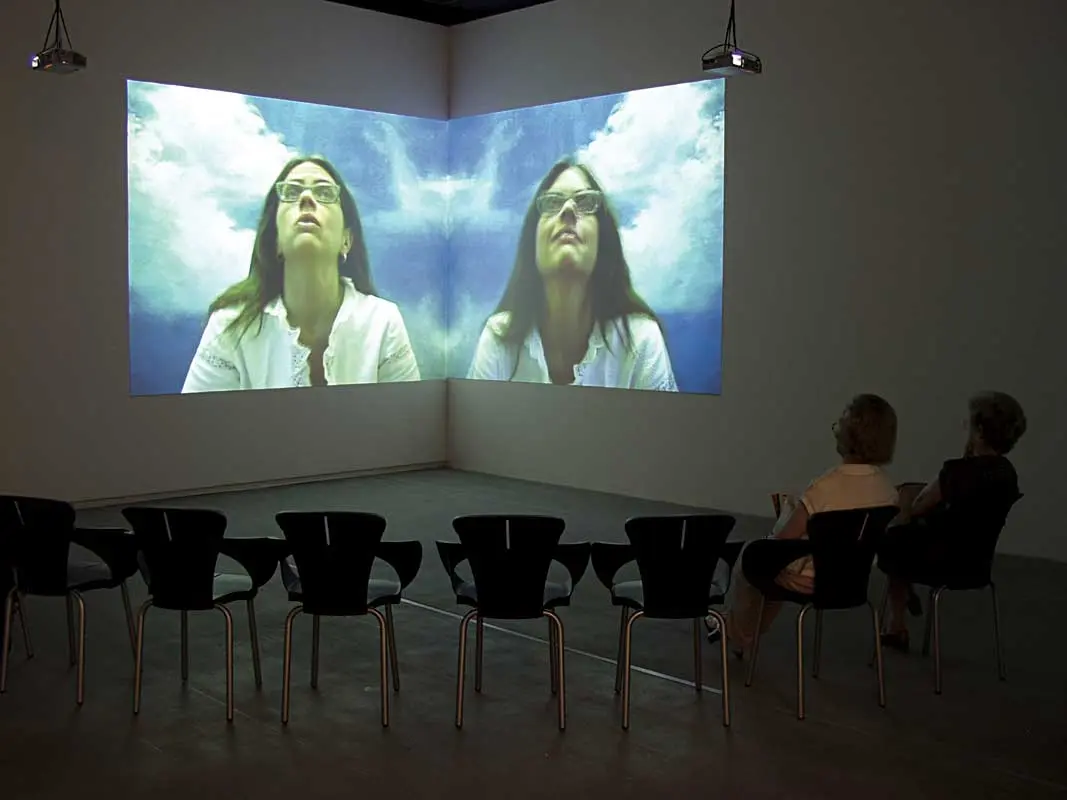
This becomes clearer in Rennó’s epic work Espelho Diario (Daily Mirror, 2002), presented on two video screens that form a ninety-degree angle. Over an exhaustive period of time, both on her own and in collaboration with the writer Alicia Duarte Penna, Rennó examined and organized stories of women named Rosângela in the pages of Brazilian tabloid newspapers. Rejecting their sensationalist imagery and distanced editorial coverage, Alicia Duarte Penna wove the newspaper stories into a narrative of a shifting cast of characters —kidnapping victims, white-collar workers, housewives— imbued with personal tragedy and at the mercy of societal events. As a rite of secular remembrance, Rennó re-enacted 133 stories in the video. No one else could create such a rhythmically complex and wilfully impenetrable construction; Espelho Diario is so dense as to be un-consumable. Yet Rennó managed to synthesize her subjects regardless of race or class, drawing attention to the ways they’ve been misrepresented, sanctioning the real experience of the silenced voices, incidents, or ideologies frequently absent from newspaper accounts.
Rennó was even more radical in her next video installation. Continuing to pursue her artistic model, she merged the realms of engineering, cinema, and the spiritual in order to examine the realms of memory and oblivion. In 2004, Rennó worked with two talented engineers to create Experiência de Cinema (Experiencing Cinema), a freestanding apparatus that repeatedly produces a cloud of vegetable oil on which archival images successively appear for a mere eight seconds and then disappear. These brief phantasms comprise four groups of thirty-one photographs that reference archetypal classifications such as crime, war, family, or love found in such seminal photographic exhibitions as The Family of Man (which opened at The Museum of Modern Art in January 1955). The deliberate foregrounding of these image pairings deflects attention away from the individual genres and onto the associative process between them and the spectral transaction of the work. This remarkable installation evokes a sense of anticipation and wonder reminiscent of the transformative effect of magic lanterns on nineteenth-century audiences. Yet, beyond this reference is the realization that this work evidences Rennó’s fearless nature, drawing deep into the past to create thought-provoking and visionary work for the future.
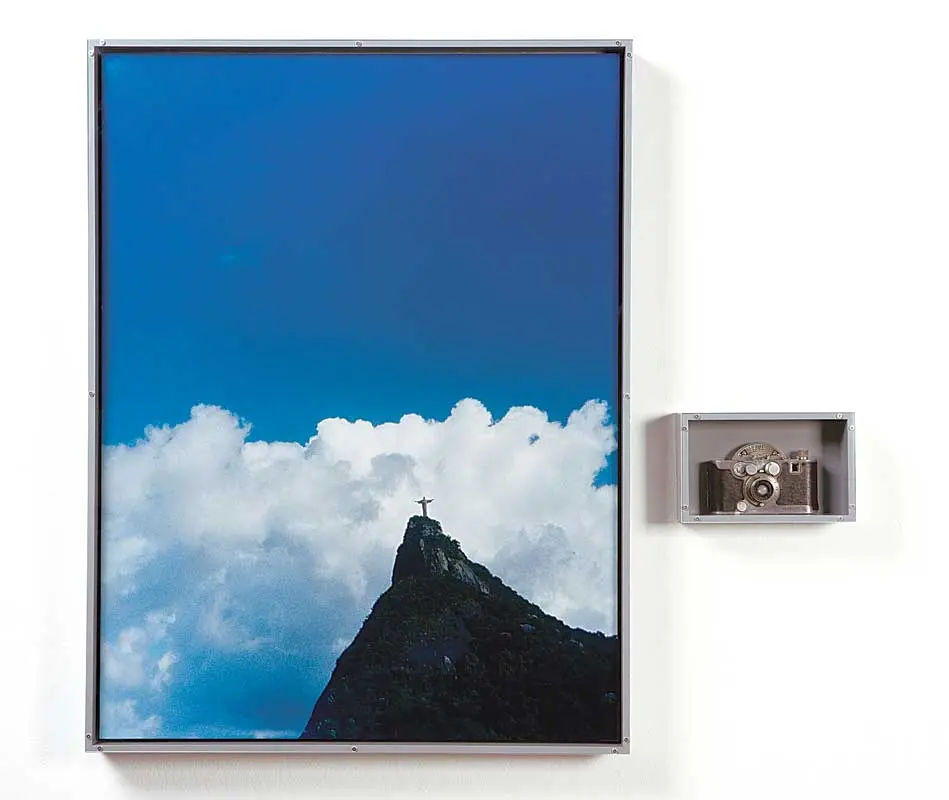
Rennó’s exploration of how society simultaneously keeps and discards images inevitably led to the investigation of control, copyright, and the power and desire of collecting along with the obsolesce of analog technologies and the ubiquitous presence of innumerable digital images. For A Última Foto (The Last Photo, 2006), Rennó asked forty-two artists to take a photograph of one of Brazil’s most iconic images, the statue of Christ the Redeemer. Revisiting her life-long engagement with photography, and utterly in command of her visual vocabulary and unconcerned with the copyright of the colossal statue, Rennó provided the artists with cameras that she had collected over a number of years. Recounting a devotion to analog, which has been condemned as a dying medium, Rennó and the collaborating artists chose one photograph from each camera and then sealed the cameras, pairing each with the chosen image. Ironically, in the midst of this collaborative project, it was reported that “a national tragedy” had occurred: the theft of rare photographs from the Fundação Biblioteca Nacional (National Library Foundation), including works by the Brazilian photographer Marc Ferrez, the Germans August Stahl and Guillermo Liebenau, and the English Benjamin Mulock that had eternalized images of nineteenth-century Brazil.1 In light of this theft, in 2008 Rennó produced her newest artist book, 2005-510117385-5 (2008), which contains reproductions of the backs of the 101 recovered historical photographs, arranged by the date that each recovered photograph was reintegrated into the library’s collection. As Rennó writes in her artist statement: “The perpetrators worked with subtlety, choosing their authors and themes, emptying albums, and substituting photographs so that the crime would only be discovered some time afterward. Three years later, with the criminal investigation still open, only 101 of these photographs have been found, all of them mutilated because the criminals employed several methods to erase the Library’s property registration marks. The criminal investigation for file number 2005-510117385-5 is ongoing and those who masterminded the theft remain unpunished.” According to Rennó, she will continue to add new reproductions to the book as long as the investigation remains open, and whenever photographs are returned. Like many of her works, this repetitive act of archiving will in time attain the quality of a ritual.
Rennó’s work is complex. Although the focus of her creation seems in every sense far from the staid environment of a conventional gallery space, she exhibits internationally in commercial galleries, biennials, and public institutions. At its best, her art is a form of consciousness-raising and potentiality, and the gallery becomes a site for dialogue and contemplation. Blurring artistic genres, Rennó is simultaneously an activist, archivist, and artist. Much of her work begins with an idea, an obsession, which becomes transmuted into perceptual and philosophical speculation without losing its roots in social reality. Rennó never loses sight of the people at the heart of these intractable realities. As she puts it, these buried images are ultimately more interesting to work with because they have the potential to say more about the “loser stories than the winner ones.”
NOTE
1. Reported by Maia Menezes, O Globo (Rio de Janeiro), July 20, 2005.
Unless otherwise noted, Rosângela Rennó’s words are taken from two sources: a conversation and the correspondence between the author and the artist from December 2008 to January 2009; and a lecture by the artist as part of the series Global Photography Now: Latin America in London at the Tate Modern in November 2006.
ELIZABETH MATHESON