Ever since
Peruvian artist Sandra Gamarra created her imaginary museum – LiMAC (Lima
Contemporary Art Museum http://www.li-mac.org) and included in its collection
her painted reproductions of mediums that reproduced art such as illustrated
pages from art books and postcards, her discourse and research veered towards
setting up an equation for understanding the experience of art and the means
through which it could be had. In Milagros, her second solo exhibition in São
Paulo, presented at Galeria Leme late last year (12.11.08 – 20.12.08,) 13 large
format canvases, a sound installation, and an installation of hanging areoles,
Gamarra shows she is changing her focus from the reproduced artwork itself, to
the point of interaction between spectator and artwork; “as we know, there is
no work of art if there is no spectator” she says in interview.
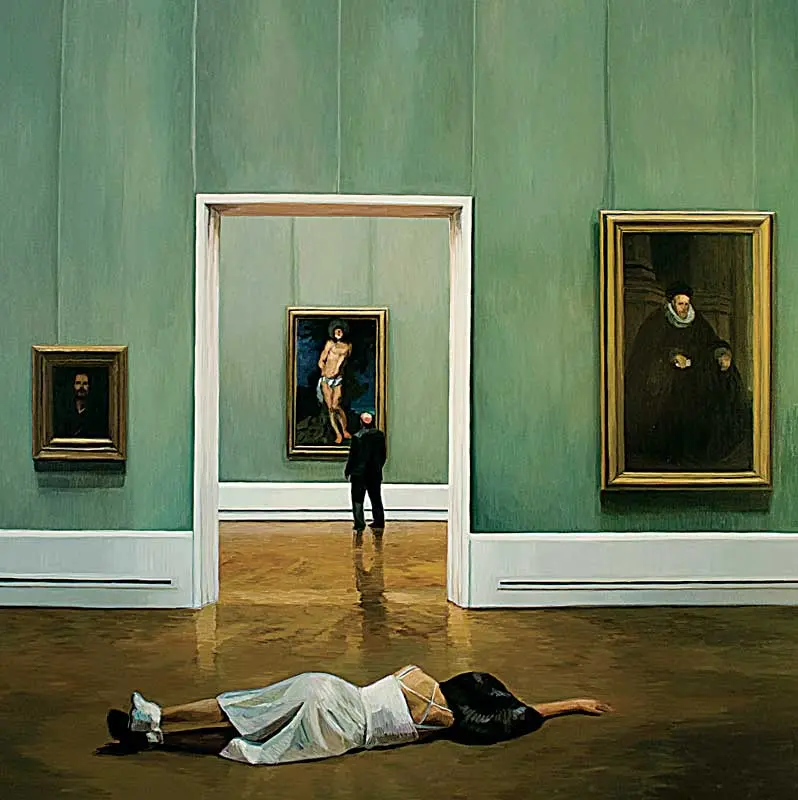
This slight but significant change in perspective lives in the series known as The New Payers and New Pilgrims, to which the works in Milagros belong. Gamarra still reproduces artworks in her canvases and still renders the location in which they reside importantly, but now, the canvases show spectators caught in a moment of transformative and/or interactive exchange with a work of art. It is no longer important to identify the artwork that is appropriated into her paintings as it may have been before, but what matters is the fact that they are understood and identified as works of art through their environment and the interaction of audience and work depicted. This equation is more expansive in it's questioning of what the experience of art actually is and what experiencing art through reproduction is, in turn. Gamarra positions it in relation to religion. “I’ve always felt the act of copying close to the way in which Christian images had to be copied to fill the new churches of a new continent,” says Gamarra.
This comparison in itself breaks no molds. Understanding the art world, the content that it exists around, and the manner in which people inhabit it is similar to the structure and conditions of organized religion. They are both centered on faith. What is an art fair or a biennale today in essence, but a high point on the art calendar during which people faithfully come from far and wide, in pilgrimage, to a location where they can be in contact with the vehicle in which their faith is invested. Pilgrims expect that they will leave having had some sort of (transcendental) experience. Faith is what allowed this, and to Sandra Gamarra, faith is still what governs the dynamics in the art world. The objects that exist in organized structures such as these “are mediators of reality and eternity; the comprehensible and the incomprehensible,” in Gamarra’s own words. If these structures are understood as microcosmic, can it not be that they too represent a more macro faith that we all have - in our existence and lives?
All paintings are based on photographs taken by Gamarra of spectators interacting with art. In one, a lonely spectator stands before a Julie Mehretu (Sola, 2008), in a triptych (Clara, 2008) she interacts with a crack on the ground – an artwork by Doris Salcedo - in the Turbine Hall, in a quasi-ecstatic state triggered by it. An Anish Kapoor inspires mirrored veneration in Angel (2008) and San Sebastian (2008) shows the power of the experience at the Gemaldgalerie, in Berlin. The Apostles, inspired by exhibition goers from around the globe, strip the depicted spectator of the object of its faith and denounce to the exhibition spectator the manifestation and effect of this faith, the same faith that took him to Galeria Leme, on a quest for a potential epiphany. This micro-macro effect inspires thoughts on the mirroring of life and social dynamics through isolated and rendered empathetic examples. “I am interested in the patterns that repeat themselves in religions as testimonies of human relations,” says Gamarra.
Working within systems recognizable to the cultures they reach out to and are received by, Sandra Gamarra comments on the relationship of the viewer and the art work in Milagros might say about different cultures: “It might say that cultures have the capacity to become more and more homogenized. As such, it might be that today’s spectators are spectators of their own cultures without being part of them anymore.” With Nimbos (2008), Gamarra leaves the canvas and explores what happens when “religious objects” are removed from their context and inserted into the artistic realm. The tens of areoles hanging up high in the center of the almost 8m atrium of the gallery, set the tone: mystic and respectful, detached yet turgid with invested meaning. But the punch comes in whispers, through Psalms (2008), an easily missed sound installation that required the spectator to get up close to the wall to listen to the quiet confession exposed in the mausoleum: to question or investigate our existence as numbed spectators of our cultures and of our circles with imbued redemptive guilt is what propels our continued quest and pilgrimages – in search of something that might jolt us from the herd.
CAMILA BELCHIOR