La voluntad de las cosas, an exhibition of works by Sebastián Romo (México City, 1973) at
the Carrillo Gil Museum, presents a series of formal and conceptual exercises
that in many cases are related to sculpture. Romo appears as a multi-disciplinary artist who uses a variety of media to express himself, including photography,
drawing, video, models, diagrams, and artist’s books, among others. The artist
reveals his interest in establishing a correlation between the conceptual and
the formal. He discovers orders and examines the relationship between maps and
three-dimensionality, alters laws, traces new pathways, and creates other
objects. In this way, he recognizes the will of things.
The show necessitates a viewer reproduced by the polished surface of La Belle Noiseuse, which brings together three flat mirrors of 226 x 122 cm, with texts in vinyl, the reflecting plane of which includes the image of the visitor thus transformed into an explorer or discoverer of projects and objects. Romo’s obsession with the annotations of conceptual art drives him to take notes of his experiences on objects that could be travel journals or artist’s books created in different formats and folded in different ways. Exhibited in glass cases, it is difficult to see them fully, and in one instance a projection on the wall is required to facilitate the analysis.
Several of Romo’s projects have their origin in Land Art. Such is the case with Caminando un cráter, which brings to the fore photography’s inability to capture the true magnitude of nature. This prompts the artist to traverse, walking in circles, the crown of a crater, action that he registers photographically. In this way, he repeats the order of the cosmos, and at the same time gives is a wheel with 360 photographs to be turned using a handle so that we can see the images. Similarly, Tropicalia is a circle created by Romo using photographs. The latter once again become objects, as their function as images have been canceled in order for them to be used exclusively as construction materials.
Romo also works with manipulated photography in You are the…, where he prints this sentence on a number of New York City skyscrapers. Such alteration works as a resource to create the illusion of an intervened physical space. At the same time, the phrase written on buildings creates the sensation of something more physical: the impression of the three-dimensional in a sculptural sense.
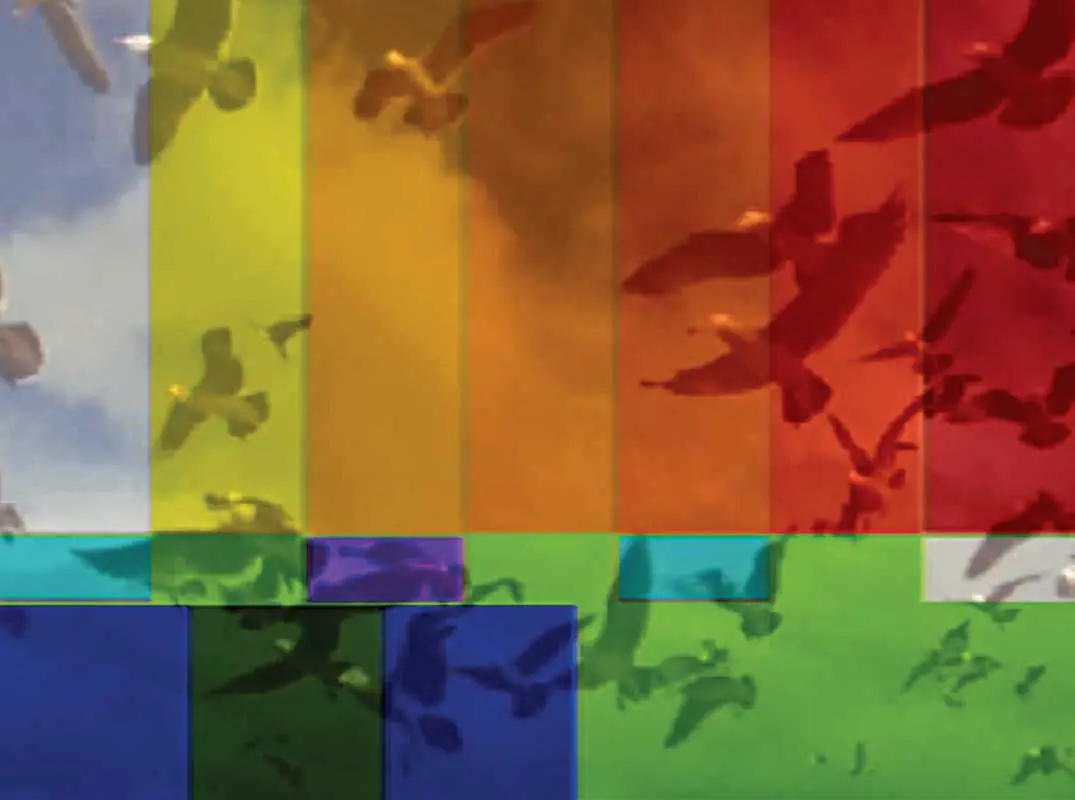
The video-installation work presented by the artist is based on the premise of spatiality and experience: Romo creates a whole stage with something as simple as the joining of two gallery walls. In Googo goo j’ oob, the projects the flight and sound of birds interspersed with color strips that bring to mind the chromatic pattern of TV transmissions, to which the viewer can become integrated if she comes close enough to experience the sound image.
In his project Komma, the artist records an event of urban life: the rising of the Nieuwe Amstelburg bridge, in Amsterdam. The video combines different languages such as sound, visual, and pictorial. Romo proposes a partial and emblematic view of the city, focusing his attention on the technical aspects of the bridge’s movement: in this way he leads the viewer towards a reflection about perception and technological mediation. This three-dimensional and sculptural view of an object and an everyday action is alternated with diagrams that indicate its mechanism in detail, as well as documentation of the process of construction of the project Komma.
Time and its various manifestations are the communicating thread between Romo’s projects and his finished works; thus he exhibits La voluntad de la naturaleza según Schopenhauer, which shows how plants subject themselves, “on their own will,” to a constant process of transformation. In his obsession with time, Romo builds a small-scale model of the place where it is being exhibited, using materials from the model elaborated and exhibited in the previous room. In this way, a prototype of the Carrillo Gil Museum becomes an allegory of the fragmentation and reutilization of the past, something recursively practiced in today’s art.
Gabinete is an installation with drawings that share a dimly lit atmosphere. Romo recreates an order and re-signifies it with photographs that recognize the macrocosm in the microcosm, and reformulates Land Art with some orange peels on cracked soil or on intervened frozen surfaces.
In his attempt to create orders and establish correlations between things, Sebastián Romo highlights a space: he makes it qualitatively different and transforms it into a cosmos. Left out is the proliferation of projects, discourses, and objects, where plurality takes the place of specificity in art.
CONSUELO ALMADA