
There is a photograph, now infamous, of a little African girl who has stopped on her crawl across the unforgiving Sudanese landscape. She leans her forehead on her tiny hands. Ominously, in the distance, a vulture looks at her, awaiting her demise. Taken in 1993 by South African photographer Kevin Carter, the photograph gained instant infamy when it was published on page three of the New York Times on March 26, 1993, sparking phone calls and letters to the newspaper, questioning the ethics of the photographer and the fate of the little girl. This photo is at the heart of Alfredo Jaar’s exhibition at Galerie Lelong.
Like many of Alfredo Jaar’s other works, his installation, The Sound of Silence (2006), presents a complex narrative through a minimalist installation that relies on technology and a simple concept. Although the work was written in 1995, the artist had no way of creating a challenging installation until ten years later. Using nominal language, Jaar’s narrative recounts a little of the photographer’s life, his entry into photojournalism as a profession, and his untimely suicide three months after this photograph won him the Pulitzer Prize.
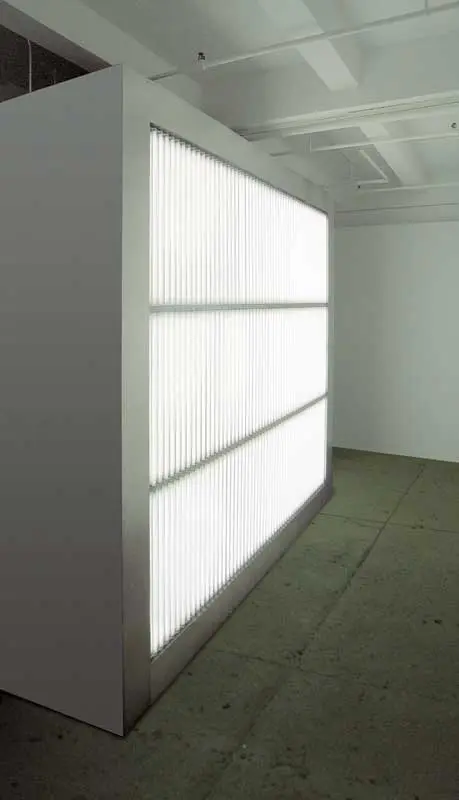
Viewers are prepared for the starkness of the interior narrative as they approach the installation. One end wall is covered entirely in white fluorescent bulbs. The light is (purposefully) blinding. Turning the corner, one enters the small theatrical space and is seated on a small bench. A presentation—somewhat like a slide show—begins, each slide telling a select fact about Kevin Carter’s life. Occasionally, his name is repeated, like a lamentation. At the height of Mr. Jaar’s narrative, the photograph is shown, enlarged to the full size of the screen. We are faced with a horrific image of the reality of famine. However, instead of allowing us to dwell on the image, the artist takes us by surprise as set of large strobe lights flashes in the darkness. Like lightning, the flash comes quickly, a sudden shock that re-inscribes the horror of the photograph. Once again, we are blinded. Even visitors prepared for this part of the installation are startled, perhaps because of the brightness of the flash or the sound of the oversized strobes.
Turning the viewer into the recipient of the photographer’s flash, the artist subverts the entire layout of his work, which, initially, places the viewer squarely in the same position as the photographer. When we see Carter’s photograph, we occupy his space, his perspective. When the strobe lights flash, we have, instead, become the subject of a photograph, turning into the observed. This is part of the entire point of the installation, which engages photojournalism, its inherent contradictions, and the audience for whom it exists. In a recent interview published in The Brooklyn Rail, the artist noted that he sees the role of the photojournalist as “the conscience of our humanity.” For Jaar, they represent the remains of our collective humanity. Implicating us in the work is part of his responsibility as an artist. This was also the point of Carter’s photograph.
Also on view is Jaar’s Searching for Africa in LIFE from 1996. This work consists of five large C-prints featuring the covers of LIFE magazine that were published between 1936 and 1966. Throughout these years, according to the artist, there were only five or six covers dedicated to the African continent, most of these featuring animals. That is, of over 1500 covers, only three percent were dedicated to Africa. For Jaar, this is a particularly egregious fact, given LIFE’s broad reach in American culture and its deep influence on public interpretations of global culture.
Part of a larger group of works addressing African issues, these two now on view at Galerie Lelong reveal Alfredo Jaar’s continued interest in addressing both the representation of Africa in the media and the difficulties presented by photojournalism. Through the media, Africa becomes easy to misunderstand as a single entity with innumerable problems. For the Western viewer, the African continent is summed up in its entirety by the body of the little girl in the photograph, her ribs visible. Similarly, Africa is summed up by five or six LIFE magazine covers in which elephants, giraffes, and hippos occupy the bush.
This reductive presentation of the continent and the lack of intervention into its problems lie at the heart of Jaar’s works, which carefully consider the delicate lines between shock value and human value, between exploitation and explication, between the visible and the implied.
ROCÍO ARANDA-ALVARADO