
The show Hier Waak Ik. –¡Hay vigilancia!– by the duet of Carla Arocha and Stéphane Schraenen, opened last November at the Periférico Caracas/Arte Contemporáneo and remained available for the public through January. This well known Venezuelan artist, based in Antwerp, Belgium, has worked with her Belgian colleague Stéphane Schraenen since 2006. On this occasion, they presented works dated between 2007 and 2008, including installations, digital photographs printed on leather, mirrors, and aluminum, as well as assemblages and three-dimensional glass objects.
The show’s central axis starts with a principle that underlies every exhibition experience: visuality. But a visuality that presents the viewer with a variety of situations that transform the vision into a controversial, uncertain, fragmented event. Indeed, reality can be mediated by filters—the work of art proper—that render our gaze an ambiguous experience. Or at least make us aware of it. In that sense, it is significant that some photographs were taken on the fly in the street, inside a room, or in a vehicle, acquire greater depth by being printed on a support like a mirror, that practically “returns” the image to us. What is projected is also reflected, and with this, its architectural precision or the linear composition of the image is “diluted.” This happens with the images of the emblematic construction site of the Miranda Metro in Caracas (formerly known as Parque del Este), printed on glass and mirror, or the beautiful image of Night Over Caracas, both from 2008.
On the other hand, while their intent is not to create optic or kinetic art, it can’t be denied that what powers the proposals of the Arocha/Schraenen duet is the desire to play with our visuality. Their glass balls (3 lies, 2008) visually summarize their immediate surroundings. The filtered reality has obviously been shifted. This is one of the keys that this artistic proposal gives us: an unexpected perceptual and sensorial experience where our movements around the work transform the filtered image we see of the immediate environment. Our movement is what produces such a transformation in the visual results.
The same thing happens with the boxes assembled with grids of mirrors (Gold y Diamond, 2008.) There is a significant recreation of our depth-of-field vision, where the visual field is constantly interrupted by a serially “carved” mirror, be it in a composition of straight vertical/horizontal lines (Mondrian) or of diagonals that resemble, to be sure, the patterns of the textile arts (lace, serialized weavings, etc.), all made using mirrors that are cut in a very subtle way. The reflected object is seen as fragmented and distorted. But it is precisely there that the underlying intent of the work resides: to make viewers reconstruct their own image—and that of their surroundings—on the basis of such dismemberment. Or to once again value what we see based on a powerfully sensorial experience.
The show’s protagonist proposal is, perhaps, the modules of mirrors. Their integration into the architecture or their participation in it condenses several significant elements that need to be noted: on the one hand, an unforgettable tradition of penetrable works of art (Soto, Le Parc) and its obverse mode, the Impenetrable (Eugenio Espinoza), to mention just Latin American referents. But Arocha/Schraenen make another interesting spatial reconsideration using different materials to those used by the artists in question: through a “fence” of mirrors— another impenetrable—they close up space from one end to the other, and at the back, they place a mirror on a wall that reflects, kinetically, both the fence and our own image, which we, of course, see on a grid. The title is Mansión Gates II. The mirror—fence or mirrored weaving— functions here as a sieve that impedes the holistic and integrative view of space (or a situation created by our presence) and at the same time is a fragmented reflection of ourselves, spectators-voyeurs of the realm thus created.
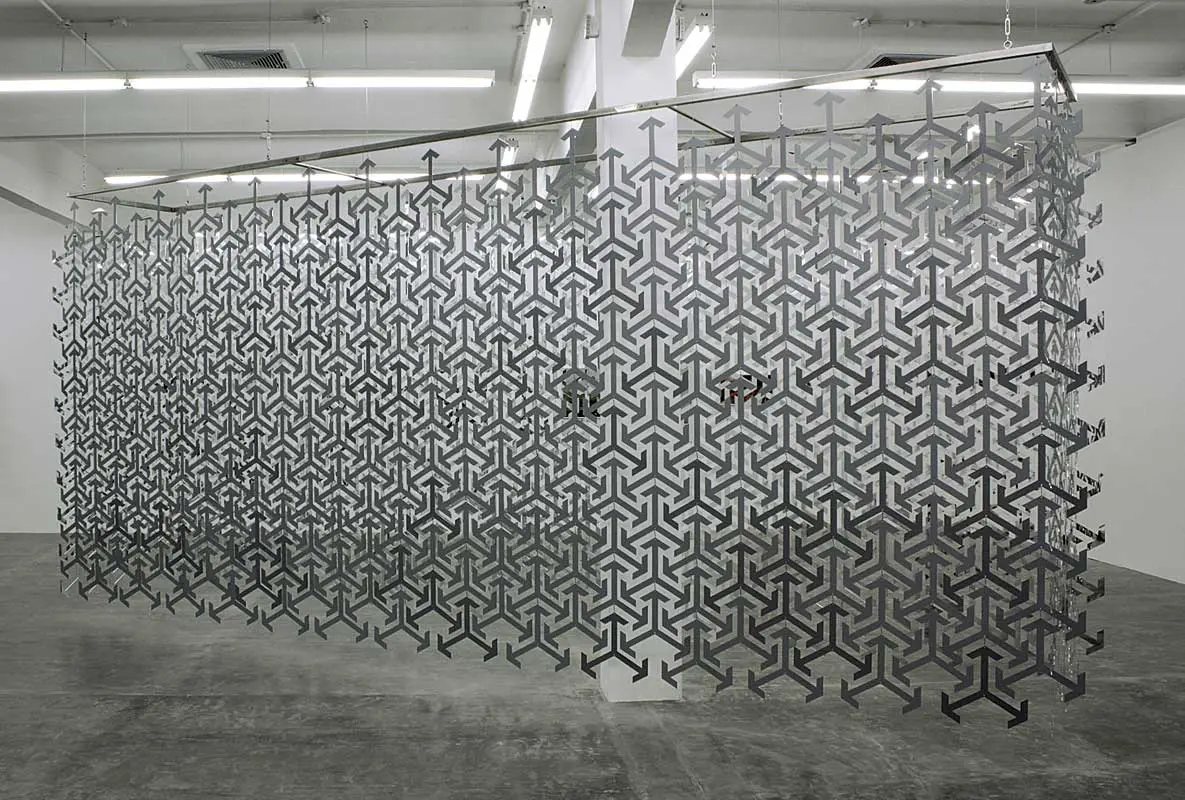
Carla Arocha’s interest in the world of fashion and design has often been noted, as has been the way in which she integrates industrial elements into her work. Marauders (2007) perhaps summarizes these relationships, as we see that the profile of the mirror grid refers to decorative forms that bring to mind textiles and embroideries. The result is a site-specific installation, a kind of mirror curtain (or a large four-sided box) that hangs above support that reflects us and serially fragments our view of the surroundings. The title synthesizes the role of the viewer who walks around the work, marauding in its interior and studiously observing the fragmented vision reflected there.
Arocha/Schraenen’s works undoubtedly foster new perceptual experience for our gaze, and with them, these artists renovate, creatively, the constructive tradition in art.
SUSANA BENKO