
Graduates from Yale University are distinguished not only by their intelligence but also by their desire to stand out as professionals. This has been evident in the political field over the last three decades, and it is also seen in the visual arts—from Claes Oldenburg to Eva Hesse. Charles Juhasz Alvarado, aged 42, studied at Yale and has always been recognized as an intelligent and highly ambitious artist. Already at Yale he stood out as a perfectionist in search of an aesthetic and ethical discourse that would separate him from the pack and made him one of his generation’s promising figures. His large-scale airplanes—powerful installations he created as a student and later as a professional artist—caught the attention of the art public and generated expectations about the future path of this youngster of Hungarian-American and Cuban-Puerto Rican descent, born in an American base in the Philippines. From the beginning it was obvious we were seeing an important artist who would leave his mark in this island, so rich in visual arts.
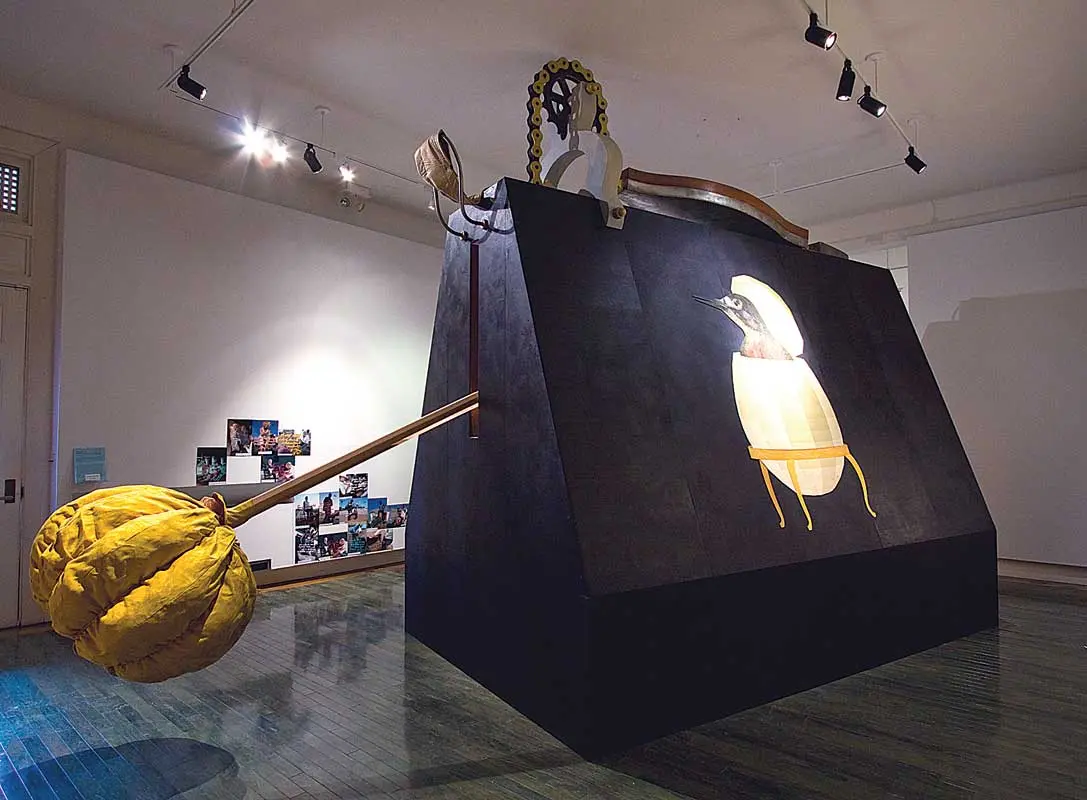
The art of installation emerged in Puerto Rico in the late 1960s. Rafael Ferrer exhibited his giant ice fragments at the Whitney, in New York, in 1967. Later, artists like Felix Gonzalez Torres, Melquíades Rosario Sastre, Rosa Irigoyen, Dhara Rivera, Pepón Osorio, and Antonio Martorell were able to gain greater acceptance for this “new” discourse in a rather conservative country, and it eventually became a highly trod avenue for local artists, from Rafael Trelles to Victor Vazquez, from Allora & Calzadilla and Carlos Rivera Villafane and Ada Bobonis to Naida Collazo and Aaron Salabarrias. Yet Juhasz brings to the field an extraordinary and impressive literary element. This artist’s three-dimensional discourse—installations and sculptures—is a complex, sophisticated, and highly intellectual one. Juhasz will use any kind of material, from wood and metal to photography and video, from leather and mirrors to fabric and detritus, to build ingenious and provocative scenarios/games that magnify different social and political realities both in his country—a beautiful island traversed by contradictions derived from its political status: a colony, christened with the confusing name of “Free Associated State of Puerto Rico”—and in the global world we inhabit, marked as it is by terrible injustices.
Because of this, in order to understand most of Juhasz’s works, words are necessary, be it in the form of written explanations of the works and their message (which quite often is integrated into the work itself) or in the form of oral explanations, where the artist, the curator, or someone who knows the path followed so far by Juhasz “tells” about it or analyzes its meaning. Early on, Juhasz used the old trick of including the dictionary definition of each word as a key element in the work. Over time, however, both the title and the written synthesis became indispensable to produce the experience intended by the artist. Thus the title of his extraordinarily impressive exhibition at the Museo de Arte Contemporáneo, a well-deserved mid-career celebration: Agudas, llanas, esdrújulas y sobreesdrújulas: varios episodios y otras ingenierías de Charles Juhasz Alvarado.
In The Painted Word, Tom Wolfe (another Yale graduate) takes the New York Times’ art critic to task for writing, in reference to a Realist painter’s exhibition, that “Realism does not lack its partisans, but it does rather conspicuously lack a persuasive theory. And given the nature of our intellectual commerce with works of art, to lack a persuasive theory is to lack something crucial — the means by which our experience of individual works is joined to our understanding of the values they signify,” thus giving, correctly or incorrectly, credence to Juhasz and thousands of conceptual artists: we have returned to the past: the work of art, an artist’s discourse, HAS to have a story.
In this exhibition, which under any criteria is very well thought out, curated, and presented, the public will not only encounter some of Juhasz’s most important works, but will also see, with the utmost clarity, the construction of an original aesthetic and ethical discourse, which has resulted in invitations to many of the most important biennials and international fairs: São Paulo, Havana, Singapore, Moscow. Juhasz has not wasted a moment in the development of his discourse. Each project, be it an international one or a local group show, is another step in the construction of an artistic/literary corpus that reflects/exposes Puerto Rican and international reality, seen through the critical gaze of an artist who is able to combine/intertwine history, art history, politics, and literature in a convincing and effective way. Added to this is his professional perfectionism in drawing/painting, photography, and the printed word, as well as in the use of wood, metal, resins and other materials.
Juhasz uses irony, cynicism, exaggeration and parody in order to present both our tragedies and the surreal world in which we live, both the injustices that mark us and the gifts life gives us. The artist has no trouble taking from Leonardo or from Cuba’s Los Carpinteros in order to establish intelligent—if at times somewhat over-conceptualized—dialogs not only with them but with scores of international artists. Some of his works are conceived so that when they are built in a different country, they incorporate its history and its political and existential reality.
Through the device of monumentality—be it in shoe-shine boxes, heads, or shaving razors—by transforming historical events into games—be it a money-transport vehicle that becomes an ice-cream truck, his moths/termites, a foosball table, or the craziness that confronts Latinos at various customs checkpoints where people don’t understand our “prohibited fruits”—in Agudas, llanas, esdrújulas y sobreesdrújulas: varios episodios y otras ingenierías de Charles Juhasz Alvarado Juhasz translates masterfully his mental and physical travels, where, like Borges did in his stories, he involves us in an unending number of possibilities/readings (which in a way we already knew, or which we wanted to know without being aware of it, as in The Garden of Forking Paths…). His multiple postmodern Trojan Horses tell of (and make us complicit in) the assault to the Wells Fargo truck by the Macheteros of Puerto Rico in West Hartford in 1983, as well as the hi$tory of the US First Ladies, from Martha Washington to Michelle Obama. And, as in The Library of Babel, what fascinates in each one of these works is the fact that they are never fully finished. Because they always contain the possibility of “traveling” again. Because words never end.
MANUEL ÁLVAREZ LEZAMA