

Ever since the comprehensive exhibition of Cildo Meireles’s work in New York in 2000, any announcements of successive shows have been filled with anticipation. The retrospective at Tate Modern was another confirmation of what has become unwaveringly apparent: a peerless artist who is historically important in advanced contemporary art, especially within conceptually based practices. What underscores this is Meireles’s rich and compelling corpus that is as cerebral as it is poetic; it is complex yet visually seductive, and it is paradoxically articulated through an economy of means. In short, there are few artists today that can couple form and concept to such a high degree of concomitant rigor, artistic intelligence, and verve while being topically expansive. With a formally diverse body of work that engages myriad themes and disciplines (including philosophy, politics, history, art history, anthropology, sociology, linguistics, design, and architecture, to name just a few), the retrospective will continue to be one of the highlights of the exhibition season, with stops in Barcelona, Houston, Los Angeles, and Toronto. Organized by the superlative Guy Brett, Tate director Vicente Todolí, and Amy Dickson, the exhibition has culled an array of artworks from a forty-year span, consisting of works on paper, sculptures, and seven large-scale installations that are visually striking but engage the auditory and olfactory senses as well.
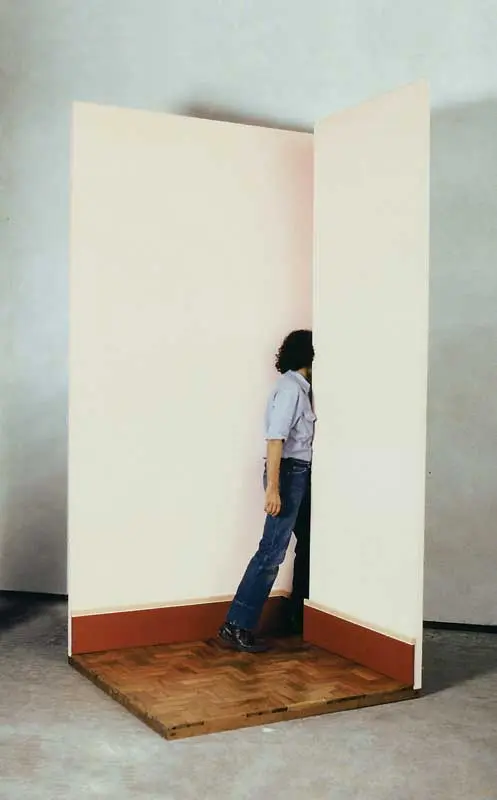
Divided into seven rooms, the retrospective begins with drawing series titled Virtual Spaces: Corners (1968) and Virtual Volumes (1968–69), proposals for projects never executed, and sculptural works including the iconic Insertions into Ideological Circuits: Coca-Cola Project (1970). The drawings are independent works but they also seem like studies or designs that are eventually manifested in three-dimensional formats. Virtual Spaces: Corners (1967–68), for instance, is the physical counterpart to the aforementioned drawings, and Meireles has said they relate to Bruce Nauman’s TV Corridor (1968–70), but they also evoke Marcel Duchamp’s Door, 11 rue Larrey (1927). While akin to the claustrophobia of TV Corridor, Virtual Spaces: Corners echoes the either/or paradox of Duchamp’s piece: whether a door can only be either open or closed. Meireles brilliantly extends Duchamp’s conundrum to include inside and outside and presence and absence, highlighting in ample philosophical terms how perspective, whether it is spatial or political, is in parallax. On the one hand, if the spectator looks at Virtual Spaces: Corners from a certain angle, the corner is closed; from another perspective, it is open, thus giving way to the dichotomies of interior/exterior and presence/absence. But is this work solely about the limits of empiricism or the epistemological fallibility of perception, or can it now be construed as metaphorically articulating the politics of space and a critique of the metaphysics of presence? Meireles masterfully leaves his works open-ended, to engender other readings than what is initially formed at first viewing, a sign of a sophisticated and complex artistic imagination.
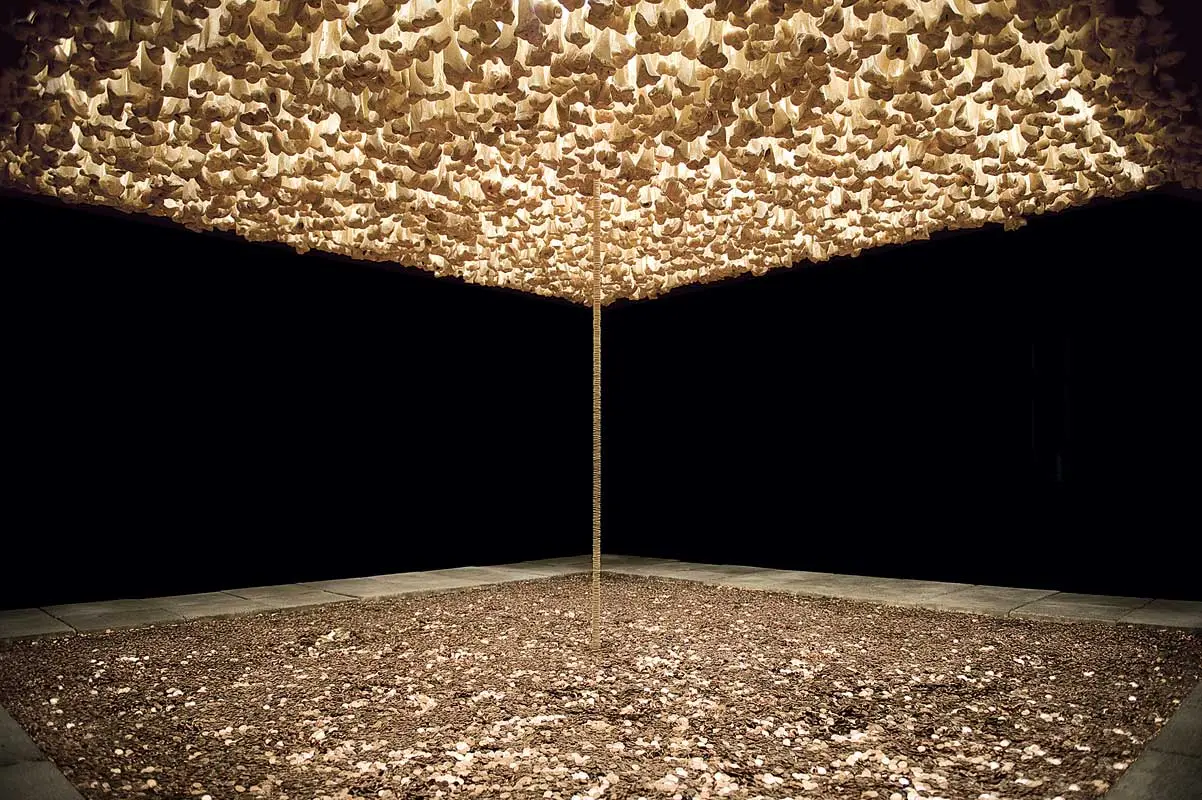
The curators were savvy, presenting work in the first room that ostensibly re-inscribed contemporary art’s historiography. Many works by Meireles were made concurrently with those by his international peers, such as his conceptual spin on Earth Art that was in dialogue with Robert Smithson or his conceptually driven process-works that preceded Jas Ban Ader. This is evinced in the Geographical Mutations series of 1969, made one year after Smithson’s Non-Sites (1968) and the same year as his asphalt rundown in Rome. Furthermore, Meireles’s Physical Art (1969)—with its unrealized component of rowing a small boat along the northern hemisphere in the direction of the earth’s spin in order to reverse the aging process—predated Bas Ader’s In Search of the Miraculous (1975), which resulted in Bas Ader’s disappearance at sea. The issue, of course, is not who came first but the larger question of Meireles’s eclipse in the annals of international contemporary art that has privileged certain narratives over others. One can only wonder about this oversight, considering the level of artistry and consistency demonstrated in Meireles’s work, including his very distinct installations.
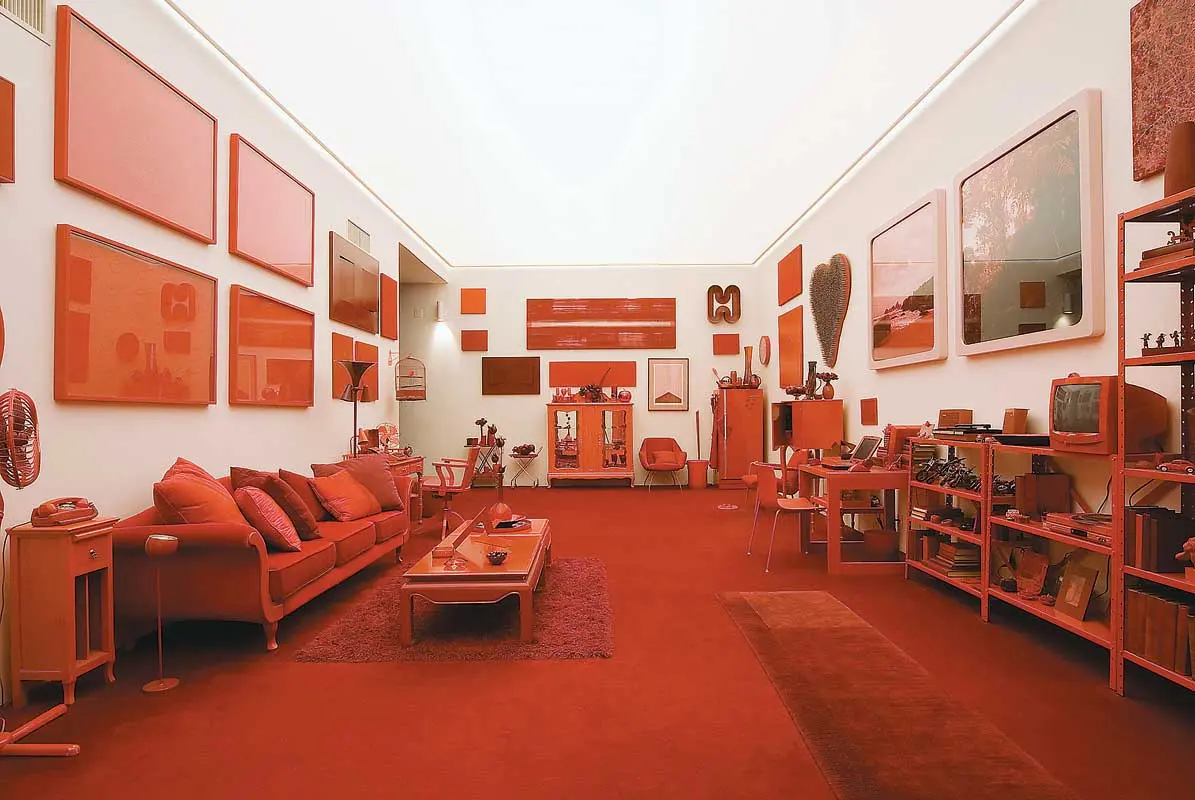
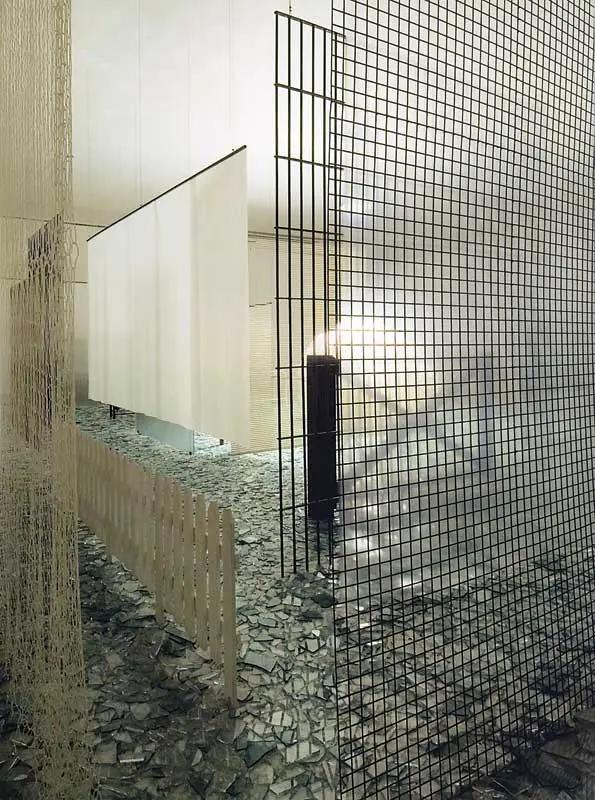
In whatever form or theme, Meireles’s installations foreground a poetic understanding of positive and negative space as ontologically integral. This was underscored in the Tate exhibition in the visually delirious Through (1983–89/2008) as well as the vertiginous, monochromatic Red Shift (1967–84). Both works have a sublime singularity, albeit paradoxically manifested through multiplicity. The former is a constellation of ephemera, including wooden fences, metal gates, chicken wire, fishing nets, mosquito nets, tennis nets, Venetian blinds, cellophane, aquariums, shards of glass, and a seemingly endless array of materials used to divide, contain, or keep things or persons at bay or enclosed. In the midst of this labyrinth are, however, two signifiers of exclusion/inclusion that hold the key to this incredibly beautiful and powerful work: prison bars and museum rope barriers. The Frankfurt School philosopher Theodor Adorno once proclaimed that the capitalist culture industry would transform the museum into a mausoleum; Meireles’s Through alludes to the museum not only as sepulcher of art but also as incarcerator of history and warden of culture. The Tate galleries that followed Through included such iconic installations as Red Shift, Southern Cross (1969–70), Mission/Missions (How To Build Cathedrals) (1987), Glovetrotter (1991), Fontes (1992–2008), Babel (2001), and Volatile (1980–94).
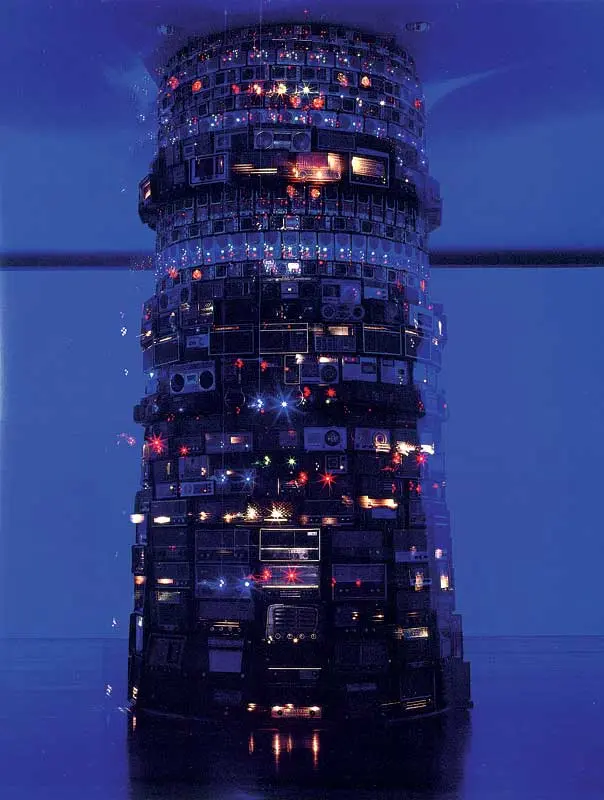
The work Babel may not only sum up the exhibition (with its chorus of works that play off each other in a kind of point/counterpoint) but also encapsulate the current historical moment of globalization. Babel consists of about 800 radios stacked into a large, obelisk-like form, beginning with older models at the bottom and ascending to newer ones at the top. They simultaneously play different stations in polyphonic disharmony, articulating what Jean Baudrillard coined as the “ecstasy of communication”—a symptom of a technocratic society in which much is said and nothing is spoken, and those with ears hear but never listen. Cildo Meireles speaks volumes with his work, and we should be so fortunate to listen.
RAÚL ZAMUDIO
Art Historian and Art Critic.