
From the street, the pewter-like winter light of a New York afternoon in late December set the appropriate atmosphere for contemplating new work by Doris Salcedo. Inside, the cool, stark first-floor rooms of the Alexander and Bonin Gallery formed an ideal vessel to contain these silent, somber sculptures. At first glance, the show seemed small, but the questions it posed were huge, offering insight into our increasingly troubled times.
Installed directly on the cement floor of the gallery and bathed in harsh fluorescent light, these substantial works, the larger being nearly nine feet long, challenged the viewer to consider them. They eloquently ask questions about materials, processes, and intent. None of these is easily answered. In fact, this experience is less of viewing and more of a confrontation.
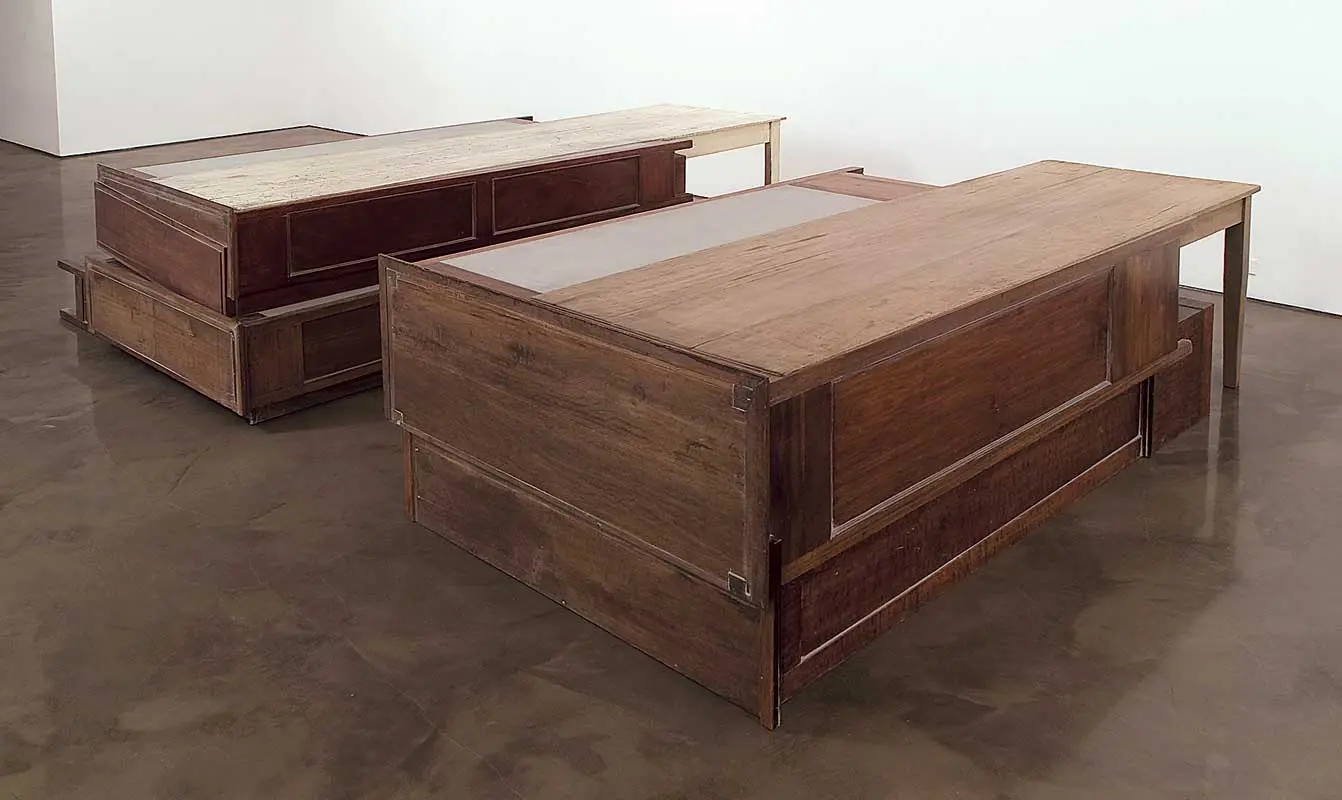
The work is dense, confounding, and not easy to “see.” First, there is the natural inclination to understand what it is you are seeing. Yes, there are familiar pieces of household furniture, but not in familiar situations. Each piece is composed of five to six pieces of furniture. These are carefully fitted together to become a single piece. Here these quotidian objects are laid flat, conjoined together on their backs, rendered useless. But, at the same time, each piece is finished with great skill and with meticulous attention to detail. The surfaces beg to be touched. There is a degree of calculation and a lack of spontaneity that is arresting and serves to deepen the pervasive sense of discomfort that is generated. These utilitarian pieces of furniture are joined together in such a way that they lose all purposefulness. The voids formed between pieces are filled with concrete. This, of course, poses another consideration: were these spaces vacant when they were filled, or do they conceal yet more? What do they hide? The viewer will not know, but the cement does lock away and fill the very spaces that were once occupied with the human elements—clothes, dishes, silverware, and people—that granted them warmth and vitality. A chair cannot even be comfortably placed at the parts of the tables that remain upright and free-standing. These are compositions that lead the observer to conclusions that are reached as one deduces what has been taken away from these things. We recognize their purpose, but the utility is gone. As new, whole objects the statement that these works make is as stark and brooding as the rooms that hold them.
The two objects that form Untitled, 2008 are the latest pieces produced by Salcedo using domestic furniture (sometimes incorporating objects used or owned by people who have disappeared), a series she began in 1992. From these smaller works grew her Istanbul Project, done for the 2003 Istanbul Biennial. For this project, she tightly fitted some 1600 wooded chairs into a space between two buildings. The overriding effect falls, strangely, somewhere between claustrophobia and emptiness. But in this case, Untitled, 2008 was the three-dimensional foundation for the prints on the gallery’s second floor. The archival, limited edition prints document the artist’s major installation projects which have been executed since 2003. These include Istanbul I and II, 2003, which are iris prints created from scans made from black and white film shot by the artist as she searched for a location for her Istanbul installation, and Shibboleth I – IV, 2007 which were published on the occasion of her installation in the Tate Modern’s Turbine Hall. In Turbine Hall, Salcedo created a huge 515 foot long crack in the floor of the hall, dividing the space and fracturing the implied solidity of the structure and the society that built it.
However, not having had a one-person exhibition in New York City since 2000, the sculptural components of this show were the literal and figurative heavyweights. Considered as a single installation, these works can be read as a concise statement regarding Salcedo’s work. Here, fused together with polished concrete, are pieces of furniture—a reading table, cabinets, perhaps an armoire—that once evoked comfort, life and humanity. Now they lie fixed in place as monuments to loss and imposed stillness, silence. These carefully conceived and beautifully constructed works are mute declarations of humanity’s violence to humanity.
CLAYTON KIRKING