
Before October 2008, amid all the hype of the art market, it was rare to find an artist willing to tackle the turmoil of wars in the Middle East and the implications of religion. However, Ernesto Pujol, who was once a monk and is well known for his site-specific, public performances, recently created a body of work that addresses these provocative issues in a poetic way.
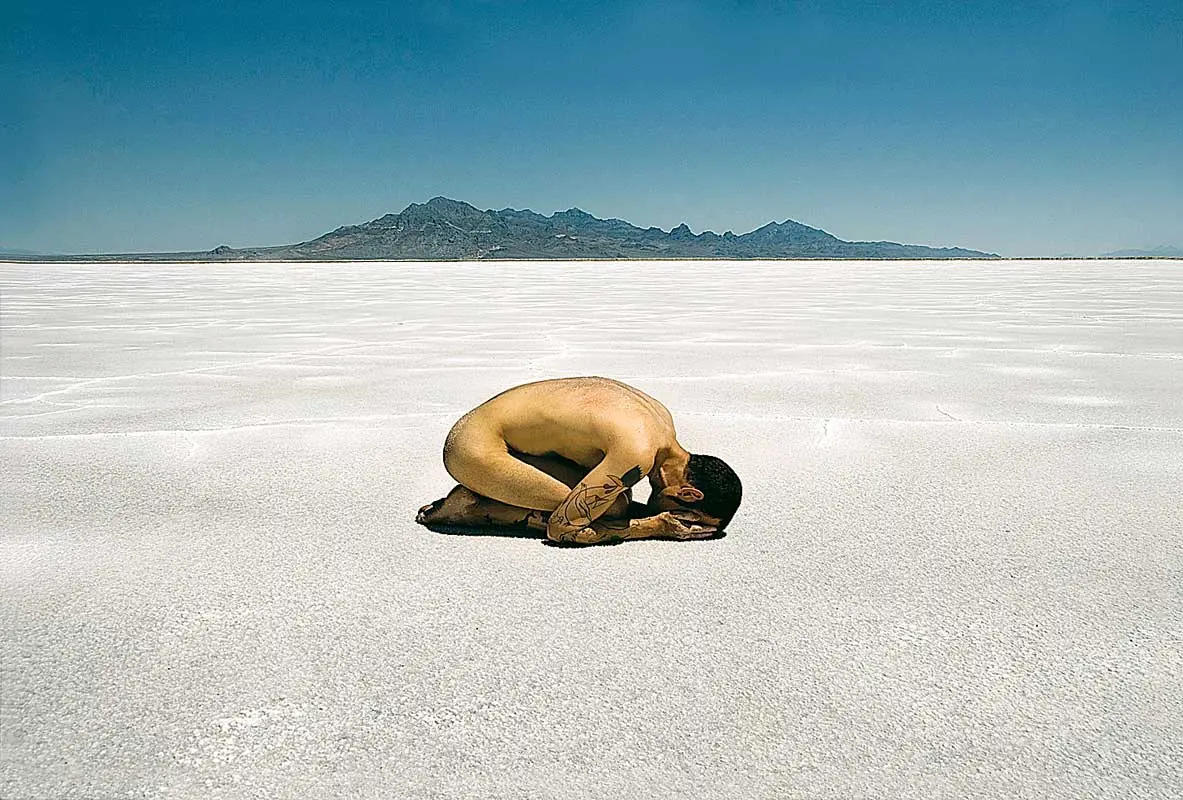
For his gallery show titled Inheriting Salt, Pujol exhibited a series of photographs: two of them focus on the Judean Desert in Israel and another two on Utah’s Salt Flats in the United States. At first glance, the two wastelands appear to have little in common. The terrain of the Judean Desert looks rugged, rocky, and craggy while the salt flats appear smooth and off-white. In the latter, you can gaze far into the distance to the extent that you see the curvature of the earth in the horizon. However, Pujol’s photographs are grappling with more than just the landscape. Each of these sublime deserts represents a site of religious pilgrimage, a place of solitude for the would-be prophet, and, more specifically for the artist, the depiction of a man dying while waiting for his good samaritan. In the process of creating the work, Pujol said that the project began as a meditation on compassion between men, but over time became more about the solitude of a person’s existential journey, feeling lost and wanting to be found, as well as the wars in the Middle East and the dying American soldier.
The significance of religion is emphasized in the show with the arrangement of a cruciform in the gallery and a fifth photograph called Pilgrim Line (Holy Sepulchre) (2008). The reference to salt refers to the artist’s childhood by the sea but also reflects upon an earlier time when the mineral was a substantial commodity in the Middle East and necessary for the preservation of food, especially meat. One may be reminded that more recently the importance of oil has replaced that of salt, playing a key role in the wars in Iraq and other countries of the region.
Like much of his work, Pujol himself figures in each of his four desert scenes. Naked, he lies down on the dry earth in two photographs, as if resting or deceased. In two other images his body appears tightly curled up like a fetus: he faces downward in the salt flats and upward in Judea. While the show is about loss, brokenness, and death, it is also about survival and perhaps even birth and renewal. Although Pujol’s project explicitly addresses the religious ordeals of the Middle East and the United States, and thereby focuses on Christianity, Islam, and Judaism, the suggestion of Buddhism and the samsara, as I see it, are apparent as well. The ongoing, never-ending cycles of life and death, religion and war, difference and intolerance, seem destined to repeat themselves unless we overcome our ignorance and learn to work together.
The importance of collaboration is a continuing theme in Pujol’s oeuvre. In the gallery’s project room, Pujol included the work of three artists: Stephanie Diamond, Rosemarie Padovano, and Joy Whalen. He chose these women because they engage in performance art and depict the female body, which Pujol felt would offset the presence of the male body in his photographs. Their work also addresses similar themes connected with religion, but to varying ends. Diamond’s Three Graces recreates a pagan theme and refers to a spiritual practice known as the Five Rhythms. Padovano depicts a chapel-like environment in which she lies at rest, like Mary before the Assumption. Lastly, Whalen shows a corrupt baptism, although her work is more broadly related to unconscious and emotional states. While Pujol’s project may bemoan, in part, the fact that the first decade of the new millennium has shown us ongoing religious strife, his work, coupled with that of his collaborators, also suggests the possibility of spiritual coexistence and peace.
CRAIG HOUSER