
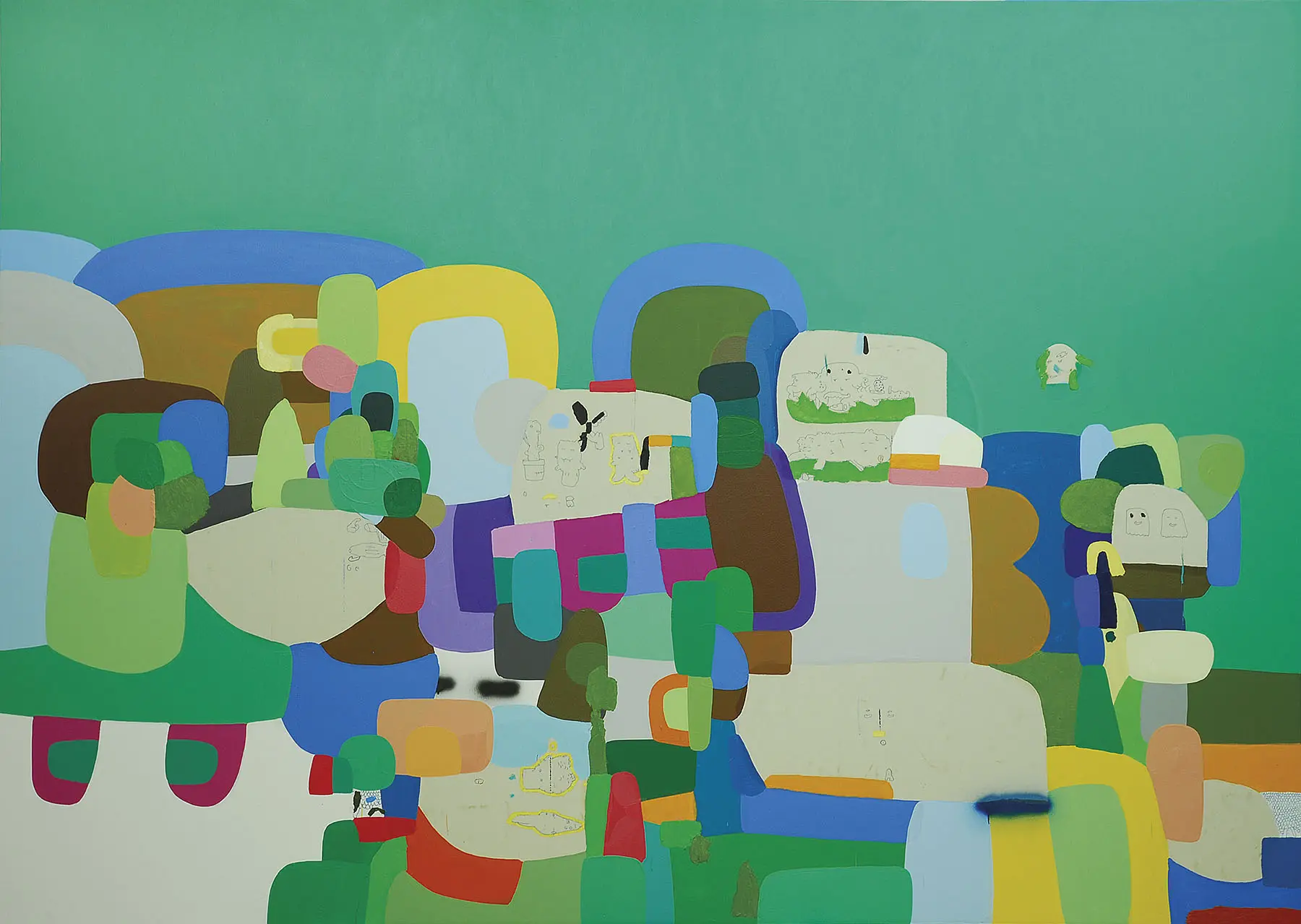
The sociology of art has insisted that the pictorial space is nothing but a reflection of the concept Man has of the world at a given moment. If this is the case exclusively when it comes to studying contemporary art we find ourselves confronted with an unexpected aesthetic fact: technological Homo sapiens1 returns —often— to “old worlds” and wagers in favor of painting’s formal solutions.
In an era of aesthetic anxieties, when objectual art has become dominant in curatorial or museographic discourses and, above all, is fascinated by a certain idea of the spectacular, painting assumes in some cases a hybrid position or a poetic retreat where a different dimension of the imaginary is affirmed. Only a Darwinian perspective —stylistic or historiographic— could assert that we have witnessed the end of representation, ignoring that the “death of painting” has been announced ever since the most famous painters of Antiquity were active. We are made aware of this truism by the work of Costa Rican artist Federico Herrero, who has self-defined his formal gamble for the pictorial caveman exercise.
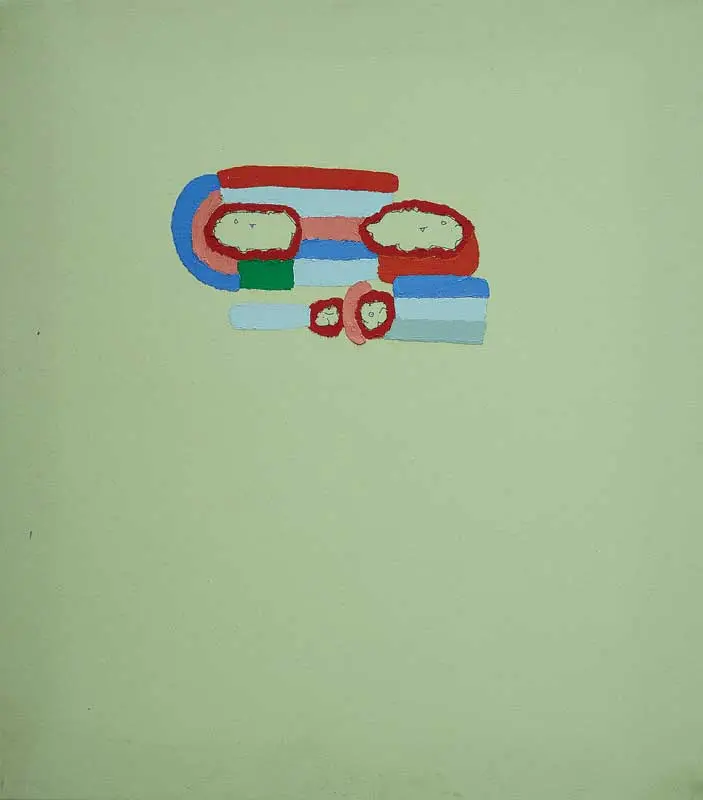
A conversation with the artist concludes that the Young Artist Award received at the 49th Venice Biennale in 2001 responded essentially to his formal choices more the how than the why of his work. The jaw-dropping simplicity of that mural landscape of color patches overwhelmed all those whose demands from the show went beyond the presence of the artist and his work. An almost shamanic, almost mystical gesture that gave back to painting one of its key attributes: painting itself.
Federico Herrero has developed his artistic will in a terrain where paradigms become repeatedly risible. He has returned to intimacy as his working space, marked by a lyrical temporality and by the need to communicate “feelings” to an Other that is not, as so often happens in the contemporary dynamic, a simple mirror.
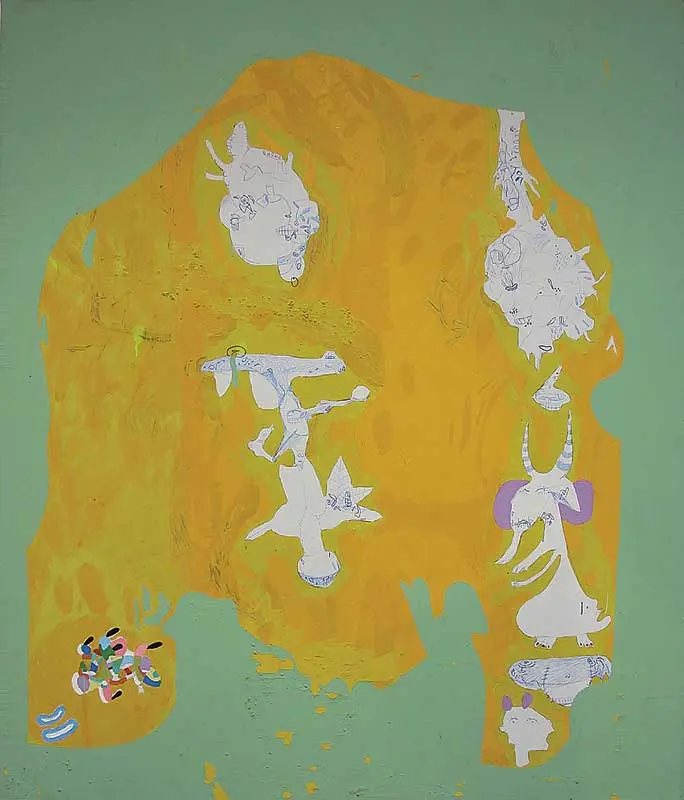
Herrero stimulates an affect-based relationship in his works, and oftentimes this incitement is based on a “supposed naiveté” in the naming of his paintings or in his “version of events,” as he understands that “the art” of discoursing about his work is, let us be redundant, work for others.
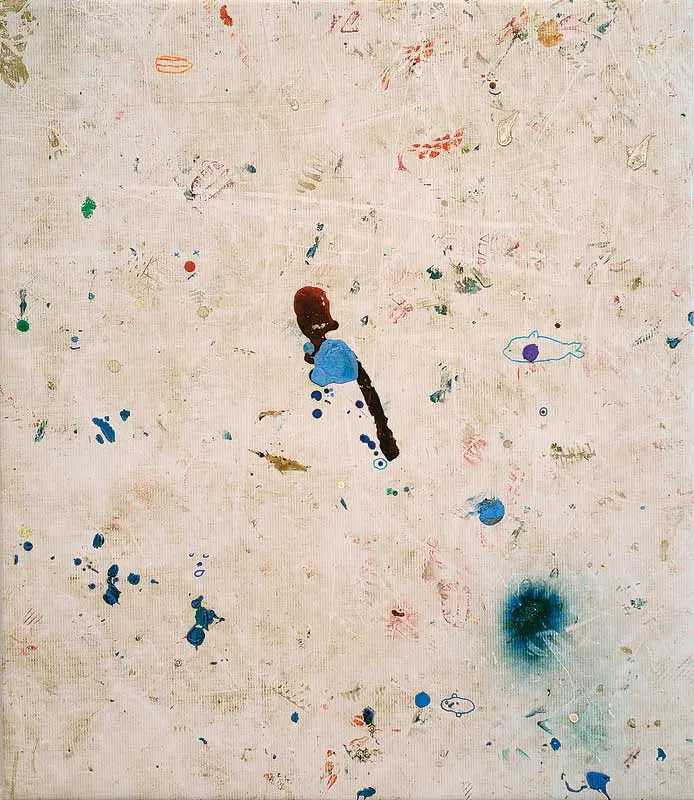
His most recent solo show, Amansalva, at the Ars TEOR/éTica Foundation in San José, Costa Rica, is a kind of synthesis of his work in recent years, where taking careful distance from the “excesses” of painting has become one of the most coherent discourses about the genre at the dawn of the new century, and a personal demand by the artist. “I heard,” he told me not too long ago, “that a certain famous artist said that paint was not going to get any better than the can that contains it.” Chosen haphazardly and containing a deliberate syntactical error, the title of the show is one of its key points, undoubtedly an armed assault on the part of the painting and all its resources, carried out by someone whose rules of containment within the canvas do not allow for expressionisms or formalisms. In Herrero’s work, the territory of the painting is well-defined. This complexity of the terrain as a “geographic” site also translates into the craft’s very temporality. Each day he paints less. However, part of his exhibition includes the floor coverings from his study, standing on which he has painted for years, and where this “supposed” informalism of the blotch is the diary of his labors, his true painting.
While contemporary art is given to literalness and to a “realist” mixture of the banality of camp aesthetics and the tormented rhetoric of psychoanalysis, subtlety and, in particular, contemplation seem radically excluded. And yet, the desire to create a symbolic space insists on his manner of dialoguing with the other. Far from the tragic spirit that pretends there is no potential in the complexity of “the painting,” Herrero shares Lawson’s certitude that artists are faced with a choice: that of giving themselves to despair or deploying painting’s “last option”: “The discursive nature of painting is useful from the point of view of persuasion since it constitutes a never-finished network of representations.”2
This unfinished nature of painting is argued in the operational domain and the unconventional “evolution” of Federico Herrero’s work. The dynamic of the Open Work3 as an epistemological metaphor and as a polysemic capacity proposed by Eco and expanded as a concept by Barthes in the death of the author finds an echo in Herrero’s production. Georges Bataille4 wondered: what would happen to the truth if we couldn’t see that which exceeds the possibility of seeing? This question is the answer that gives meaning to Federico Herrero’s work. The artist proposes the culpability of the gaze —an intentionality pre-fixed by knowledge— as a form of blindness. Guilt, regardless of how important it is in the mental image of the blind, was not the sole connotation of blindness in the ancient world. But blindness can also be a gift: blind people might be in contact with another reality, distinct from the one in which we live. For some characters, blindness can be the external manifestation of what is hidden in a mysterious interior.5
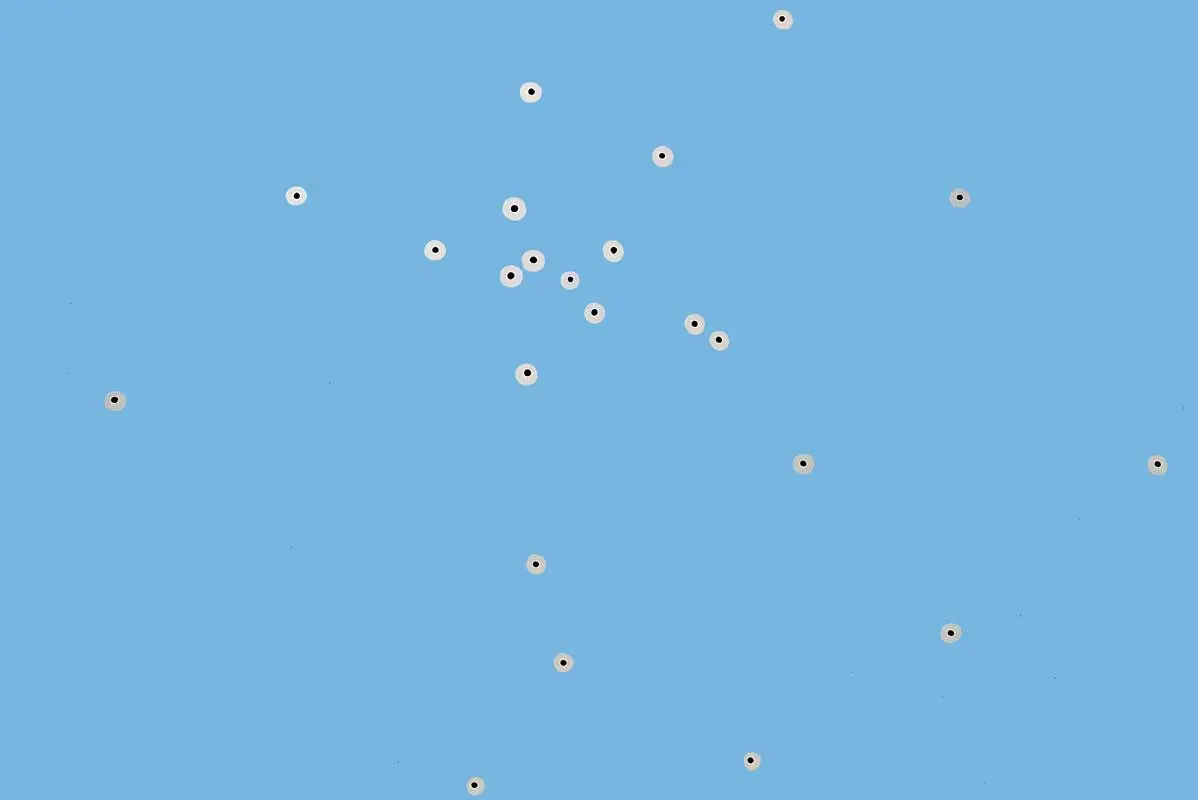
While critics and collectors find his painting “filled with painting” the claim to beauty and the complexity of his artistic proposal, Herrero persists in the opposite. The artist has said that the less he paints, the closer he feels to the complex mental territory of painting, an operation that inverts Derrida’s proposal6 and takes us to the same conclusions. Because of that, Paisaje con 21 círculos or his series Máscaras is the unquestionable pathway towards his own degree-zero that proposes as a summa in the hammocks of Patio, while in Paisaje… the external need presumes of finding a meaning to the shape of the circle as an “eye” and metaphorize there a discourse on the gaze; while Herrero only insists on veiling, on the “blind spot” of painting. In his Masks, it seems as if the artist always returns to that part of our anatomy that has to do with seeing. He forces us to see from a perspective that is not institutionalized.
It is common for the work of this artist to use the color blue (Paisaje…,) which is, alongside green (Patio,) one of the colors with which he works large flat masses of paint. Despite a raid into pastels (pink, sky-blue, violet, orange,) green and blue are the most extensively used colors in Herrero’s work. Perhaps because, even if unintentionally, he continues to insist on the conceptual genesis of his oeuvre: the landscape. The discovery by the Romantics of “the tragedy of the landscape” is simultaneous with the opening of aesthetics toward spiritual nomadism. The Romantic journey is always a search for oneself, along with interior exploration: an unending flight. In his paintings, Herrero seeks an intemporality and unreality that would give our imagination its maximum intensity. This is the construction of worlds that are cryptic in appearance, with bucolic and yet vertiginous and unsettling scenes. A feeling for the intrigue of an unreal image that is nevertheless plausible in its degree of synthesis. And he does this at a time when it would seem that our ability to contemplate and even to deploy narrations is “exhausted.” This is why painting without paint, even the unprepared canvas, the inevitable traces of that “supposed exhaustion” of painting, are his greatest incidence in it.
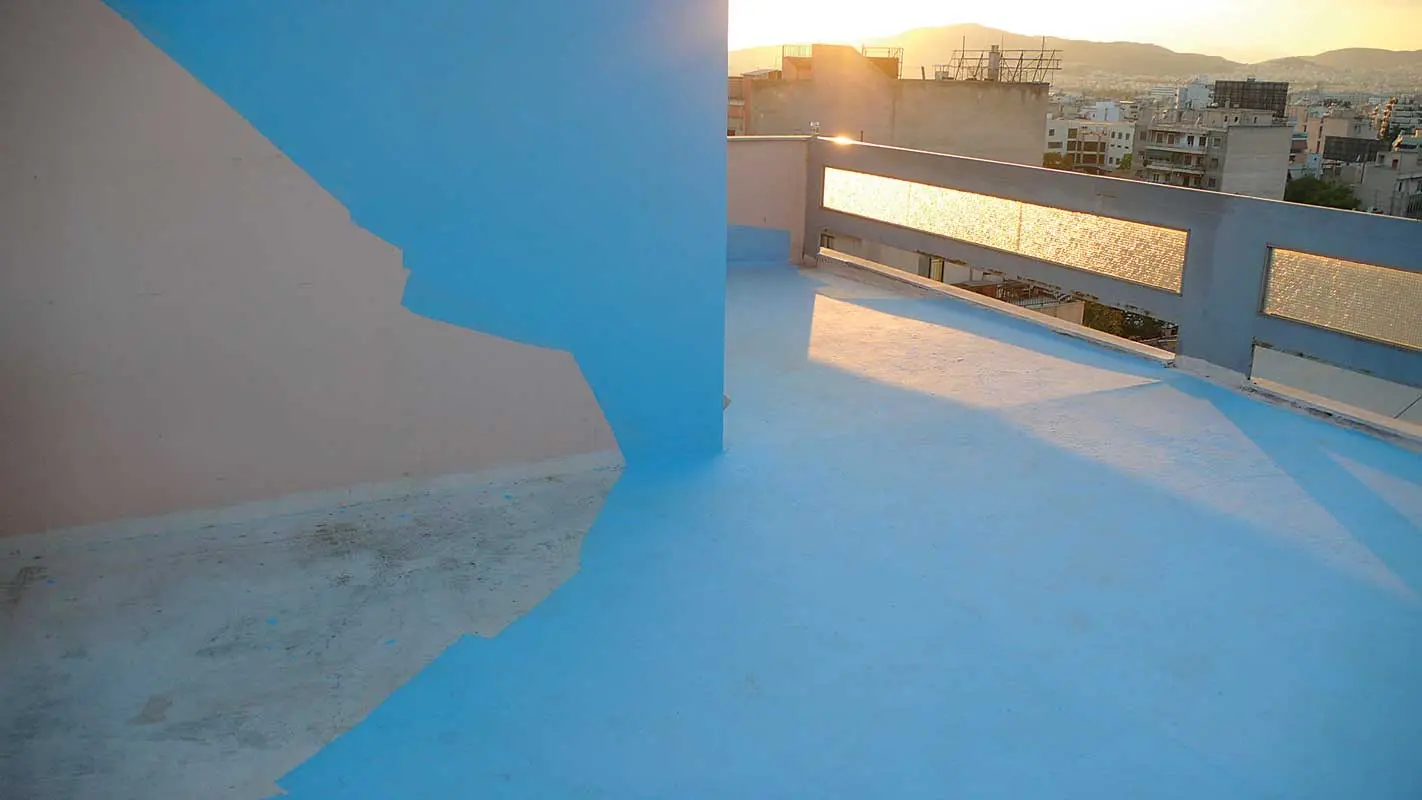
In a text about Bram van Velde, Herrero asserted that to paint is to approach nothingness, and emptiness: the artist is the carrier of life, or, better yet, is someone who lives a secret that must be expressed. Painting only exists by virtue of its displacement towards the unknown; it is an accumulation of gazes, something that fascinates and also a surface that is reserved.7 Because of this, Federico Herrero proposes “painting” as a starting point, the cornerstone or raw material for the embodiment of the weave of his visual text. Then he betrays it, ceases to be concerned with the archetypal forms he gives it, and turns towards their deconstruction, or, worse, to his automatic discourse of absences. In its disrespect for classical forms, Herrero’s painting freely strolls through the most plural domains of visual culture: it enjoys the irony of some colors, and some elements of the comic book genre; it relishes the atmosphere and treatment of the landscape and constructs its own narrative; it courts children’s books and uses them to color, assuming in that way intermediacy as a modus operandi. Then the artist gets tired, and we know what happens.
In this way, Herrero declares himself “a kind of autodidact,” and that lack of reverence for the academic has made him one of the most interesting figures in contemporary painting. His work responds more to achievement in the level of excess on the part of the artist than to a pratfall on installed control. This betrayal of what ought to free the painter from all conventions and allows him to work with repressed desire, to open the doors of the subconscious, the dream world, the fantastic. The anecdotes of his paintings become surrealist, not only in terms of style but in their narrative treatment, even obeying motivations that are analogous to those of dreams. In the same way, there appear in his work some leitmotifs in the realm of figuration. The “fish scales” that metaphorize the epidermis, the fangs that show up in some of the mask’s eyes. Disturbing elements that break through without having been invited, like the voices, are heard by a schizophrenic. These “small, subtle betrayals” are indelible marks in Herrero’s work. This is to say, traces of the “authorship” that he refuses to recognize in a macro discourse, but distinguish the passage of his “impishness” through the work.
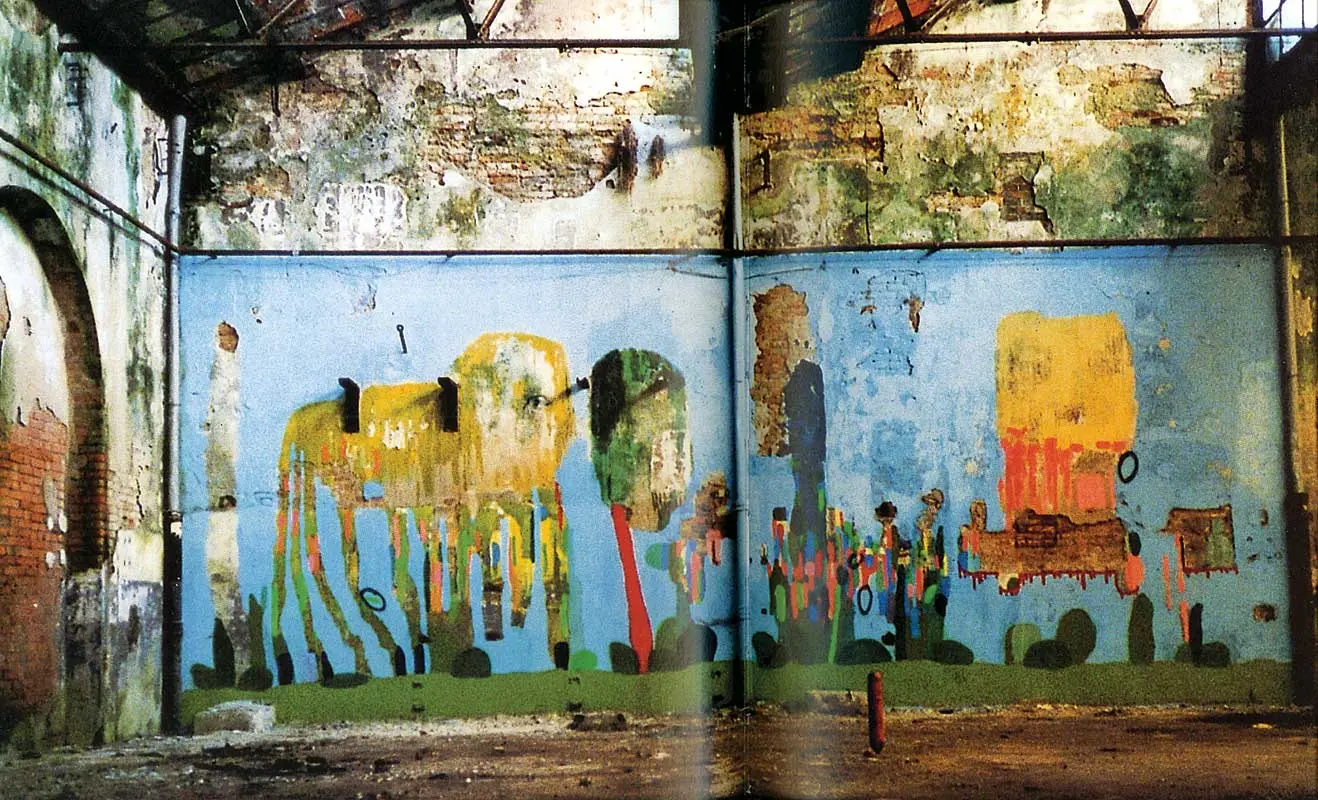
Herrero’s painting has the ability to establish an unmediated dialog with the viewer. The shapes, the colors, and the magnificence advance towards whoever is looking with a friendly yet complex gesture. Of course, the friendliness is just a beginning, a closeness proposed by the image in order to, once the connection is established, launch an exploration. It is by breaking down Herrero’s work that we get frightened and surprised, that we laugh, that we appeal to sensations of primary order, almost caveman-like, like painting’s very gesture.
On other occasions, Herrero seems to lighten his works up, and yet moves towards a more metaphysical painting; observing “the non-places,” he interrupts the landscape and challenges nature, a raw material of the genre. He has once again rationalized, on the basis of feeling, an oeuvre that has its roots in those invented landscapes of reality where he places large blotches that contain the overflows of paint, and not the other way, as is the convention. In his isolation, free of distractions to break his aesthetic proposal, he locates large fields of absence that disturb the perspective of his landscapes. There is in these paintings a symbiosis between the concept of the traditional landscape and the counterpoint of the undone, of the unrealizable, of the unreal, of the untrue, which does not take place in the “human eye.”8 Thus, he concludes that the stasis of reality resides in the gaze.
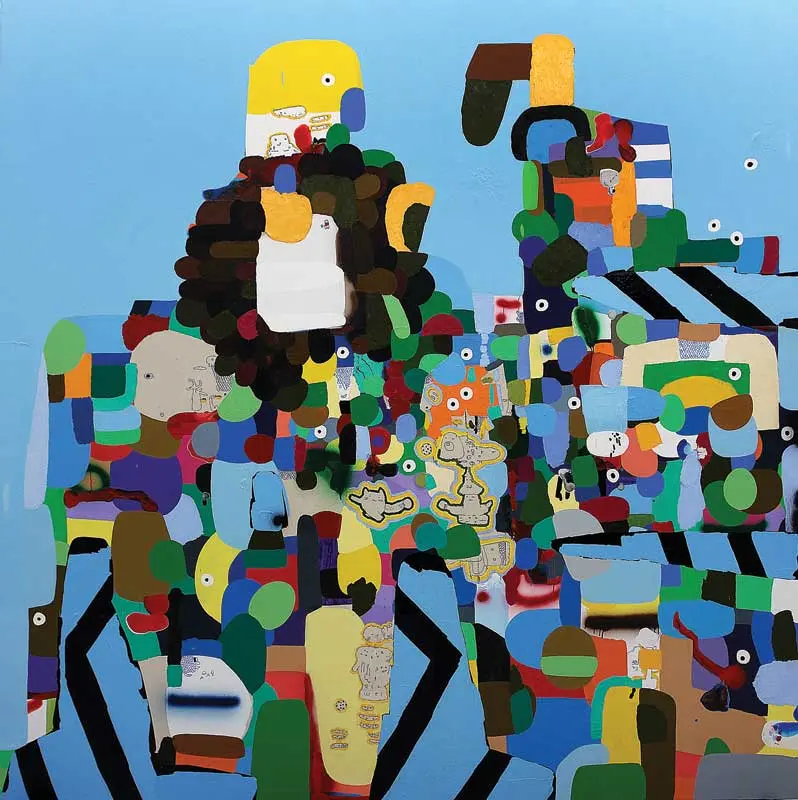
The trajectory followed by this artist is not that of contemporary nomadism, but persistence on primordial emotions. A search for lucidity forces him to traverse —pictorially— the greatest of solitudes, that “darkness” that is the sign of the modern. It is possible to find a filiation between Herrero’s work and the pictorial attitude of Gerhard Richter, in his radical use of demonstration instruments in the destruction of illusion. For Herrero, the instrument of color is what the rhetorical potential of light is for Richter. They have both broken with the presumed contradiction between abstract and figurative painting, preoccupied mostly with the impact of the image or its ability to create an emotional climate, an emotional situation that is absolutely primary. Painting is a kind of redemption.9
However, Federico Herrero owes more to his contemporaries than to the tradition of painting. He finds more commonalities in the work of Gabriel Orozco —a certain idea of perversion as a mode and divertimento— than in forced, narrative, boring painting. I know that his wish to stop painting is as strong as the impulse that forces him to continue doing it. There are no sketches, nothing preconceived, the painting is finished when it leaves his study. The aura of space is the aura of “his time,” of the work’s “real” time. He is not a “tale-teller,” as he sometimes wants to have us believe. There are false naivetés and landscapes named after letters that peek out in them. There is no history that can be woven, revered, or written. In his painting, all there is is painting. Or better yet: there is no painting. That’s what it is.
NOTES
1. Herbert Read, Imagen e Idea. Mexico: Fondo de Cultura Económica, 1957, p. 88.
2. Thomas Lawson, Última salida: la pintura en Arte después de la modernidad. Nuevos planteamientos en torno a la representación, Ed. Akal, 2001, p. 164.
3. Umberto Eco, La Obra Abierta. Madrid: Editorial Planeta, 1984.
4. Georges Bataille, Le bleu du ciel. Paris: Gallimard, 1997.
5. Moshe Barasch, La ceguera. Historia de una imagen mental. Madrid: Ediciones Cátedra, 2003, p. 44.
6. On this topic, Derrida has pointed out that reading is unending because each layer contains a new one. “Reading resembles thus those X-rays that reveal, under the skin of the latest painting, a hidden, other work: by the same painter or a different one, it doesn’t matter, who, lacking materials or seeking a new effect, used the substance of the old canvas or preserved a fragment of a first sketch. And under that, another one.” Jacques Derrida, La diseminación. Madrid: Editorial Fundamentos, 1975, p. 536.
7. Roger Laporte, Bram van Velde o esa pequeña cosa que fascina. Las Palmas de Gran Canaria: Editorial Asphodel, 1984, pp. 22-23.
8. A few months ago Herrero was fascinated by an article in a local newspaper that announced that reality is in motion and action when we are not watching it.
9. “I could also speak of redemption. Or of hope, the hope that painting can, despite everything, have an impact.” Benjamin Buchloh, “Conversaciones con Gerhard Richter”, in Gerhard Richter. Madrid: Museo Nacional Centro de Arte Reina Sofía, 1994, p. 40.
CLARA ASTIASARÁN
Bachelor in Art History from Universidad de La Habana (1996) and a graduate of the Masters of Fine Arts at Universidad de Costa Rica (2003). Currently an independent curator and General Coordinator of VALORARTE.